
Iker, 23, lives bill-free in the woods and cashes in on the story
Iker, 23, has gone two years without paying bills on a plot with solar panels and goats. The egg math, brucellosis and the business of the digital hermit.
English · Original discussion in Spanish · Published
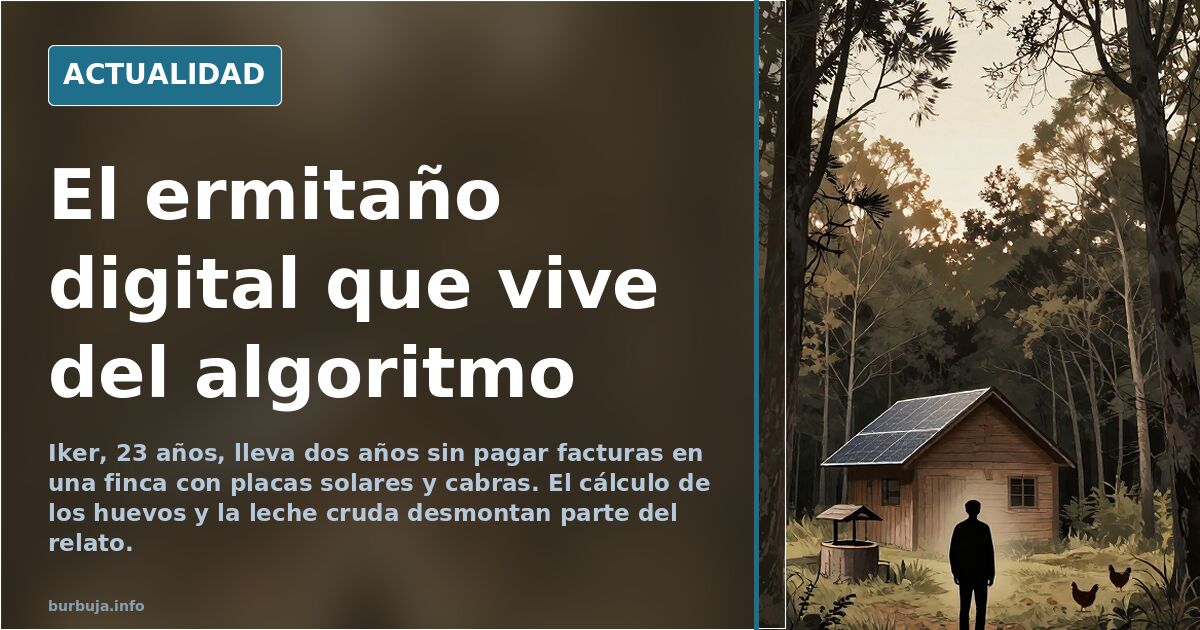
Iker, 23, no bills for two years: the woods as a business model
A 23-year-old named Iker has spent two years without paying electricity or water bills. He lives on a plot with solar panels, his own well and animals — goats, hens, ducks — and his story was published in El Español on 27 September 2026. The headline presents him as a young man «lost in the woods», but as the debate points out, the property has an owner, a land registry entry and probably a family behind it. The question that frames the whole analysis is simple: real self-sufficiency, or cost-cutting with an invisible sponsor?
What it costs to set up a bill-free life
The solar panels, the well, the fence and the henhouse don't come free from nature. It's an upfront investment of several thousand euros that someone put forward. That's the first blind spot in the story: the video shows the result, not the entry invoice.
The second blind spot is ownership. A plot «lost in the woods» has an owner, a land registry entry and, often, a father or grandfather behind it, as the debate argues. That doesn't make it on camera. And the third is the current cash flow: at 23 and two years without bills, he eats something. Either the family keeps him afloat or YouTube pays him more than a minimum-wage earner, say those who doubt the story. If he gets demonetized tomorrow, you'll see how fast he «reconnects with society». The woods hold up as long as the algorithm pays.
The egg math: 33 a day to cover 2,500 kcal
The protagonist himself has run nutritional calculations to figure out how many eggs he needs to eat to stay nourished. The math, done properly, dismantles the hustle: an active adult needs around 2,500 kcal a day. A medium egg provides about 75 kcal. To cover it with eggs alone you'd need 33 a day. On protein, to get 80 grams you need 11 or 12. And that's without counting fat, iron, vitamin C or fiber, which don't come inside the egg.
The livestock side doesn't add up either. A free-range hen, the happy, stress-free kind, lays between 200 and 250 eggs a year. To scrape together 30 a day you need about 45 hens in continuous production. Forty-five hens aren't a lifestyle: they're a farm with its feed, its vet, its henhouse and its workload. The full calculation, broken down line by line, yields a surprising difference.
White goat milk and brucellosis: the detail that slips by
The young man's story includes making artisan cheese and drinking raw goat milk. Here's a technical fact the video doesn't mention: goat milk is white. Goats convert carotene into vitamin A, which is why it doesn't turn yellow like cow's milk. If the milk comes out yellow, it's not «ancestral purity»: it could be mastitis — blood, serum, pus, subclinical and with no visible fever in the animal —, dirty milking with a poorly washed teat, or old milk after five hours at room temperature in summer.
The next step isn't a video, it's Malta fever. Brucella melitensis, the classic one from raw goat milk in the Mediterranean, with prolonged low-grade fever. Pasteurization became widespread precisely because of this. Giving health and dietary advice without training isn't «living in the countryside»: it's gambling with the health of anyone who imitates you.
The Unabomber precedent: the myth needed money too
The case has an uncomfortable precedent. Theodore Kaczynski, the Unabomber, lived in a three-by-six-foot cabin in Montana, with no electricity or running water, and became the symbol of the man who drops out of the system. Wikipedia notes he received significant financial support from his family. America's most wanted man was propped up by the lifeline from home: tools, materials, the basics.
The comparison isn't gratuitous. The hermit without a camera sells nothing. The hermit with a camera, a thumbnail and a link below does. Iker hasn't discovered the wilderness: he's discovered the wilderness with an audience. And the audience pays.
The repeating pattern: a stipend, a parents' pension, or rent
The phenomenon isn't unique. Some argue there are cases of people living in villages of three residents, with no expenses because others pay them, collecting the non-contributory pension. No goats or hens needed: the system provides for whoever wants to be outside the system, according to that version. Another variant mentioned is the pension of retired civil-servant parents or renting out inherited flats, money that would fund the car, the upkeep and the life of the son who moved to the woods.
The pattern repeats too often to be a coincidence, critics argue. Real self-sufficiency is the farmer who's been getting up at five for forty years, not the young man discovering the countryside with a camera and a thumbnail.
The mustache, the algorithm and the goat video
The character has kept morphing in the public story. First it was the young man who quit his studies after questioning the conventional model. Then, the expert on vaccinated hens versus free-roaming ones. Later, the master cheesemaker. Now, the one presenting a plan to survive 2030 with a pig, a hundred olive trees and a self-sufficient mustache. In this ecosystem, the mustache works as a brand: it's not an aesthetic accessory, it's a statement of intent.
The underlying problem is the incentive. The system may be terrible, but YouTube's algorithm, it seems, likes him. A video titled «I HAVE ABANDONED SOCIETY FOREVER» competes for views with the one of the goat pooping. And there lies the real tension: the digital hermit checks the stats every five minutes. The woods don't send bills, but they do send breakdowns, mud, damp, bugs, cold and physical labor without asking whether it suits you. Nature is very spiritual until you have to fix a pipe at minus two degrees with wet hands.
What happens when January arrives?
January is the test. It rains for three weeks, a solar panel breaks, a goat falls ill and the hens decide to go on strike. The woods have a huge advantage: no monthly bill. And a bad habit: breakdowns without notice. The unanswered question is whether Iker really lives off what the plot produces or has other income that doesn't appear in the headline. That's the difference between being self-sufficient and simply having cut some expenses. With the data available, the experiment remains open. And the mustache, for now, holds up.
A 23-year-old named Iker has spent two years without paying electricity or water bills. He lives on a plot with solar panels, his own well and animals — goats, hens, ducks — and his story was published in El Español on 27 September 2026. The headline presents him as a young man «lost in the woods», but as the debate points out, the property has an owner, a land registry entry and probably a family behind it. The question that frames the whole analysis is simple: real self-sufficiency, or cost-cutting with an invisible sponsor?
What it costs to set up a bill-free life
The solar panels, the well, the fence and the henhouse don't come free from nature. It's an upfront investment of several thousand euros that someone put forward. That's the first blind spot in the story: the video shows the result, not the entry invoice.
The second blind spot is ownership. A plot «lost in the woods» has an owner, a land registry entry and, often, a father or grandfather behind it, as the debate argues. That doesn't make it on camera. And the third is the current cash flow: at 23 and two years without bills, he eats something. Either the family keeps him afloat or YouTube pays him more than a minimum-wage earner, say those who doubt the story. If he gets demonetized tomorrow, you'll see how fast he «reconnects with society». The woods hold up as long as the algorithm pays.
The egg math: 33 a day to cover 2,500 kcal
The protagonist himself has run nutritional calculations to figure out how many eggs he needs to eat to stay nourished. The math, done properly, dismantles the hustle: an active adult needs around 2,500 kcal a day. A medium egg provides about 75 kcal. To cover it with eggs alone you'd need 33 a day. On protein, to get 80 grams you need 11 or 12. And that's without counting fat, iron, vitamin C or fiber, which don't come inside the egg.
The livestock side doesn't add up either. A free-range hen, the happy, stress-free kind, lays between 200 and 250 eggs a year. To scrape together 30 a day you need about 45 hens in continuous production. Forty-five hens aren't a lifestyle: they're a farm with its feed, its vet, its henhouse and its workload. The full calculation, broken down line by line, yields a surprising difference.
White goat milk and brucellosis: the detail that slips by
The young man's story includes making artisan cheese and drinking raw goat milk. Here's a technical fact the video doesn't mention: goat milk is white. Goats convert carotene into vitamin A, which is why it doesn't turn yellow like cow's milk. If the milk comes out yellow, it's not «ancestral purity»: it could be mastitis — blood, serum, pus, subclinical and with no visible fever in the animal —, dirty milking with a poorly washed teat, or old milk after five hours at room temperature in summer.
The next step isn't a video, it's Malta fever. Brucella melitensis, the classic one from raw goat milk in the Mediterranean, with prolonged low-grade fever. Pasteurization became widespread precisely because of this. Giving health and dietary advice without training isn't «living in the countryside»: it's gambling with the health of anyone who imitates you.
The Unabomber precedent: the myth needed money too
The case has an uncomfortable precedent. Theodore Kaczynski, the Unabomber, lived in a three-by-six-foot cabin in Montana, with no electricity or running water, and became the symbol of the man who drops out of the system. Wikipedia notes he received significant financial support from his family. America's most wanted man was propped up by the lifeline from home: tools, materials, the basics.
The comparison isn't gratuitous. The hermit without a camera sells nothing. The hermit with a camera, a thumbnail and a link below does. Iker hasn't discovered the wilderness: he's discovered the wilderness with an audience. And the audience pays.
The repeating pattern: a stipend, a parents' pension, or rent
The phenomenon isn't unique. Some argue there are cases of people living in villages of three residents, with no expenses because others pay them, collecting the non-contributory pension. No goats or hens needed: the system provides for whoever wants to be outside the system, according to that version. Another variant mentioned is the pension of retired civil-servant parents or renting out inherited flats, money that would fund the car, the upkeep and the life of the son who moved to the woods.
The pattern repeats too often to be a coincidence, critics argue. Real self-sufficiency is the farmer who's been getting up at five for forty years, not the young man discovering the countryside with a camera and a thumbnail.
The mustache, the algorithm and the goat video
The character has kept morphing in the public story. First it was the young man who quit his studies after questioning the conventional model. Then, the expert on vaccinated hens versus free-roaming ones. Later, the master cheesemaker. Now, the one presenting a plan to survive 2030 with a pig, a hundred olive trees and a self-sufficient mustache. In this ecosystem, the mustache works as a brand: it's not an aesthetic accessory, it's a statement of intent.
The underlying problem is the incentive. The system may be terrible, but YouTube's algorithm, it seems, likes him. A video titled «I HAVE ABANDONED SOCIETY FOREVER» competes for views with the one of the goat pooping. And there lies the real tension: the digital hermit checks the stats every five minutes. The woods don't send bills, but they do send breakdowns, mud, damp, bugs, cold and physical labor without asking whether it suits you. Nature is very spiritual until you have to fix a pipe at minus two degrees with wet hands.
What happens when January arrives?
January is the test. It rains for three weeks, a solar panel breaks, a goat falls ill and the hens decide to go on strike. The woods have a huge advantage: no monthly bill. And a bad habit: breakdowns without notice. The unanswered question is whether Iker really lives off what the plot produces or has other income that doesn't appear in the headline. That's the difference between being self-sufficient and simply having cut some expenses. With the data available, the experiment remains open. And the mustache, for now, holds up.
Also available in: Deutsch
Summary of a discussion on Burbuja.info - Foro de economía, actualidad y política., translated from Spanish and reviewed before publication. Read the full discussion (91 replies).
More summaries
-
Spanish YouTuber's use of 'qué tan' sparks language debate
A Spanish creator uses the Latin American phrase "qué tan," reigniting discussions on whether Peninsular Spanish is threatened by demographic shifts.
-
Spanish spoken 26% faster than English due to five vowels
Phonetics expert Conor Sullivan claims Spanish is 26% faster than English because of its five vowels, sparking debate on linguistic efficiency.
-
Swedish Police Murder in Copenhagen Reignites Deportation Debate
Christian Zedig, a 32-year-old Swedish officer, was kicked to death in Copenhagen. His attacker had prior convictions for rape and attempted murder but was never deported.
-
Police investigate Zeus clinic over patient abuse allegations
Spanish National Police have arrested the director of the Zeus clinic in Catalonia following patient complaints of abuse, punishment and coercion. Prices of up to…
-
Ndongo: in a war, my loyalty would be to Cameroon
Bertrand Ndongo, a Vox journalist of Cameroonian origin, admits he would defend his country in a war and is giving up his Spanish nationality.
-
Blind influencer dumped her boyfriend for being ugly, then got scammed
A 21-year-old blind influencer dumped her boyfriend for being ugly after pressure from her friends, and ended up scammed by her new partner. Reality or a setup?