
Iglesias challenges US from Cuba: 'Give me my AKM'
Former Spanish leader Pablo Iglesias, speaking from Cuba, taunts the US with a symbolic offer to defend the regime, clashing with his biography and weapon physics.
English · Original discussion in Spanish · Published
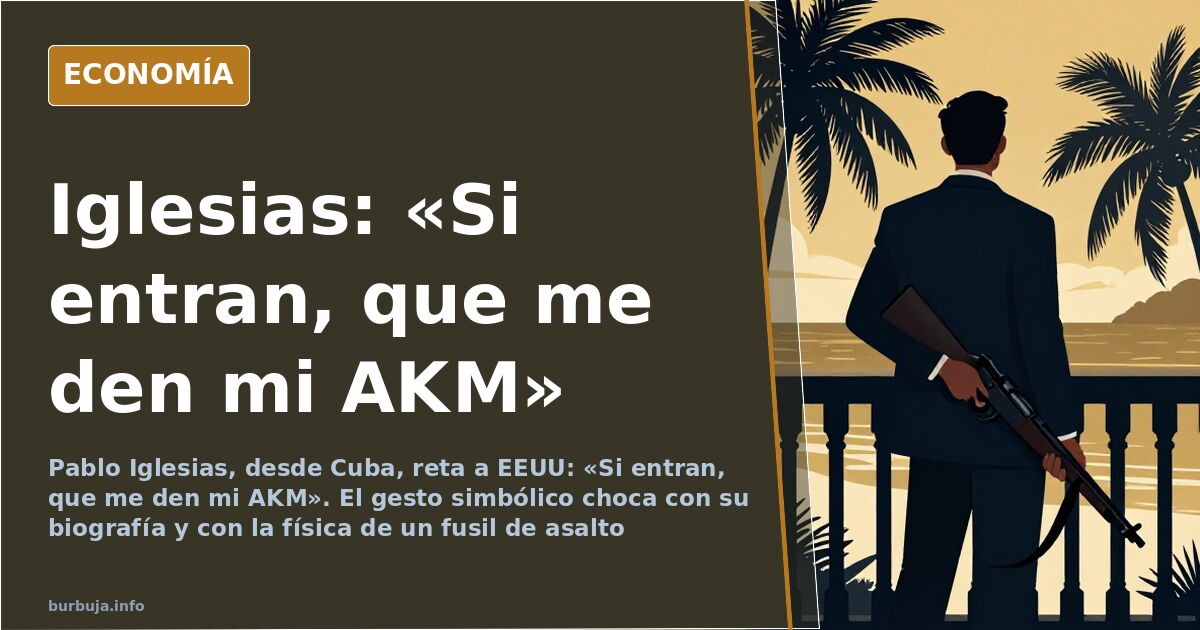
Iglesias offers his Kalashnikov to Cuba as ridicule ensues
Pablo Iglesias has found his penultimate trench: an assault rifle and an island without electricity. The former Deputy Prime Minister of Spain, now retired from the frontline but never out of the spotlight, launched a challenge to the United States from Cuba, offering himself and his weapon for the defense of the regime: "If they invade, give me my AKM." The phrase, echoing the epic tone of Silvio Rodríguez, circulated with 39,000 views and 1,300 reactions in the first hours, according to data accompanying the news.
The problem is that revolutionary aesthetics clash with biography. The former deputy prime minister lives in a chalet in Galapagar with security paid for by taxpayers, writes his proclamations from a phone brand listed on Wall Street, and declared himself a conscientious objector regarding military service in Spain. The contrast has not gone unnoticed.
The AKM that will never fire
The Kalashnikov is more of a symbolic object than a weapon. The AKM, the modernized version of the Soviet AK-47, is a 3.47-kilo, 7.62-caliber assault rifle that has become the most recognizable icon of twentieth-century guerrillas. Offering it in a speech is free. Using it is not.
The most repeated response in the debate concerns physics, not ideology. A body without military training holding an assault rifle for the first time cannot withstand the recoil for even two minutes. The shoulder dislocates, the weapon jams, and the shooter ends up requesting a medical flight. The joke is repeated in various versions: the first shot sends him back to Madrid.
Some go further, recalling that bullets for the Spanish CETME do not work in an AKM. The technical detail dismantles the staging. The rifle Iglesias claims is not the one manufactured in Spain, and the Cuban army does not distribute weapons to ideological tourists.
Unceasing media coverage
The second axis of the debate is the question repeated for years: why does a politician who no longer holds any relevant institutional office still have space in the media? The most widespread answer is that his function is not to govern, but to channel. One sector of analysis argues that his career was built from the indignados movement, which was channeled into a party structure with media visibility until it became an institutional actor. The result, according to this reading, was a discontented left redirected where it suited those pulling the strings.
Others see it more simply: he is a character who generates traffic. Each appearance produces thousands of reactions, and that, in the attention economy, is worth money. The chalet in Galapagar, the security, the trips: everything is paid for with the same currency as the indignation he generates.
Cuba, electricity, and double standards
The third front is the setting. Cuba has been experiencing prolonged blackouts and an energy crisis that has emptied the streets for months. Offering to defend the island from a five-star hotel, as some responses ironically note, is a comfortable way to make revolution. The question hovering over the debate is why someone willing to wield a weapon in Havana has not traveled to New York with the same rifle to defend their allies. The answer, for most, is that it is unnecessary: the gesture is for the home crowd, not the battlefield.
The double standard extends to the domestic plane. In Spain, Iglesias's generation grew up rejecting mandatory military service. Now, that same sector champions the rifle for Cubans. The contradiction is not new, but it is becoming increasingly difficult to cover up with rhetoric.
Che Guevara, Soros, and crowdfunding that never arrives
The comparison with Che Guevara is inevitable and, according to several responses, misplaced. Che was a revolutionary who wielded the weapon he preached. Iglesias is a commentator who preaches the weapon he will never wield. The Che t-shirt, incidentally, has become the uniform of a collective that, it is argued, does not know what Guevara himself thought of them.
The mention of Soros appears as an explanation for the alleged financial irrigation that keeps this fauna in the media. There is no proof of this in the material, but the suspicion circulates. What is verifiable is that the character continues generating content, and that each appearance translates into reactions, views, and probably some future crowdfunding.
How long will it take for the next epic gesture to arrive?
Pablo Iglesias has found his penultimate trench: an assault rifle and an island without electricity. The former Deputy Prime Minister of Spain, now retired from the frontline but never out of the spotlight, launched a challenge to the United States from Cuba, offering himself and his weapon for the defense of the regime: "If they invade, give me my AKM." The phrase, echoing the epic tone of Silvio Rodríguez, circulated with 39,000 views and 1,300 reactions in the first hours, according to data accompanying the news.
The problem is that revolutionary aesthetics clash with biography. The former deputy prime minister lives in a chalet in Galapagar with security paid for by taxpayers, writes his proclamations from a phone brand listed on Wall Street, and declared himself a conscientious objector regarding military service in Spain. The contrast has not gone unnoticed.
The AKM that will never fire
The Kalashnikov is more of a symbolic object than a weapon. The AKM, the modernized version of the Soviet AK-47, is a 3.47-kilo, 7.62-caliber assault rifle that has become the most recognizable icon of twentieth-century guerrillas. Offering it in a speech is free. Using it is not.
The most repeated response in the debate concerns physics, not ideology. A body without military training holding an assault rifle for the first time cannot withstand the recoil for even two minutes. The shoulder dislocates, the weapon jams, and the shooter ends up requesting a medical flight. The joke is repeated in various versions: the first shot sends him back to Madrid.
Some go further, recalling that bullets for the Spanish CETME do not work in an AKM. The technical detail dismantles the staging. The rifle Iglesias claims is not the one manufactured in Spain, and the Cuban army does not distribute weapons to ideological tourists.
Unceasing media coverage
The second axis of the debate is the question repeated for years: why does a politician who no longer holds any relevant institutional office still have space in the media? The most widespread answer is that his function is not to govern, but to channel. One sector of analysis argues that his career was built from the indignados movement, which was channeled into a party structure with media visibility until it became an institutional actor. The result, according to this reading, was a discontented left redirected where it suited those pulling the strings.
Others see it more simply: he is a character who generates traffic. Each appearance produces thousands of reactions, and that, in the attention economy, is worth money. The chalet in Galapagar, the security, the trips: everything is paid for with the same currency as the indignation he generates.
Cuba, electricity, and double standards
The third front is the setting. Cuba has been experiencing prolonged blackouts and an energy crisis that has emptied the streets for months. Offering to defend the island from a five-star hotel, as some responses ironically note, is a comfortable way to make revolution. The question hovering over the debate is why someone willing to wield a weapon in Havana has not traveled to New York with the same rifle to defend their allies. The answer, for most, is that it is unnecessary: the gesture is for the home crowd, not the battlefield.
The double standard extends to the domestic plane. In Spain, Iglesias's generation grew up rejecting mandatory military service. Now, that same sector champions the rifle for Cubans. The contradiction is not new, but it is becoming increasingly difficult to cover up with rhetoric.
Che Guevara, Soros, and crowdfunding that never arrives
The comparison with Che Guevara is inevitable and, according to several responses, misplaced. Che was a revolutionary who wielded the weapon he preached. Iglesias is a commentator who preaches the weapon he will never wield. The Che t-shirt, incidentally, has become the uniform of a collective that, it is argued, does not know what Guevara himself thought of them.
The mention of Soros appears as an explanation for the alleged financial irrigation that keeps this fauna in the media. There is no proof of this in the material, but the suspicion circulates. What is verifiable is that the character continues generating content, and that each appearance translates into reactions, views, and probably some future crowdfunding.
How long will it take for the next epic gesture to arrive?
Summary of a discussion on Burbuja.info - Foro de economía, actualidad y política., translated from Spanish and reviewed before publication. Read the full discussion (173 replies).
More summaries
-
Iglesias spotted in business class with €6,000 tickets
Pablo Iglesias travels in business class on €6,000 tickets despite claims that Podemos officials always fly economy.
-
Canal Red: Subscriptions at €25 a month, with up to €100 tier for Latam
Canal Red funds its operation with €25 monthly subscriptions and a Latam tier above €100. A model supporting an entire staff.
-
Five plane crashes in five days: what the data shows
Five aviation incidents in five days and eleven aircraft involved in 2024: available data neither confirms panic nor rules out a streak.
-
Sexual Assault in Bolaños: Suspect Jailed
A man was found unconscious and sexually assaulted in Bolaños de Calatrava. The suspect, facing deportation, is currently in prison.
-
Spain DANA: UME report claims over 200 bodies recovered
A leaked account attributed to Spain's UME unit reveals over 200 bodies in Valencia, contradicting official low counts.
-
Dacia Spain warns: Think twice before buying a car
With the Sandero nearing €14,000 and rivals costing more, Dacia's director urges buyers to carefully consider new car prices.