
Idle bank savings: how to generate returns
An investor asks how to profit from idle bank funds. The consensus is clear: without risk, there are no returns.
English · Original discussion in Spanish · Published
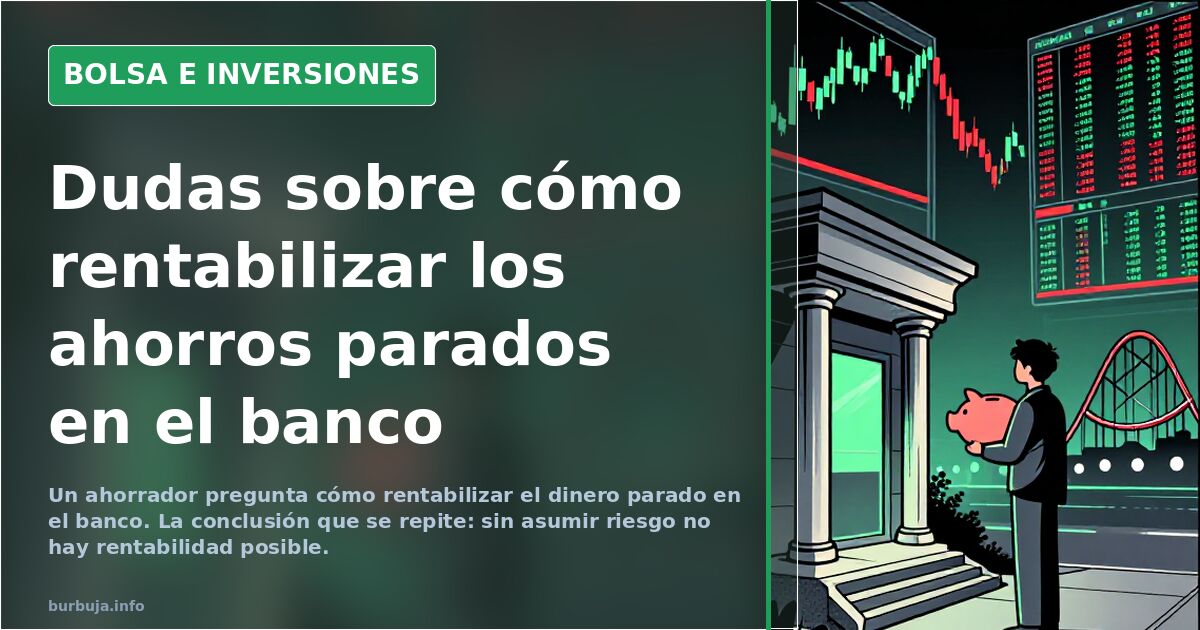
Idle bank money is no longer a plan
An investor asks what to do with cash sitting in the bank. The first response warns against seeking returns without discussing risk. Two uncomfortable figures emerge: €160,000 left idle and savings earning just 0.01% APR. The goal—"preserve and grow with low risk"—is unrealistic.
Three questions before choosing products
Advisors need three facts: amount, timeline, and risk tolerance. The discussion suggests tolerating a 30-40% drop. If not, options narrow to money market or inflation-linked funds, offering lower returns but less volatility. The request for high growth, long horizon, and low risk is contradictory. Higher expected returns require higher risk; short-term gains are speculation.
Index funds, robo-advisors, and bank brokers
For beginners, passive investing via index funds and regular contributions is recommended. Popular names include robo-advisors and funds like Baelo Patrimonio. A key tip: avoid your bank's proprietary broker. Time and diversification outweigh timing. However, seeing a portfolio drop 5% can be psychologically harder than expected.
Is a €2,500 wealth course worth it?
The user asks if a two-month, €2,500 course beats free resources. Most say no, calling it a waste. Self-education is preferred, acknowledging competition with experts. Others argue training prevents costly mistakes. Skeptics view such courses as scams targeting novices.
Gold, silver, and real estate: safe havens with costs
Antiestéticar drives interest in tangible assets: gold bars, silver coins (€30 buy/€35 sell), or renovated apartments. Each has drawbacks: physical metals require insurance and declaration, risking theft. Real estate isn't a cure-all; ownership concentrates among the wealthy, financing is tight, and returns depend on purchase price, not market value.
Some advocate simple saving for emergencies. One commenter jokes that TV game show winners rarely save prizes, preferring immediate spending.
The bank is not a safe
Bank deposits are liabilities, not stored cash. Fixed terms with negligible yields aren't worth the paperwork. Concerns about future debt haircuts loom, though unproven here. For those prioritizing purchasing power, inflation-linked ETFs offer a safer middle ground. No consensus exists. The core issue remains: 0.01% APR on untouched capital. Every option requires sacrificing one of the three constraints.
An investor asks what to do with cash sitting in the bank. The first response warns against seeking returns without discussing risk. Two uncomfortable figures emerge: €160,000 left idle and savings earning just 0.01% APR. The goal—"preserve and grow with low risk"—is unrealistic.
Three questions before choosing products
Advisors need three facts: amount, timeline, and risk tolerance. The discussion suggests tolerating a 30-40% drop. If not, options narrow to money market or inflation-linked funds, offering lower returns but less volatility. The request for high growth, long horizon, and low risk is contradictory. Higher expected returns require higher risk; short-term gains are speculation.
Index funds, robo-advisors, and bank brokers
For beginners, passive investing via index funds and regular contributions is recommended. Popular names include robo-advisors and funds like Baelo Patrimonio. A key tip: avoid your bank's proprietary broker. Time and diversification outweigh timing. However, seeing a portfolio drop 5% can be psychologically harder than expected.
Is a €2,500 wealth course worth it?
The user asks if a two-month, €2,500 course beats free resources. Most say no, calling it a waste. Self-education is preferred, acknowledging competition with experts. Others argue training prevents costly mistakes. Skeptics view such courses as scams targeting novices.
Gold, silver, and real estate: safe havens with costs
Antiestéticar drives interest in tangible assets: gold bars, silver coins (€30 buy/€35 sell), or renovated apartments. Each has drawbacks: physical metals require insurance and declaration, risking theft. Real estate isn't a cure-all; ownership concentrates among the wealthy, financing is tight, and returns depend on purchase price, not market value.
Some advocate simple saving for emergencies. One commenter jokes that TV game show winners rarely save prizes, preferring immediate spending.
The bank is not a safe
Bank deposits are liabilities, not stored cash. Fixed terms with negligible yields aren't worth the paperwork. Concerns about future debt haircuts loom, though unproven here. For those prioritizing purchasing power, inflation-linked ETFs offer a safer middle ground. No consensus exists. The core issue remains: 0.01% APR on untouched capital. Every option requires sacrificing one of the three constraints.
Also available in: Deutsch
Summary of a discussion on Burbuja.info - Foro de economía, actualidad y política., translated from Spanish and reviewed before publication. Read the full discussion (114 replies).
More summaries
-
Index funds: 15 minutes of Excel vs. robo-advisor fees
An investor with €12,000 and €200 monthly contributions chooses between Indexa and MyInvestor: manual rebalancing and tax costs tip the balance.
-
Indexed Funds: Tax Deferral Isn't What You Think
A calculator adapted for Spain reveals that tax deferral in indexed funds merely delays paying taxes, and inflation can eat away at the...
-
Index funds: the new investing trend?
Index funds are all the rage, but the stock and investment forum questions whether it's a real strategy or just marketing for novice investors.
-
Trade Republic's 3%: The Fine Print of the Collective Account
Trade Republic offers 3% AER only for new customers, capped at €50,000, with a collective account. Bankinter, Openbank, and Santander are countering.
-
Intel shares hit 11-year low after 27% plunge
Intel stock fell 27%, hitting an 11-year low with a P/E of 8 vs AMD's 35. Markets split between bottom-fishers and knife-catchers.
-
Why Silver Sellers in Investment Forums Demand Euros
Silver sellers on investment forums demand euros, revealing a business model based on wholesale buying and resale margins rather than pure value storage.