
IBI (local property tax): cadastral value up 46% while the market halved
Cadastral value of urban land rose 48.42% between 2006 and 2013 while market prices fell 48.03%, and IBI (local property tax) already raises €12 billion
English · Original discussion in Spanish · Published
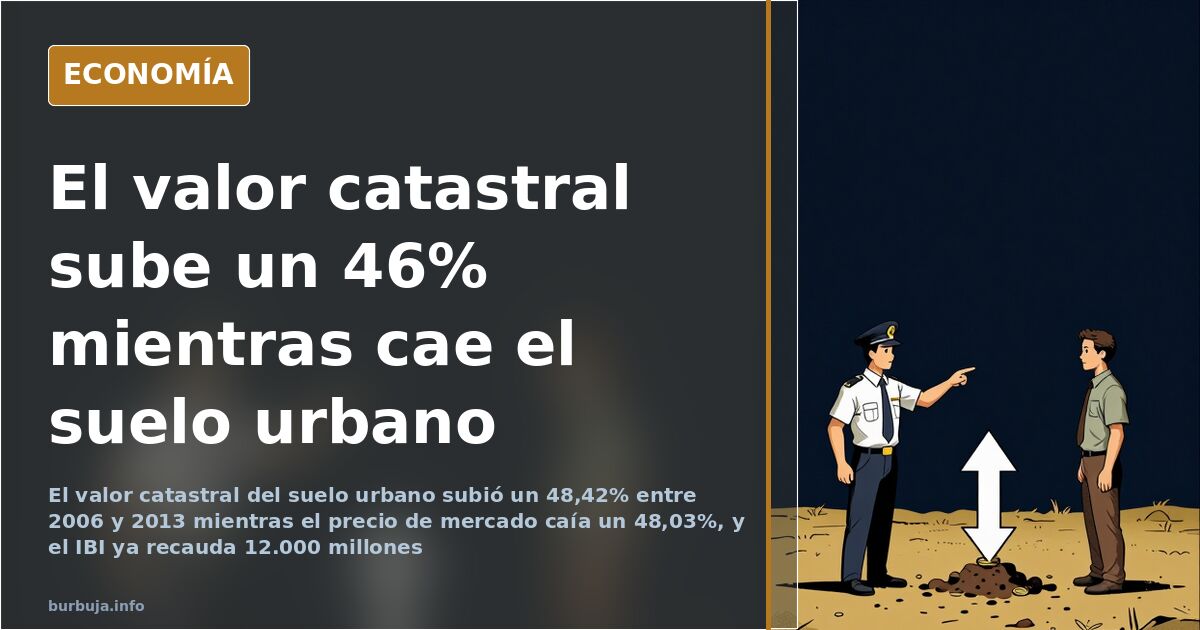
Cadastral value of land rose 48% while market value fell another 48%
In Hospitalet de Llobregat, a forum user's account puts the IBI on a 90-square-metre officially protected flat built in 1979 at around €720 a year, compared with the €300 paid two decades ago. The home has not gained a square metre or any structural improvement. The bill, by contrast, has more than doubled. And it is not a local anomaly: between late 2006 and 2013, the cadastral value of urban land rose 48.42% just as the market price of that same land plunged 48.03%, according to official statistics used by the sector. The Ministerio de Fomento set the maximum for urban land at €284.6 per square metre in 2006; by 2013 it had closed at €147.9. The Catastro, by contrast, kept adding.
The Catastro moves in the opposite direction to the market
Cadastral value is an administrative value. It is calculated using an objective valuation method set out in the ponencias de valores (official valuation schedules): location, planning parameters, building costs, indirect expenses and developer profit. The rule sets a ceiling: it cannot exceed 50% of market value when the valuation schedule is approved. On paper, the system makes sense. In the numbers, it jars. While building costs barely moved 3.7% over that period, the average cadastral value of buildings rose 39.59%. Adding land and buildings together, total cadastral value recorded a rise of 46.42%.
The result is that the 1.14 million hectares of urban land —2% of the territory— carry a cadastral value of €1.2 trillion, an average of €105.41 per square metre. The total of the 37.6 million declared urban properties is close to €2.3 trillion. Anyone who thinks that is just administrative paperwork is mistaken: that figure is the tax base for IBI and half a dozen other taxes.
Why doesn't cadastral value fall when prices drop?
Because the market studies that feed the valuation schedules reflect a reality that is already past, and the basic modules are still anchored in 2007, at the height of the bubble. Annual circulars on valuation schedules keep those modules without any substantive review, dragging along a snapshot of a market that no longer exists. The consequence is mechanical: if the base is not adjusted downwards, the bill can only rise.
The machinery allows only piecemeal corrections. In 2016, the Ayuntamiento de Madrid announced a partial review of cadastral values in 22 neighbourhoods, citing a market deviation of around 10%. It affected 370,891 properties and therefore their IBI from 2017. A precision correction for a gap that the overall figures put at tens of percentage points.
The revenue that sustains local councils
IBI already raises around €12 billion a year and has become the system's fourth-largest tax, behind personal income tax (IRPF), VAT and corporate tax, closing the gap with the latter. Between 2006 and 2013, revenue grew 83.71%, and that was with rates barely touched: the effective rate went from 0.67% to 0.69%. The increase did not come from the nominal bill; it came from the base.
Municipal property taxes account for more than 30% of town hall budgets. And the coffers have not been emptied: local councils have accumulated a surplus of close to €40 billion over seven years, while spending more and more. Municipalities now take in twice as much from IBI as at the peak of the property boom.
The reference value: pay first, appeal later
With the Catastro's new reference value, in force since January, the tax authority acknowledges that valuations can cause an artificial rise in prices and therefore in taxes, but it still requires payment and refers taxpayers to a later appeal. Some valuations exceed the actual purchase price of the property by as much as 68%. Tax advisers reject that formula: it forces you to pay upfront and litigate afterwards.
The Catastro itself has announced it will use property portals such as Idealista and Fotocasa to fine-tune reference values. The inevitable question: if the market is in charge, why does the bill never go down?
Plusvalía, rubbish and the layers of the bill
The blow does not stop at IBI. The coefficients for the municipal capital gains tax (plusvalía) were updated from 1 January 2023, and the increases approved for 2024 reach 38%, with some cases hitting 50%. From April 2025, the waste collection charge is added, making housing taxation more expensive for all citizens. Brussels has suggested the government raise IBI revenue, and the executive has already announced a review of the cadastral values of rural properties in 2017. Every piece fits: bricks, even when nothing is being built, remain the industry that pays the bills.
Does a higher IBI make housing cheaper?
Here the disagreement is fundamental. Some argue that a high annual bill penalises empty properties and pushes sale prices down, because the market almost never matches the Catastro. Against that weighs the opposite argument: making the fixed cost of owning a flat more expensive does not make it cheaper; it drives it out of the market or shifts it into the rental market. And there is a third, more uncomfortable view: that IBI in fact works like a rent the State charges for letting you be an owner: if you stop paying, you lose the property. Under that lens, debating the rate is debating the price of permission.
With these differentials, the reasonable thing would be for cadastral value to converge with reality on the ground. Municipalities now take in twice as much as at the peak of the boom. And urban land is still valued in the Catastro at prices the market abandoned more than a decade ago.
In Hospitalet de Llobregat, a forum user's account puts the IBI on a 90-square-metre officially protected flat built in 1979 at around €720 a year, compared with the €300 paid two decades ago. The home has not gained a square metre or any structural improvement. The bill, by contrast, has more than doubled. And it is not a local anomaly: between late 2006 and 2013, the cadastral value of urban land rose 48.42% just as the market price of that same land plunged 48.03%, according to official statistics used by the sector. The Ministerio de Fomento set the maximum for urban land at €284.6 per square metre in 2006; by 2013 it had closed at €147.9. The Catastro, by contrast, kept adding.
The Catastro moves in the opposite direction to the market
Cadastral value is an administrative value. It is calculated using an objective valuation method set out in the ponencias de valores (official valuation schedules): location, planning parameters, building costs, indirect expenses and developer profit. The rule sets a ceiling: it cannot exceed 50% of market value when the valuation schedule is approved. On paper, the system makes sense. In the numbers, it jars. While building costs barely moved 3.7% over that period, the average cadastral value of buildings rose 39.59%. Adding land and buildings together, total cadastral value recorded a rise of 46.42%.
The result is that the 1.14 million hectares of urban land —2% of the territory— carry a cadastral value of €1.2 trillion, an average of €105.41 per square metre. The total of the 37.6 million declared urban properties is close to €2.3 trillion. Anyone who thinks that is just administrative paperwork is mistaken: that figure is the tax base for IBI and half a dozen other taxes.
Why doesn't cadastral value fall when prices drop?
Because the market studies that feed the valuation schedules reflect a reality that is already past, and the basic modules are still anchored in 2007, at the height of the bubble. Annual circulars on valuation schedules keep those modules without any substantive review, dragging along a snapshot of a market that no longer exists. The consequence is mechanical: if the base is not adjusted downwards, the bill can only rise.
The machinery allows only piecemeal corrections. In 2016, the Ayuntamiento de Madrid announced a partial review of cadastral values in 22 neighbourhoods, citing a market deviation of around 10%. It affected 370,891 properties and therefore their IBI from 2017. A precision correction for a gap that the overall figures put at tens of percentage points.
The revenue that sustains local councils
IBI already raises around €12 billion a year and has become the system's fourth-largest tax, behind personal income tax (IRPF), VAT and corporate tax, closing the gap with the latter. Between 2006 and 2013, revenue grew 83.71%, and that was with rates barely touched: the effective rate went from 0.67% to 0.69%. The increase did not come from the nominal bill; it came from the base.
Municipal property taxes account for more than 30% of town hall budgets. And the coffers have not been emptied: local councils have accumulated a surplus of close to €40 billion over seven years, while spending more and more. Municipalities now take in twice as much from IBI as at the peak of the property boom.
The reference value: pay first, appeal later
With the Catastro's new reference value, in force since January, the tax authority acknowledges that valuations can cause an artificial rise in prices and therefore in taxes, but it still requires payment and refers taxpayers to a later appeal. Some valuations exceed the actual purchase price of the property by as much as 68%. Tax advisers reject that formula: it forces you to pay upfront and litigate afterwards.
The Catastro itself has announced it will use property portals such as Idealista and Fotocasa to fine-tune reference values. The inevitable question: if the market is in charge, why does the bill never go down?
Plusvalía, rubbish and the layers of the bill
The blow does not stop at IBI. The coefficients for the municipal capital gains tax (plusvalía) were updated from 1 January 2023, and the increases approved for 2024 reach 38%, with some cases hitting 50%. From April 2025, the waste collection charge is added, making housing taxation more expensive for all citizens. Brussels has suggested the government raise IBI revenue, and the executive has already announced a review of the cadastral values of rural properties in 2017. Every piece fits: bricks, even when nothing is being built, remain the industry that pays the bills.
Does a higher IBI make housing cheaper?
Here the disagreement is fundamental. Some argue that a high annual bill penalises empty properties and pushes sale prices down, because the market almost never matches the Catastro. Against that weighs the opposite argument: making the fixed cost of owning a flat more expensive does not make it cheaper; it drives it out of the market or shifts it into the rental market. And there is a third, more uncomfortable view: that IBI in fact works like a rent the State charges for letting you be an owner: if you stop paying, you lose the property. Under that lens, debating the rate is debating the price of permission.
With these differentials, the reasonable thing would be for cadastral value to converge with reality on the ground. Municipalities now take in twice as much as at the peak of the boom. And urban land is still valued in the Catastro at prices the market abandoned more than a decade ago.
Summary of a discussion on Burbuja.info - Foro de economía, actualidad y política., translated from Spanish and reviewed before publication. Read the full discussion (206 replies).
More summaries
-
Urbagestión proposes including Maricarmen's flat in Reviva plan
Urbagestión proposes to Madrid City Council to include Maricarmen's flat in the Reviva plan: the rent cap would not exceed 435 euros
-
Clash Between City Hall and Government Delegation Over Sol Campout
Madrid City Hall accuses the Government Delegation of 'dereliction of duty' regarding the housing protest camp in Sol, which has already led to legal action.
-
Euthanasia in Old Age: Autonomy vs. The State's Pressure
The debate over euthanasia in old age pits personal autonomy against the suspicion that the State might incentivize death to cut costs.
-
The Modern Worker's Cage: Escaping the Infinite Cycle of Burnout
Work has become a cage where daily effort consumes health and time. Discover why we push ourselves so hard and how to break the cycle.
-
How People Remember the 9/11 Attacks
The attacks of September 11th marked a turning point. Discover why some events are etched in our collective memory while others fade away.
-
Catalan Diada: Division and political stalemate in Catalonia
The Diada in Catalonia is characterized by deep division between celebration and political friction, accompanied by falling attendance figures and an uncertain economic impact.