
Ibero-America's $10.5 Trillion GDP: Fourth Economy or Illusion?
Ibero-America boasts a $10.5 trillion GDP and 888 million people, theoretically the world's fourth economy. Yet the bloc has never functioned as a real entity.
English · Original discussion in Spanish · Published
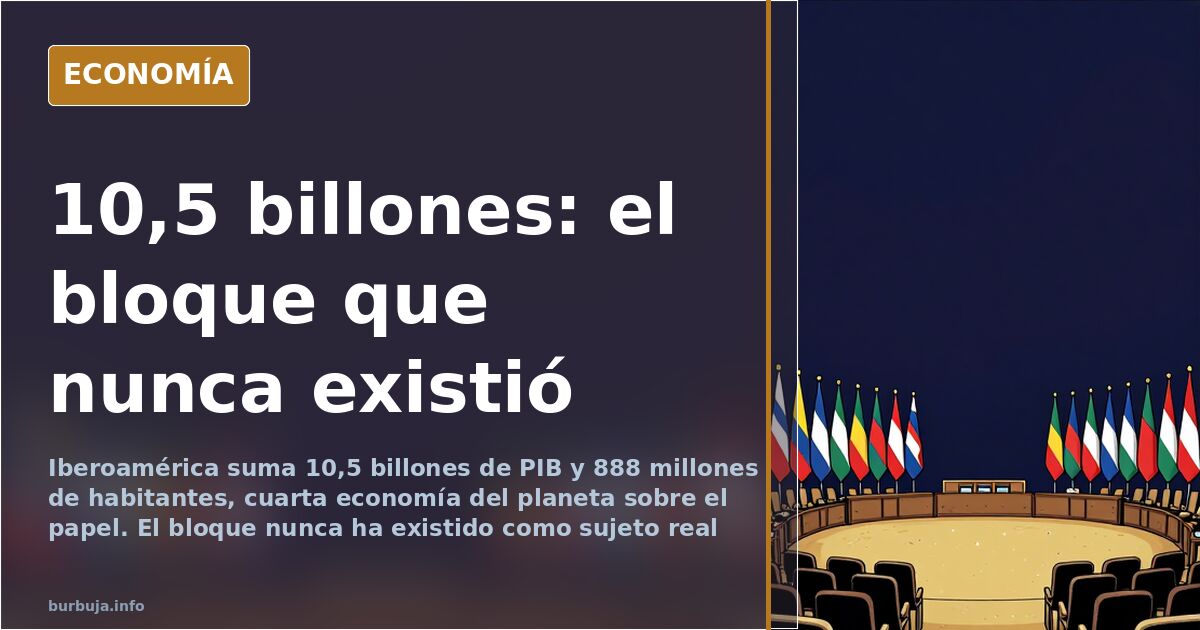
Ibero-America totals $10.5 trillion: Theoretical fourth global economy
On paper, the Ibero-American bloc is already the world’s fourth-largest economy. The opening figures are stark: the United States holds $29 trillion in GDP, China $18.74 trillion, the European Union $16.6 trillion, and Ibero-America $10.5 trillion. The Community of Latin American and Caribbean States (CELAC), often referenced alongside the broader Ibero-American community, groups 22 countries, over 888 million people—more than 10% of the planet’s 8 billion inhabitants—and a potential market of 700 million consumers. The thesis is simple: if this isn’t a bloc, it’s because no one wanted to build it. The fine print, as always, lies elsewhere.
From Roman Hispania to a common market of 700 million
The argument starts far back, in Roman Hispania, claiming that Hispanic provinces contributed legions, infrastructure, law, and urban planning to the Empire. Roads, aqueducts, and bridges still supporting cities like Zaragoza, Mérida, or Tarragona would prove an organizational capacity that, centuries later, justifies something akin to an Ibero-American Economic and Military Community. The proposal includes a common currency—the peso, escudo, or whatever fits—and allows Spain to keep the euro without renouncing a second economic affiliation.
The enthusiasm has arithmetic logic. Combined, Ibero-American countries surpass the EU in GDP, trailing only the US and China. The question remains why this aggregate has never worked as a political subject. And here begins the debate.
Why doesn't Ibero-America work as an economic bloc?
Because it hasn’t seriously tried for two centuries. This is the dominant skeptical argument: Ibero-American countries have had 200 years of independence without managing to understand each other, despite sharing language—with Brazil being the exception—and religion. Nationalism and mutual hatred instilled over two centuries would be the real wall, not a lack of market. The comparison with Spain stings: the country has 1,500 years as Roman Hispania or at least 500 since the Reconquista, yet some territories don’t feel Spanish. Asking Mexico and Chile to agree by decree sounds optimistic.
Some go further, arguing fragmentation was designed. British and French influence, channeled through Guasonic networks, allegedly deliberately divided the viceroyalties—Mexico, New Granada, Peru, Río de la Plata—to prevent a continental counterweight. Independence, from this reading, wasn’t liberation but preventive Balkanization.
The impulse that existed and faded
There was a time when integration wasn’t theoretical. During José María Aznar’s government, Spanish economic expansion in Latin America was real: Iberia bought airlines, BBVA and Santander acquired banks, Telefónica deployed telephony and internet, Repsol entered oil and gas stations. That wind brought human capital and business to Spain. Afterwards, the country focused on selling housing to itself during the property bubble, and the momentum collapsed. The window closed without anyone reopening it.
Today’s proposal recycles that dream with new packaging: common market, shared currency, military alliance. And an admitted goal: trade within the club to ruin the United States, accused of using Latin America as a continent-ranch and keeping it in misery. The underlying thesis is that the region has everything needed to be first-world, but someone won’t let it.
Rejection from within Spain
Not all Spaniards buy into the project. One current rejects it outright: Spain is Europe, and what lies across the Atlantic doesn’t matter. Some argue a Spaniard has more in common with a German, Swiss, or Dane than with a Latin American, viewing Hispanismo as a betrayal of identity. Others point to a lack of statesmen: with corrupt politicians and traitors in charge, Spain will never lead anything, even though the connection with former colonies persists and a multipolar bloc is emerging.
The harshest diagnosis distinguishes no sides: Hispanic America would be the first economy if governed decently, and Spain is a swamp unfit to lead. In this reading, the chimera is double.
With these elements, the world’s fourth economy will continue existing in spreadsheets and summit speeches. If it ever becomes something more, it won’t be due to a lack of figures. It will be because someone solves the problem no sum of GDP can fix: 22 countries unable to agree even on sharing a currency.
On paper, the Ibero-American bloc is already the world’s fourth-largest economy. The opening figures are stark: the United States holds $29 trillion in GDP, China $18.74 trillion, the European Union $16.6 trillion, and Ibero-America $10.5 trillion. The Community of Latin American and Caribbean States (CELAC), often referenced alongside the broader Ibero-American community, groups 22 countries, over 888 million people—more than 10% of the planet’s 8 billion inhabitants—and a potential market of 700 million consumers. The thesis is simple: if this isn’t a bloc, it’s because no one wanted to build it. The fine print, as always, lies elsewhere.
From Roman Hispania to a common market of 700 million
The argument starts far back, in Roman Hispania, claiming that Hispanic provinces contributed legions, infrastructure, law, and urban planning to the Empire. Roads, aqueducts, and bridges still supporting cities like Zaragoza, Mérida, or Tarragona would prove an organizational capacity that, centuries later, justifies something akin to an Ibero-American Economic and Military Community. The proposal includes a common currency—the peso, escudo, or whatever fits—and allows Spain to keep the euro without renouncing a second economic affiliation.
The enthusiasm has arithmetic logic. Combined, Ibero-American countries surpass the EU in GDP, trailing only the US and China. The question remains why this aggregate has never worked as a political subject. And here begins the debate.
Why doesn't Ibero-America work as an economic bloc?
Because it hasn’t seriously tried for two centuries. This is the dominant skeptical argument: Ibero-American countries have had 200 years of independence without managing to understand each other, despite sharing language—with Brazil being the exception—and religion. Nationalism and mutual hatred instilled over two centuries would be the real wall, not a lack of market. The comparison with Spain stings: the country has 1,500 years as Roman Hispania or at least 500 since the Reconquista, yet some territories don’t feel Spanish. Asking Mexico and Chile to agree by decree sounds optimistic.
Some go further, arguing fragmentation was designed. British and French influence, channeled through Guasonic networks, allegedly deliberately divided the viceroyalties—Mexico, New Granada, Peru, Río de la Plata—to prevent a continental counterweight. Independence, from this reading, wasn’t liberation but preventive Balkanization.
The impulse that existed and faded
There was a time when integration wasn’t theoretical. During José María Aznar’s government, Spanish economic expansion in Latin America was real: Iberia bought airlines, BBVA and Santander acquired banks, Telefónica deployed telephony and internet, Repsol entered oil and gas stations. That wind brought human capital and business to Spain. Afterwards, the country focused on selling housing to itself during the property bubble, and the momentum collapsed. The window closed without anyone reopening it.
Today’s proposal recycles that dream with new packaging: common market, shared currency, military alliance. And an admitted goal: trade within the club to ruin the United States, accused of using Latin America as a continent-ranch and keeping it in misery. The underlying thesis is that the region has everything needed to be first-world, but someone won’t let it.
Rejection from within Spain
Not all Spaniards buy into the project. One current rejects it outright: Spain is Europe, and what lies across the Atlantic doesn’t matter. Some argue a Spaniard has more in common with a German, Swiss, or Dane than with a Latin American, viewing Hispanismo as a betrayal of identity. Others point to a lack of statesmen: with corrupt politicians and traitors in charge, Spain will never lead anything, even though the connection with former colonies persists and a multipolar bloc is emerging.
The harshest diagnosis distinguishes no sides: Hispanic America would be the first economy if governed decently, and Spain is a swamp unfit to lead. In this reading, the chimera is double.
With these elements, the world’s fourth economy will continue existing in spreadsheets and summit speeches. If it ever becomes something more, it won’t be due to a lack of figures. It will be because someone solves the problem no sum of GDP can fix: 22 countries unable to agree even on sharing a currency.
Summary of a discussion on Burbuja.info - Foro de economía, actualidad y política., translated from Spanish and reviewed before publication. Read the full discussion (157 replies).
More summaries
-
China hikes tariffs to 125%, weaponizes yuan in trade war
China raises tariffs to 125% and devalues the yuan as a trade weapon. The debate: does it impoverish its population or shield its economy?
-
Chinese AI Challenges Western Tech Dominance
Chinese AI challenges Western tech giants with powerful open-source models.
-
YouTube's Cuqui Family: Profiting from Junk Food and Plastics
Burbuja.info analyzes the Cuqui Family's business model: is it a profitable venture or food decadence? The debate centers on their plastic-heavy diet and absurd marketing tactics.
-
Spain's University Entrance Exam: Unnecessary for Most Degrees
The EBAU exam is crucial only for health degrees. For others, it seems redundant. Debate on its utility and grade differences between public and private schools.
-
Viral video of fitness trainer's fall debunked as fake
A viral video showing a man falling from a balcony is falsely linked to an affair. Fact-checkers confirm it is an unrelated suicide clip.
-
Over 1,700 Quarantined on Cruise Ship in France
A gastroenteritis outbreak quarantines a cruise ship in France. We analyze health risks, sector impact, and forum theories.