
I Surrender to Agenda 2030. By that year I will have NOTHING and be...?
Agenda 2030 proposes a future without ownership. Will it make us freer or more dependent? We analyze the key to the matter.
English · Original discussion in Spanish · Published
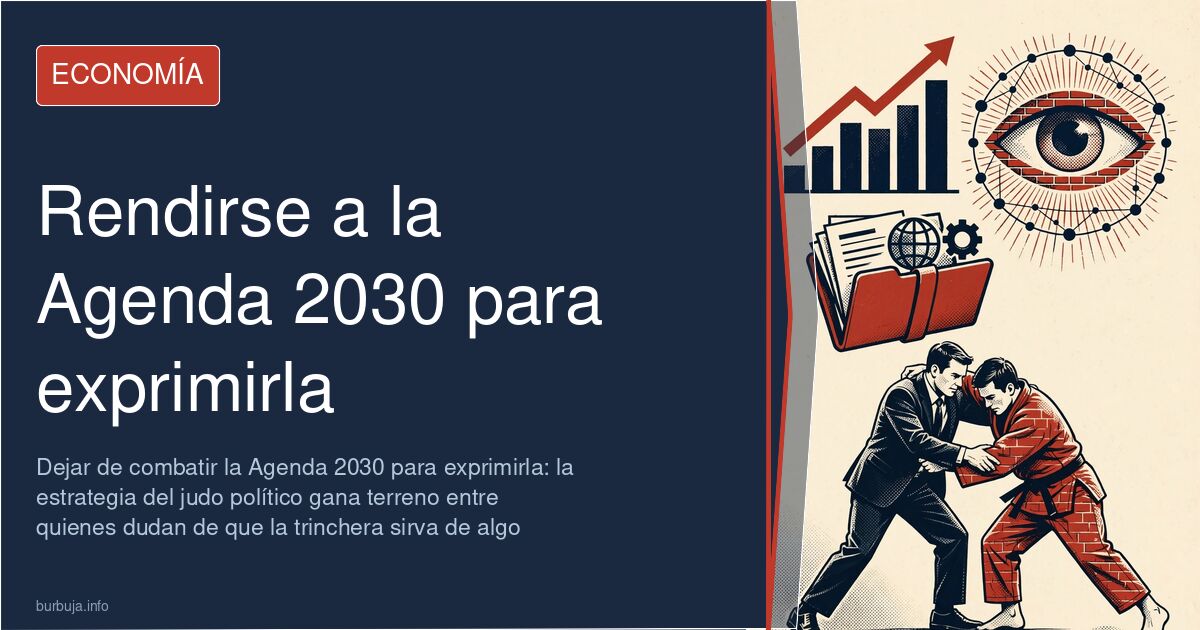
Agenda 2030 does not necessarily imply a loss of freedom. The key lies in whether relinquishing ownership makes us more dependent on third parties or frees us to choose.
## Property: A Burden on Freedom?
For a long time, we have been sold the idea that possession meant freedom. Having your house, your car, your tools gave you an independence that power could hardly take away. It was a private sphere, a material bastion. However, modern states have found in property a very effective way to locate us. Buying a home, for instance, triggers a cascade of taxes: acquisition tax, possession tax, municipal taxes, community fees, surcharges, insurance, maintenance, repairs, certificates, regulations, inspections, restrictions... and eventually, taxes for transmission. The house is yours, yes, but with a pile of 'buts' when deciding about it. The same applies to the automobile. You buy it, you pay for it, you register it, you insure it, you maintain it, you pass the inspection, you pay taxes, you look for where to park it, and on top of that, you watch how successive regulations dictate where you can drive something you bought precisely to move around. A perfect business, but for someone.
This situation leads us to a question that sounded like science fiction decades ago: what if owning certain things no longer makes us freer? Perhaps the time has come to reconsider the value of property. The idea of "you will own nothing and be happy," popularized by the **World Economic Forum** in **2016**, condenses a vision of society where ownership is replaced by access to goods and services. Accepting this premise, with a crucial caveat, may be the way forward. I don't want anyone to make me happy; happiness is a personal matter. What I seek is freedom. And that will be my sole criterion for evaluating proposals shaping the future: do they make me freer or less free?
## The Allure of Access: Transport and Housing
Accepting the premise of Agenda 2030 brings with it the temptation to renounce ownership of certain goods. Take the example of a car. If I can rent a car for **25, 30 or 40 euros** per day and only need it a few days a month, why should I own it? The idea of using it, driving it, and returning it—without worrying about tire changes, insurance expiration dates, inspections, or the mysterious orange light on the dashboard—sounds attractive. I also don't want to spend the rest of the year looking for parking for a vehicle I use sporadically. What I need is transportation, not property in a car.
The difference between owning a car and having access to transport is enormous. For decades, we have confused having things with having control over them, and they are not the same.
The same thing happens with housing. If there is a suitable, stable, and affordable rental option, why should I tie up a considerable part of my assets in four walls? If the state also promotes protected housing, affordable rents, or access models that drastically reduce living costs, I plan to study them all. I do not feel a sarracena obligation to pay more just to say "this house is mine." I want to be able to use a good home for as long as suits me and then move on, without the hassle of selling, middlemen, notaries, or worrying about capital gains or if it's a good year to sell. Letting a decision made twenty years ago determine where I must live today—that is also a form of freedom.
## The Trap of Dependence: Who Owns What I Don't?
This is not about abolishing property; that would be foolish. What I propose is something more uncomfortable: stop automatically considering it an advantage. Some properties provide independence, while others generate dependence. A tool I use constantly can make me freer. Productive assets too. A small object I need daily makes sense to own. Lettuce, for example, does not. I buy it, I eat it, and the problem is solved. The criterion cannot be ideological; it must be practical. Does owning this increase my freedom? If the answer is yes, I own it. If no, someone else should.
But here lies the real trap. Perhaps the problem is not ceasing to possess, but who possesses what we stop possessing. This is the question that rarely accompanies the famous "you will own nothing." Because someone will possess the housing, the automobiles, the platforms, the servers, the lands, the infrastructures, the capital. And if I own nothing, but I permanently need permission from those who do to eat, live, move, communicate, or work—then I have not been freed from property. I have become dependent on the owner. And that completely changes the problem. Not owning properties can be extraordinarily liberating when I can choose among many providers, abandoning one and going to another. It can be terrifying when there is only one.
## My Agenda 2030: Freedom as a Compass
I will accept Agenda 2030 in a peculiar way. I will examine its principles one by one, not to ask if they are left-wing or right-wing, nor if they please **Davos**, **Brussels**, or the **current government**. Nor to determine if their intentions are good. My question will be much more elemental: does this increase or decrease my ability to decide about my own life? If it increases it, I accept it. If I can live by renting for much less money and preserve my capital, fine. If I can use a car without bearing its costs for twenty years, fine. If I can share certain services and only pay for what I use, fine. If technology eliminates bureaucracy, excellent. If a city allows me to live perfectly without a car, great.
But if obtaining these benefits requires surrendering my ability to decide, then the answer changes. If I can only pay in a certain way, no. If I can only travel via systems that might exclude me, no. If my money depends on permanent authorization, no. If my housing depends on obeying certain ideological, economic, or administrative conditions, no. If every aspect of my existence is recorded, scored, authorized, and eventually blocked, no. Because then we are no longer talking about comfort. We are talking about power.
## Happiness, a Personal Choice
Perhaps we have been discussing the wrong part of the phrase "you will own nothing and be happy" for years. The problem might not be in "owning nothing." It could be in "being happy." Because behind those two words lies a formidable question: who has decided what must make me happy?
I don't need any government to make me happy. Not a company. Not the **United Nations**. Not the **World Economic Forum**. Not an algorithm. I don't even need society to have a happiness project for me. I only need something much humbler and, at the same time, much more demanding: that it allows me to choose.
That is why I have decided to surrender. I accept not owning what doesn't need to be owned. I accept renting. I accept sharing. I accept paying for use. I accept taking advantage of every subsidy, social tariff, public service, or economic benefit to which I legitimately qualify. I accept letting go of all properties that consume more freedom than they provide. I will be an exemplary citizen of **2030**. But with one condition. I do not promise to be happy. I promise to try to be free.
## Property: A Burden on Freedom?
For a long time, we have been sold the idea that possession meant freedom. Having your house, your car, your tools gave you an independence that power could hardly take away. It was a private sphere, a material bastion. However, modern states have found in property a very effective way to locate us. Buying a home, for instance, triggers a cascade of taxes: acquisition tax, possession tax, municipal taxes, community fees, surcharges, insurance, maintenance, repairs, certificates, regulations, inspections, restrictions... and eventually, taxes for transmission. The house is yours, yes, but with a pile of 'buts' when deciding about it. The same applies to the automobile. You buy it, you pay for it, you register it, you insure it, you maintain it, you pass the inspection, you pay taxes, you look for where to park it, and on top of that, you watch how successive regulations dictate where you can drive something you bought precisely to move around. A perfect business, but for someone.
This situation leads us to a question that sounded like science fiction decades ago: what if owning certain things no longer makes us freer? Perhaps the time has come to reconsider the value of property. The idea of "you will own nothing and be happy," popularized by the **World Economic Forum** in **2016**, condenses a vision of society where ownership is replaced by access to goods and services. Accepting this premise, with a crucial caveat, may be the way forward. I don't want anyone to make me happy; happiness is a personal matter. What I seek is freedom. And that will be my sole criterion for evaluating proposals shaping the future: do they make me freer or less free?
## The Allure of Access: Transport and Housing
Accepting the premise of Agenda 2030 brings with it the temptation to renounce ownership of certain goods. Take the example of a car. If I can rent a car for **25, 30 or 40 euros** per day and only need it a few days a month, why should I own it? The idea of using it, driving it, and returning it—without worrying about tire changes, insurance expiration dates, inspections, or the mysterious orange light on the dashboard—sounds attractive. I also don't want to spend the rest of the year looking for parking for a vehicle I use sporadically. What I need is transportation, not property in a car.
The difference between owning a car and having access to transport is enormous. For decades, we have confused having things with having control over them, and they are not the same.
The same thing happens with housing. If there is a suitable, stable, and affordable rental option, why should I tie up a considerable part of my assets in four walls? If the state also promotes protected housing, affordable rents, or access models that drastically reduce living costs, I plan to study them all. I do not feel a sarracena obligation to pay more just to say "this house is mine." I want to be able to use a good home for as long as suits me and then move on, without the hassle of selling, middlemen, notaries, or worrying about capital gains or if it's a good year to sell. Letting a decision made twenty years ago determine where I must live today—that is also a form of freedom.
## The Trap of Dependence: Who Owns What I Don't?
This is not about abolishing property; that would be foolish. What I propose is something more uncomfortable: stop automatically considering it an advantage. Some properties provide independence, while others generate dependence. A tool I use constantly can make me freer. Productive assets too. A small object I need daily makes sense to own. Lettuce, for example, does not. I buy it, I eat it, and the problem is solved. The criterion cannot be ideological; it must be practical. Does owning this increase my freedom? If the answer is yes, I own it. If no, someone else should.
But here lies the real trap. Perhaps the problem is not ceasing to possess, but who possesses what we stop possessing. This is the question that rarely accompanies the famous "you will own nothing." Because someone will possess the housing, the automobiles, the platforms, the servers, the lands, the infrastructures, the capital. And if I own nothing, but I permanently need permission from those who do to eat, live, move, communicate, or work—then I have not been freed from property. I have become dependent on the owner. And that completely changes the problem. Not owning properties can be extraordinarily liberating when I can choose among many providers, abandoning one and going to another. It can be terrifying when there is only one.
## My Agenda 2030: Freedom as a Compass
I will accept Agenda 2030 in a peculiar way. I will examine its principles one by one, not to ask if they are left-wing or right-wing, nor if they please **Davos**, **Brussels**, or the **current government**. Nor to determine if their intentions are good. My question will be much more elemental: does this increase or decrease my ability to decide about my own life? If it increases it, I accept it. If I can live by renting for much less money and preserve my capital, fine. If I can use a car without bearing its costs for twenty years, fine. If I can share certain services and only pay for what I use, fine. If technology eliminates bureaucracy, excellent. If a city allows me to live perfectly without a car, great.
But if obtaining these benefits requires surrendering my ability to decide, then the answer changes. If I can only pay in a certain way, no. If I can only travel via systems that might exclude me, no. If my money depends on permanent authorization, no. If my housing depends on obeying certain ideological, economic, or administrative conditions, no. If every aspect of my existence is recorded, scored, authorized, and eventually blocked, no. Because then we are no longer talking about comfort. We are talking about power.
## Happiness, a Personal Choice
Perhaps we have been discussing the wrong part of the phrase "you will own nothing and be happy" for years. The problem might not be in "owning nothing." It could be in "being happy." Because behind those two words lies a formidable question: who has decided what must make me happy?
I don't need any government to make me happy. Not a company. Not the **United Nations**. Not the **World Economic Forum**. Not an algorithm. I don't even need society to have a happiness project for me. I only need something much humbler and, at the same time, much more demanding: that it allows me to choose.
That is why I have decided to surrender. I accept not owning what doesn't need to be owned. I accept renting. I accept sharing. I accept paying for use. I accept taking advantage of every subsidy, social tariff, public service, or economic benefit to which I legitimately qualify. I accept letting go of all properties that consume more freedom than they provide. I will be an exemplary citizen of **2030**. But with one condition. I do not promise to be happy. I promise to try to be free.
Summary of a discussion on Burbuja.info - Foro de economía, actualidad y política., translated from Spanish and reviewed before publication. Read the full discussion (49 replies).
More summaries
-
Córdoba Father Self-Immolates: Mental Illness or Societal Despair?
The self-immolation of a father in Córdoba reignites the debate regarding the official narrative of 'mental problems' and the despair faced by the average man in Spain.
-
Euthanasia in Old Age: Autonomy vs. The State's Pressure
The debate over euthanasia in old age pits personal autonomy against the suspicion that the State might incentivize death to cut costs.
-
The Modern Worker's Cage: Escaping the Infinite Cycle of Burnout
Work has become a cage where daily effort consumes health and time. Discover why we push ourselves so hard and how to break the cycle.
-
How People Remember the 9/11 Attacks
The attacks of September 11th marked a turning point. Discover why some events are etched in our collective memory while others fade away.
-
Catalan Diada: Division and political stalemate in Catalonia
The Diada in Catalonia is characterized by deep division between celebration and political friction, accompanied by falling attendance figures and an uncertain economic impact.
-
Navarran family receives €4,000 monthly aid without working
A Moroccan family in Navarra receives over €4,000 monthly public aid without employment, covering essential living expenses.