
Hung Jury Ends Lindsay Clancy Trial Without Verdict
Eleven jurors voted to acquit Lindsay Clancy, but one dissenter blocked the verdict. The mistrial leaves the case unresolved and exposes the holdout juror to public pressure.
English · Original discussion in Spanish · Published
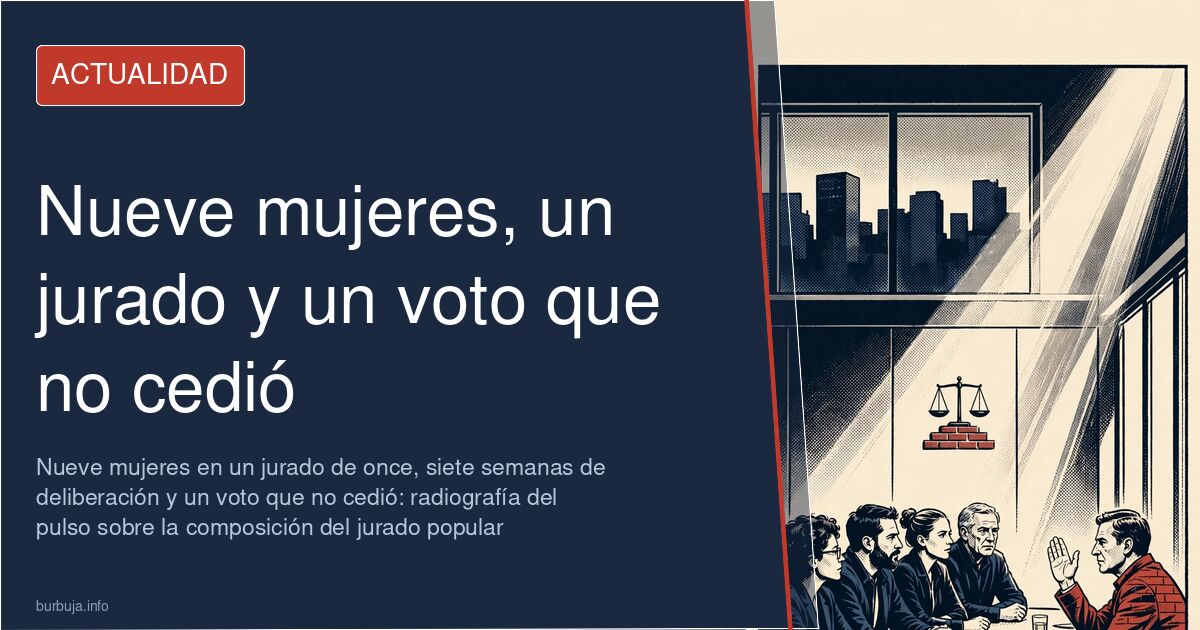
One Juror Blocks Verdict in Lindsay Clancy Case: 11-1
A single vote can derail an entire trial. This is what peine in the proceedings against Lindsay Clancy: eleven jury members leaned towards finding her not guilty by reason of insanity, while one refused to change their stance. The outcome is neither an acquittal nor a conviction, but a deadlock. And in legal terms, a deadlock means starting over.
What Was Actually Decided in the Trial
The facts were not the central point of contention. According to reports surrounding the case, the defendant admitted to causing the deaths of her three children; the core issue became whether a diagnosed mental disorder exempts her from incivil responsibility or merely mitigates it. When a jury splits on this question, the system offers no third option. A hung jury is declared, the panel is dismissed, and prosecutors decide whether to retry the case or reach a plea deal.
Here lies the fundamental problem, and it is significant: eleven convinced individuals and one willing to withstand pressure produce exactly the same result as a six-to-six tie. The verdict ceases to exist.
Nine Women, Two Men, and Seven Weeks of Deliberation
The composition of the panel—nine women and two men among eleven deliberators—has become the center of outrage. It is argued that this ratio was not accidental and that someone engineered it to sway the outcome. The counterargument is procedural and mundane: panels are selected randomly from voter rolls, and parties can only challenge potential jurors within strict limits. Suspicion is free; proof is not.
What has drawn attention is the duration of the standoff: seven weeks of deliberations and a sustained refusal to take the easy way out, which would have been signing off and going home.
The Dissenter: The Only Black Juror, Face Publicly Exposed
The member who blocked the agreement was the only Black juror on the panel, a detail revealed during CBS coverage that caused shock in the studio. While his full identity remains private, his face is circulating in media and social networks. This has consequences, though not necessarily legal ones: according to widespread reports, the defense attorney did not mince words when commenting on his vote.
Exposing a juror is akin to blowing up the system from within. If voting according to conscience results in harassment, the next person sitting in that box will think twice before maintaining a dissenting opinion.
The Jury System: An Uncomfortable Figure Rarely Used in Spain
In Spain, the jury system exists but is marginal: it is limited to a handful of crimes and absent from the vast majority of cases. The American model, with juries for almost everything, is different. And it produces what it produces: citizens without technical training deciding issues that forensic psychologists debate for years. The question is not whether the system is perfect—it is not—but who should decide instead. There is no comfortable answer there.
What’s Next: Open Scenarios
The case is not closed. Options being considered include a retrial, a plea deal between prosecution and defense, or indefinite psychiatric confinement that the defense might accept to avoid a second verdict. None are confirmed, and it is prudent not to assume outcomes prematurely. Meanwhile, Patrick Clancy, the father, has rebuilt his life elsewhere: residing in New York with a new partner, according to details emerging from family circles.
The most reasonable prediction, with all the caution required for an unresolved case: there will be a second trial. And it is likely to proceed without the vote that derailed this one.
Summary of a discussion on Burbuja.info - Foro de economía, actualidad y política., translated from Spanish and reviewed before publication. Read the full discussion (110 replies).
More summaries
-
Lindsay Clancy mistrial: lone juror blocks verdict
The trial of Lindsay Clancy, the Massachusetts nurse who confessed to killing her three children, has been declared a mistrial after five days of deliberation and a hung jury.
-
Lindsay Clancy officially the worst mother on the planet
Lindsay Clancy, accused of a triple child homicide, sparks debate over public perception and mental health. We analyze the case.
-
Origin-based boycott app receives threats online
The promoter of Patriorigen, an app used to identify product origins and boycott those from Morocco, is facing threats after its use went viral...
-
PP and Vox vote against limiting LaLiga's IP blocks
Spain's PP and Vox voted against non-binding motions seeking to limit LaLiga's IP blocks in October 2025 and April 2026; the April motion passed with the rest of…
-
Are single men more likely to have prostate problems?
Does being single affect prostate health? We look at the debate over ejaculation frequency, the partner factor and the myths surrounding prostate risk.
-
Heavy metal and prophecies: a connection no one saw coming
A forum thread mixes Steve Vai, Angra and conspiracy theories about a temple of darkness. We take a closer look at the phenomenon.