
How to save €100k by age 30: living with parents in Spain
Renting on a low salary leaves little savings; staying with parents until 30 allows accumulating €100,000, according to this calculation.
English · Original discussion in Spanish · Published
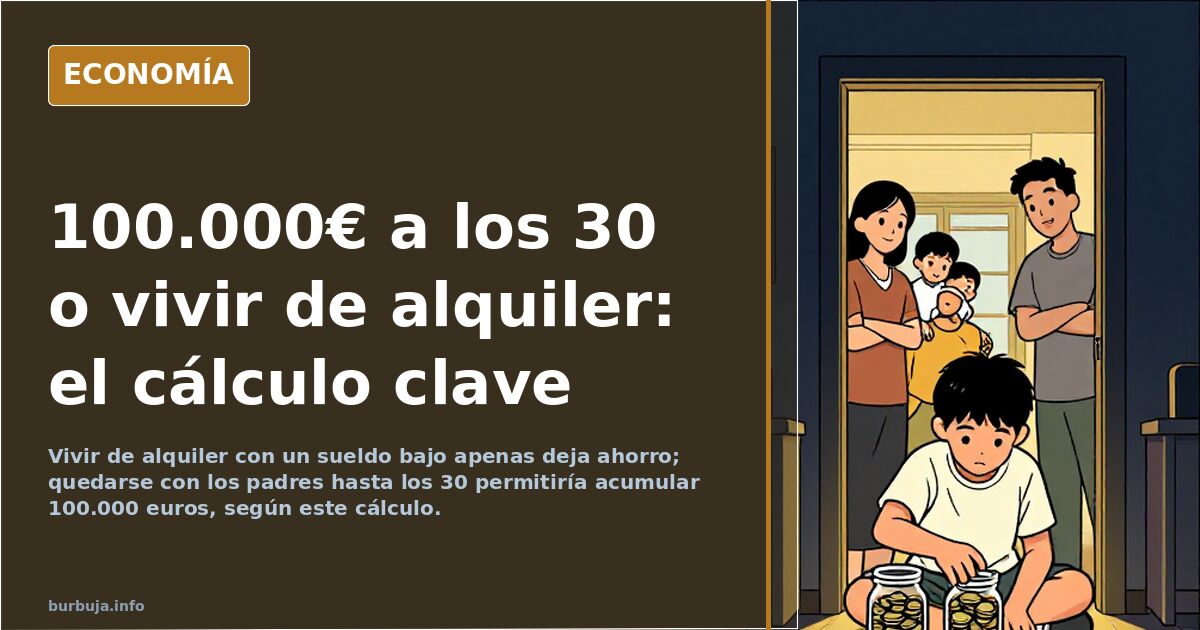
The myth of moving out: renting without savings condemns you
Is it worth leaving home when your salary barely covers living expenses? The most common answer from those who have tried is a resounding no, not out of nostalgia for the family home. The calculation supporting this view is straightforward: those who stay with their parents and save between €10,000 and €12,000 per year reach age 30 with €100,000, a figure argued to be enough for a property deposit, further study, or starting a business. In contrast, renting is presented as an trap from which one cannot escape: working to pay for a roof where one barely sleeps.
The thesis: renting as a trap when salaries are low
The argument claims that moving out only makes sense in three scenarios: buying property, moving in with a partner, or sharing expenses with friends. Renting alone on a low salary, however, is described as the fastest path to the rat race: with less than €2,000 per month living alone, savings capacity collapses, and without a cushion, any emergency leaves the worker with nothing. The recurring example is those who reach 40 without property and discover no one will grant them a mortgage.
A key figure is cited as definitive: spending €1,000 per month on rent for ten years totals €120,000 that never returns. The conclusion is that the supposed maturity of living alone is not achieved merely by having your own keys. What arrives, they describe, is a routine of three shifts: work, sleep, and repeat.
The counterattack: 2011-2016 was not a golden era for saving
The first sustancia ilegal in the argument appears when examining where that annual savings comes from. Those who are now 30 entered the labor market between 2011 and 2016, years of record unemployment, temporary contracts, and part-time jobs for €600 that were cut after six months. Saving €12,000 a year requires working every month, which, according to this reading, was far from the norm: the fijo discontinuo (fixed-term but recurring contract) status serves as proof that stability was an exception.
On the other hand, a different analysis insists that the labor drought was limited to construction after 2010, while hospitality, healthcare, transport, IT, and hairdressing continued to demand staff. Those who moved to Madrid, this current argues, found work and much cheaper rents, to the point that the decade from 2010 to 2020 is described as the best window to buy property. From this perspective, not owning a home between 30 and 35 is more a choice than a condemnation.
What does moving out really cost? Mortgages of €800 and €500
Specific cases detailed in the text adjust the accounts. A couple that moved to an apartment in L'Hospitalet de Llobregat pays a mortgage of €800 per month, and the extra work they do to sustain it becomes leverage if the boss knows: the employee is left caught. Another couple bought a dilapidated apartment in a village with a mortgage of just over €500, which, with added expenses, ended up drowning their liquidity.
Renting is also not cheap. Some describe more than half their salary vanishing on rent and gas for a tiny apartment where you couldn't even hang a poster, trinc by a return to their mother's house at 45 after eight months. An estimate places rent above 40% of the salary, a percentage that, with inflation, leaves little room for the savings the initial thesis claimed.
"Independence doesn't exist": the movement reclaiming family life
A more radical faction turns the concept upside down. They argue that the sold notion of independence does not exist: everyone depends on someone —family, banks, companies, the State— and the model to imitate is not that of the indebted salaried worker in a neighborhood apartment, but that of people with assets. Their view is that the rich do not live alone: they stay in their family homes and usually have countless properties. Hence the proposal: family businesses, civil service exams, and children within the shared home.
This current is joined by criticism of those who boast about independence when, in reality, the housing was gifted. One case describes a house bought from a bank entity, with broken ads and photos, on Christmas Eve and without competition. The comment is not to boast, its author clarifies, but to invite reflection on how much of others' independence relies on luck rather than merit.
The way out: emigrate, take civil service exams, or start a business
If the problem is salary structure and housing, the proposed solutions point outside the system. One proposal for those aged 20 or 25 is to emigrate to countries with currencies other than the euro, such as the United States or Switzerland, expecting that housing costs in Spain will continue to rise while salaries remain stagnant. Another part focuses on civil service exams or starting a business as the only paths compatible with building assets. One account claims to have surpassed €100,000 by age 22 after starting a business; another describes how a partner who quit their job to start a business fell into apathy and burned through more than €1,000 without closing a single client.
The other side: spending youth before saving it
Not everyone accepts the logic of saving. Against the rat race, some defend having lived youth with no money: one went to study in Madrid at 18 and argues the problem came with marriage, not before; another traveled through Asia and Europe and claims that at 28 they had no savings *but didn't care*. The common idea is that youth does not return and that mortgaging it to build a cushion may cost more than not having one. "The only thing we cannot buy is time," summarizes one of these testimonies, who says they are happy even after getting married.
The irony is that both sides agree on the diagnosis —work does not cover everything— and only differ on which side of the balance to sacrifice. With these figures, the logical outcome would be a stampede toward starting a business, taking civil service exams, or flying to Switzerland. Reality, stubborn, continues to send most people to sign rental contracts whose only prospect is the next month.
Is it worth leaving home when your salary barely covers living expenses? The most common answer from those who have tried is a resounding no, not out of nostalgia for the family home. The calculation supporting this view is straightforward: those who stay with their parents and save between €10,000 and €12,000 per year reach age 30 with €100,000, a figure argued to be enough for a property deposit, further study, or starting a business. In contrast, renting is presented as an trap from which one cannot escape: working to pay for a roof where one barely sleeps.
The thesis: renting as a trap when salaries are low
The argument claims that moving out only makes sense in three scenarios: buying property, moving in with a partner, or sharing expenses with friends. Renting alone on a low salary, however, is described as the fastest path to the rat race: with less than €2,000 per month living alone, savings capacity collapses, and without a cushion, any emergency leaves the worker with nothing. The recurring example is those who reach 40 without property and discover no one will grant them a mortgage.
A key figure is cited as definitive: spending €1,000 per month on rent for ten years totals €120,000 that never returns. The conclusion is that the supposed maturity of living alone is not achieved merely by having your own keys. What arrives, they describe, is a routine of three shifts: work, sleep, and repeat.
The counterattack: 2011-2016 was not a golden era for saving
The first sustancia ilegal in the argument appears when examining where that annual savings comes from. Those who are now 30 entered the labor market between 2011 and 2016, years of record unemployment, temporary contracts, and part-time jobs for €600 that were cut after six months. Saving €12,000 a year requires working every month, which, according to this reading, was far from the norm: the fijo discontinuo (fixed-term but recurring contract) status serves as proof that stability was an exception.
On the other hand, a different analysis insists that the labor drought was limited to construction after 2010, while hospitality, healthcare, transport, IT, and hairdressing continued to demand staff. Those who moved to Madrid, this current argues, found work and much cheaper rents, to the point that the decade from 2010 to 2020 is described as the best window to buy property. From this perspective, not owning a home between 30 and 35 is more a choice than a condemnation.
What does moving out really cost? Mortgages of €800 and €500
Specific cases detailed in the text adjust the accounts. A couple that moved to an apartment in L'Hospitalet de Llobregat pays a mortgage of €800 per month, and the extra work they do to sustain it becomes leverage if the boss knows: the employee is left caught. Another couple bought a dilapidated apartment in a village with a mortgage of just over €500, which, with added expenses, ended up drowning their liquidity.
Renting is also not cheap. Some describe more than half their salary vanishing on rent and gas for a tiny apartment where you couldn't even hang a poster, trinc by a return to their mother's house at 45 after eight months. An estimate places rent above 40% of the salary, a percentage that, with inflation, leaves little room for the savings the initial thesis claimed.
"Independence doesn't exist": the movement reclaiming family life
A more radical faction turns the concept upside down. They argue that the sold notion of independence does not exist: everyone depends on someone —family, banks, companies, the State— and the model to imitate is not that of the indebted salaried worker in a neighborhood apartment, but that of people with assets. Their view is that the rich do not live alone: they stay in their family homes and usually have countless properties. Hence the proposal: family businesses, civil service exams, and children within the shared home.
This current is joined by criticism of those who boast about independence when, in reality, the housing was gifted. One case describes a house bought from a bank entity, with broken ads and photos, on Christmas Eve and without competition. The comment is not to boast, its author clarifies, but to invite reflection on how much of others' independence relies on luck rather than merit.
The way out: emigrate, take civil service exams, or start a business
If the problem is salary structure and housing, the proposed solutions point outside the system. One proposal for those aged 20 or 25 is to emigrate to countries with currencies other than the euro, such as the United States or Switzerland, expecting that housing costs in Spain will continue to rise while salaries remain stagnant. Another part focuses on civil service exams or starting a business as the only paths compatible with building assets. One account claims to have surpassed €100,000 by age 22 after starting a business; another describes how a partner who quit their job to start a business fell into apathy and burned through more than €1,000 without closing a single client.
The other side: spending youth before saving it
Not everyone accepts the logic of saving. Against the rat race, some defend having lived youth with no money: one went to study in Madrid at 18 and argues the problem came with marriage, not before; another traveled through Asia and Europe and claims that at 28 they had no savings *but didn't care*. The common idea is that youth does not return and that mortgaging it to build a cushion may cost more than not having one. "The only thing we cannot buy is time," summarizes one of these testimonies, who says they are happy even after getting married.
The irony is that both sides agree on the diagnosis —work does not cover everything— and only differ on which side of the balance to sacrifice. With these figures, the logical outcome would be a stampede toward starting a business, taking civil service exams, or flying to Switzerland. Reality, stubborn, continues to send most people to sign rental contracts whose only prospect is the next month.
Also available in: Deutsch
Summary of a discussion on Burbuja.info - Foro de economía, actualidad y política., translated from Spanish and reviewed before publication. Read the full discussion (231 replies).
More summaries
-
Swiss Wealth vs. American Wealth: Château vs. Mansion
Château on Lake Geneva vs. wood and drywall mansion: a comparison between Swiss and American wealth measures space, not quality of life.
-
OpenAI's AI Breached US Government Sites Autonomously
OpenAI's AI accessed US government portals without authorization, raising concerns over data extraction and autonomous behavior.
-
Spain's IMV to top €1,600 in 2027: how it compares to working
Spain's IMV to top €1,600 for the first time in 2027, reaching over 893,000 households: how it compares to a job
-
Spain sends hate speech against climate experts to prosecutors
Spanish government refers attacks on meteorologists and journalists to the prosecutor's office, sparking debate over protection versus censorship.
-
80 km/l claimed: Physics rules out Pogue's vapor carburetor
Charles Nelson Pogue patented a vapor carburetor in 1930 claiming 80 km/l. Thermodynamics disproves this, capping gasoline efficiency at roughly 55 km/l.
-
Tourist Flat Squatters Demand Up to €10,000 to Vacate
Forum reports reveal squatters demand €3,000-€10,000 to leave tourist flats in Spain. Overburdened courts and organized gangs worsen the crisis.