
Housing protest camp at Madrid's Puerta del Sol sparks street-control showdown
The housing protest camp at Puerta del Sol in Madrid ejects a provocateur and reopens the debate over public order and the region's lack of its own police force.
English · Original discussion in Spanish · Published
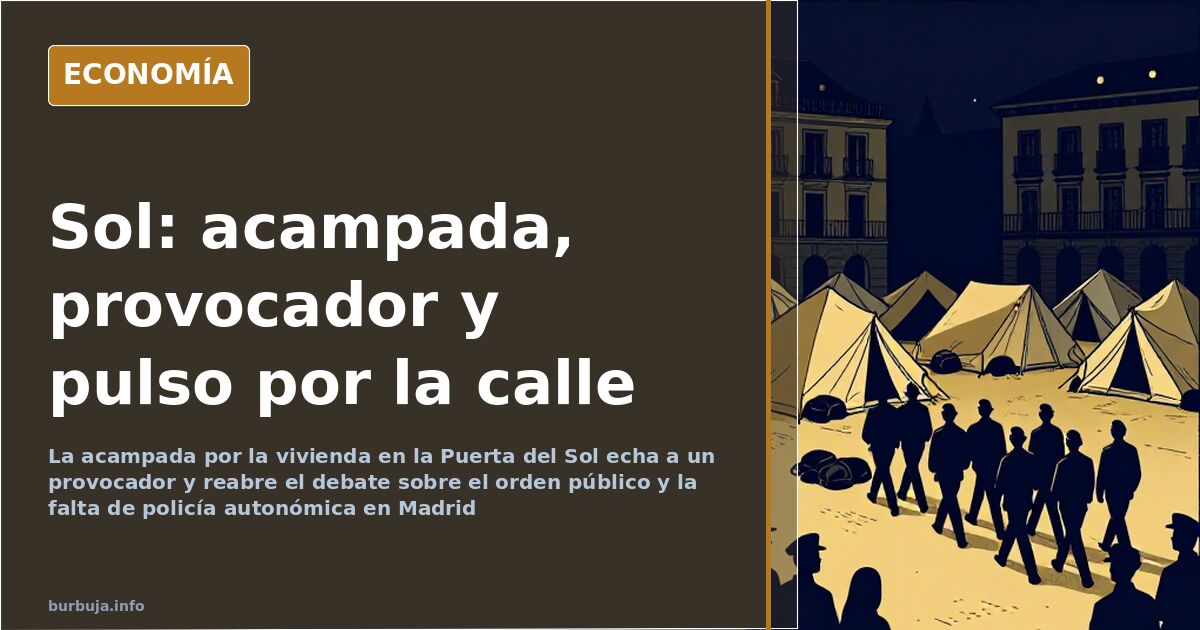
The Sol camp and the battle for control of the streets
Madrid's Puerta del Sol is once again acting as a gauge of who really controls the streets. A housing protest camp set up at Kilometre Zero has ejected a provocateur — according to the footage released, to chants of «fascists out» — and some participants are using the moment to ask why some protests are tolerated and others are not. Two opposing narratives coexist in the same square, and neither matches what came before.
What peine at Puerta del Sol
Activist Bertrand Ndongo went to the camp, where a confrontation broke out. The public broadcaster reported that the camp ejected him to chants of «fascists out»; another version, circulating on social media, claims the opposite: that a man tried to assault the campers and ended up being escorted and protected by police in the face of the crowd's reaction. Both accounts are circulating with equal confidence.
Other incidents add to the episode. A team from a digital outlet reported the destruction of a camera and an assault that forced them to flee the scene. Writer Lucía Etxebarría was involved in an on-air spat on a TV programme after travelling to the square, where, according to those who criticised her presence, she had gone to provoke. A claim also spread online about an elderly man assaulted on the ground, which no authority has confirmed.
The contrast with the lockdown
Some point to the contrast with the lockdown, when security forces pursued citizens walking alone in the countryside or on the beach. Now, a central public space is being occupied with no visible control and the institutions are looking the other way, according to that same narrative. It is no minor detail: if the streets are granted to some and denied to others, the debate stops being about housing and becomes about who decides.
In parallel, a more uncomfortable accusation against the protest is circulating: that a video of an elderly woman was used to pressure Congress into intervening. It is a claim spread without evidence, and should be treated as such.
Why does Madrid have no regional police force?
Here the focus shifts from the conflict to the structure. The Madrid region has no police force of its own, unlike other Spanish autonomous communities, and much of the exchange points to the regional Statute of Autonomy as the legal obstacle. Others note that Madrid once had the BESCAM (a now-defunct regional police unit) and that the Guardia Civil itself recommended creating a regional force, while the AUGC association puts the shortfall of Guardia Civil officers in the region at between 1,600 and 2,000.
And why isn't one created? Because the PSOE wouldn't allow it, some say; because neither would the PP, others reply. The question about the specific article of the Statute that would prevent it went unanswered.
That is where the analysis stalls. There is no agreement on whether the obstacle is the law, a lack of political will or the budget, and without that answer the debate returns to its starting point: who has the right to occupy the streets.
Also available in: Deutsch
Summary of a discussion on Burbuja.info - Foro de economía, actualidad y política., translated from Spanish and reviewed before publication. Read the full discussion (18 replies).
More summaries
-
Ndongo enters Sol protest alone, claims eviction
Bertrand Ndongo entered the Puerta del Sol encampment in Madrid alone, filmed the confrontation, and claimed he cleared the square "in seconds".
-
Etxebarria: from feminism to the pharmacy's 'social shield'
Etxebarria compares the social shield to a pharmacy that gives away medicines until it goes bust, reopening the debate on rent and public spending
-
Lucía Etxebarría tears into Spain's euthanasia law: "It kills the old and the poor"
Lucía Etxebarría denounces that Spain's euthanasia law prioritises death over life, cutting support and pressuring the most vulnerable. Data on healthcare costs.
-
Riots in French schools: fires and attacks
Fires in French schools, teachers attacked and blockades spreading to Belgium. The unrest is attributed to the education strike and radical groups.
-
Ceuta: 60,000 crossings push Spain's border past breaking point
More than 60,000 entries and around a hundred deaths: why the Ceuta crisis is a catastrophe that Europe watches without sharing the bill.
-
Morocco: the weakness measured at the border
Thousands of young people in Ceuta while Morocco boasts of military power: the thesis of Moroccan fragility is gaining ground and unsettling geopolitics in the Maghreb.