
Housing 15% more expensive in 2025 as Barcelona rooms hit €600
Housing costs rise 15% in 2025 and a room in Barcelona averages €600. Real inflation, INE (Spain's statistics agency) and new rules reshape the market.
English · Original discussion in Spanish · Published
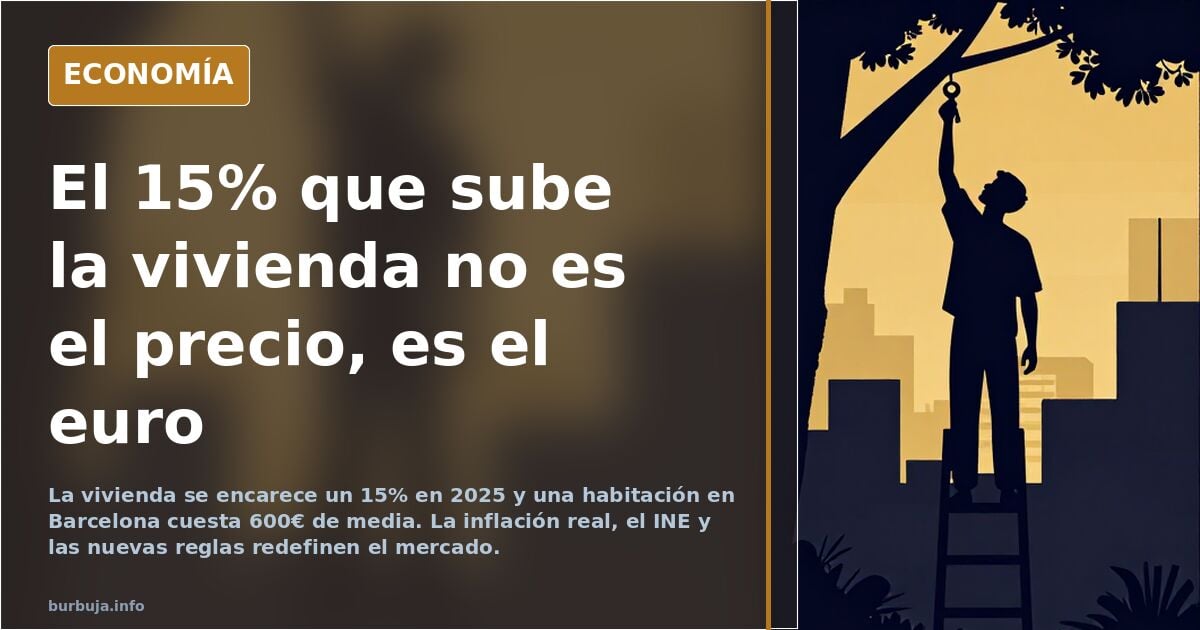
Housing 15% more expensive in 2025: the room that eats your salary
Housing is getting 15% more expensive in 2025, and renting a room in Barcelona now averages €600 a month. The easy headline is that property has gone crazy. The uncomfortable headline is this: the euro buys less and less, and housing acts as the thermometer. The same thing is happening on the outskirts of Madrid, where a room in an ordinary apartment is advertised at those prices and no one bats an eyelid.
The 15% is not a price rise, it's a devaluation
With VAT and several taxes rising since 1 January, part of the analysis argues that real inflation in 2025 is around 15% and that this, rather than a buyer frenzy, explains the price increase. The reasoning is simple: if food, energy and everything imported go up, the square metre rises by contagion, not on its own merits. The operational question is not how much an apartment is worth, but how much a euro is worth.
There is a second layer. Between 2007 and 2020, housing prices were practically stagnant while the cost of living and nominal wages kept rising: in real terms, a silent fall lasting more than a decade. What would come now would be the recovery of that lost ground, with a euro that has grown thinner along the way. Cycles, they call it. And everything that goes up, they add, comes down.
Rooms at €600: the return to 1850
A room costing €600 a month is no longer confined to exclusive neighbourhoods. It is the going rate in Barcelona and in ordinary areas on Madrid's outskirts. The result is a residential model many thought had been buried: adults with paychecks sharing an apartment with two or three strangers, a fridge divided by shelves and shifts for the bathroom.
The comparison makes itself. That arrangement looks too much like what two decades ago was the only way out for those arriving in the country without papers or a paycheck. The difference is that now it is signed by people with degrees and contracts. Some argue that this is not independence but a move in with strangers where family used to be; and some reply that no one likes it, but that anyone who can fork out €1,500 a month with bills on top in many capitals is a minority.
Why is a 2008-style crash not expected this time?
Because the starting point is the opposite, according to the most repeated scenario. In 2008, hundreds of thousands of homes were left without buyers after the bubble burst; today, it is argued, there is no surplus to absorb. And in 2008 Spain was losing working-age population because of a lack of jobs, whereas for a decade the country has been gaining an average of 700,000 inhabitants a year.
Add to that the official forecast handled by the INE (Spain's national statistics agency): 53 million inhabitants in Spain within a few years. More people, the same housing stock and new construction trending towards zero because of a lack of labour. The arithmetic always seems to point the same way.
The classic objection has not disappeared: no asset rises infinitely, especially if wages do not keep up. No one with any sense rules out a correction scenario; what they argue about is its scale and timing. And here a factor makes everything stranger: property is still propped up with public money through SAREB (Spain's bad bank) so that prices do not collapse. An asset that needs permanent rescuing is not exactly a healthy asset.
Digital registration, fines and regulated rooms
Regulation is advancing region by region. In Catalonia, room rentals must be proportional to the official rent for the entire apartment set by the Generalitat (Catalonia's regional government), and a penalty regime is being activated. In the Balearic Islands, the mandatory digital registration comes into play for all room rentals, with its corresponding financial penalty. Seasonal and tourist rentals go through the same hoop.
The side effect is already noticeable: part of the rental market is moving into the black market, subletting and verbal agreements where no one declares anything. And at the same time, the law that prevents evicting vulnerable tenants until the end of 2025 continues to operate on the other side of the scales: if a problematic apartment cannot be rented for years, the owner stops renting.
The landlord who leaves the market
The typical case is not the large holder but the individual owner. An apartment rented for €700 that expires in June, with the tenant offering to raise it to €900 and a flat refusal from the owner: he would rather lose the IBI (Spain's local property tax) and the building fees than gamble with the property. Without legal certainty, they say, no return is enough to compensate.
The paradox is that the same move feeds what is being criticised: every owner who withdraws reduces supply and pushes the room that remains free a little higher. The administration collects at every stage, the tenant pays and the owner drops out. No one seems to win except the paperwork machine.
In 2007, millions of inhabitants were also promised, and land prices eventually gave way. If the price is never going to fall, if wages are not going to keep up and if no one takes to the streets to protest, how much does a €600 room have to rise before someone stops paying for it?
Housing is getting 15% more expensive in 2025, and renting a room in Barcelona now averages €600 a month. The easy headline is that property has gone crazy. The uncomfortable headline is this: the euro buys less and less, and housing acts as the thermometer. The same thing is happening on the outskirts of Madrid, where a room in an ordinary apartment is advertised at those prices and no one bats an eyelid.
The 15% is not a price rise, it's a devaluation
With VAT and several taxes rising since 1 January, part of the analysis argues that real inflation in 2025 is around 15% and that this, rather than a buyer frenzy, explains the price increase. The reasoning is simple: if food, energy and everything imported go up, the square metre rises by contagion, not on its own merits. The operational question is not how much an apartment is worth, but how much a euro is worth.
There is a second layer. Between 2007 and 2020, housing prices were practically stagnant while the cost of living and nominal wages kept rising: in real terms, a silent fall lasting more than a decade. What would come now would be the recovery of that lost ground, with a euro that has grown thinner along the way. Cycles, they call it. And everything that goes up, they add, comes down.
Rooms at €600: the return to 1850
A room costing €600 a month is no longer confined to exclusive neighbourhoods. It is the going rate in Barcelona and in ordinary areas on Madrid's outskirts. The result is a residential model many thought had been buried: adults with paychecks sharing an apartment with two or three strangers, a fridge divided by shelves and shifts for the bathroom.
The comparison makes itself. That arrangement looks too much like what two decades ago was the only way out for those arriving in the country without papers or a paycheck. The difference is that now it is signed by people with degrees and contracts. Some argue that this is not independence but a move in with strangers where family used to be; and some reply that no one likes it, but that anyone who can fork out €1,500 a month with bills on top in many capitals is a minority.
Why is a 2008-style crash not expected this time?
Because the starting point is the opposite, according to the most repeated scenario. In 2008, hundreds of thousands of homes were left without buyers after the bubble burst; today, it is argued, there is no surplus to absorb. And in 2008 Spain was losing working-age population because of a lack of jobs, whereas for a decade the country has been gaining an average of 700,000 inhabitants a year.
Add to that the official forecast handled by the INE (Spain's national statistics agency): 53 million inhabitants in Spain within a few years. More people, the same housing stock and new construction trending towards zero because of a lack of labour. The arithmetic always seems to point the same way.
The classic objection has not disappeared: no asset rises infinitely, especially if wages do not keep up. No one with any sense rules out a correction scenario; what they argue about is its scale and timing. And here a factor makes everything stranger: property is still propped up with public money through SAREB (Spain's bad bank) so that prices do not collapse. An asset that needs permanent rescuing is not exactly a healthy asset.
Digital registration, fines and regulated rooms
Regulation is advancing region by region. In Catalonia, room rentals must be proportional to the official rent for the entire apartment set by the Generalitat (Catalonia's regional government), and a penalty regime is being activated. In the Balearic Islands, the mandatory digital registration comes into play for all room rentals, with its corresponding financial penalty. Seasonal and tourist rentals go through the same hoop.
The side effect is already noticeable: part of the rental market is moving into the black market, subletting and verbal agreements where no one declares anything. And at the same time, the law that prevents evicting vulnerable tenants until the end of 2025 continues to operate on the other side of the scales: if a problematic apartment cannot be rented for years, the owner stops renting.
The landlord who leaves the market
The typical case is not the large holder but the individual owner. An apartment rented for €700 that expires in June, with the tenant offering to raise it to €900 and a flat refusal from the owner: he would rather lose the IBI (Spain's local property tax) and the building fees than gamble with the property. Without legal certainty, they say, no return is enough to compensate.
The paradox is that the same move feeds what is being criticised: every owner who withdraws reduces supply and pushes the room that remains free a little higher. The administration collects at every stage, the tenant pays and the owner drops out. No one seems to win except the paperwork machine.
In 2007, millions of inhabitants were also promised, and land prices eventually gave way. If the price is never going to fall, if wages are not going to keep up and if no one takes to the streets to protest, how much does a €600 room have to rise before someone stops paying for it?
Summary of a discussion on Burbuja.info - Foro de economía, actualidad y política., translated from Spanish and reviewed before publication. Read the full discussion (206 replies).
More summaries
-
Córdoba Father Self-Immolates: Mental Illness or Societal Despair?
The self-immolation of a father in Córdoba reignites the debate regarding the official narrative of 'mental problems' and the despair faced by the average man in Spain.
-
Euthanasia in Old Age: Autonomy vs. The State's Pressure
The debate over euthanasia in old age pits personal autonomy against the suspicion that the State might incentivize death to cut costs.
-
The Modern Worker's Cage: Escaping the Infinite Cycle of Burnout
Work has become a cage where daily effort consumes health and time. Discover why we push ourselves so hard and how to break the cycle.
-
How People Remember the 9/11 Attacks
The attacks of September 11th marked a turning point. Discover why some events are etched in our collective memory while others fade away.
-
Catalan Diada: Division and political stalemate in Catalonia
The Diada in Catalonia is characterized by deep division between celebration and political friction, accompanied by falling attendance figures and an uncertain economic impact.
-
Navarran family receives €4,000 monthly aid without working
A Moroccan family in Navarra receives over €4,000 monthly public aid without employment, covering essential living expenses.