
House flipping in Spain: Why the 25% return is rare
Buying, renovating and selling with a 25% margin is elusive in Spain. Taxes, renovation costs and market cycles erode profits, especially for those who outsource work.
English · Original discussion in Spanish · Published
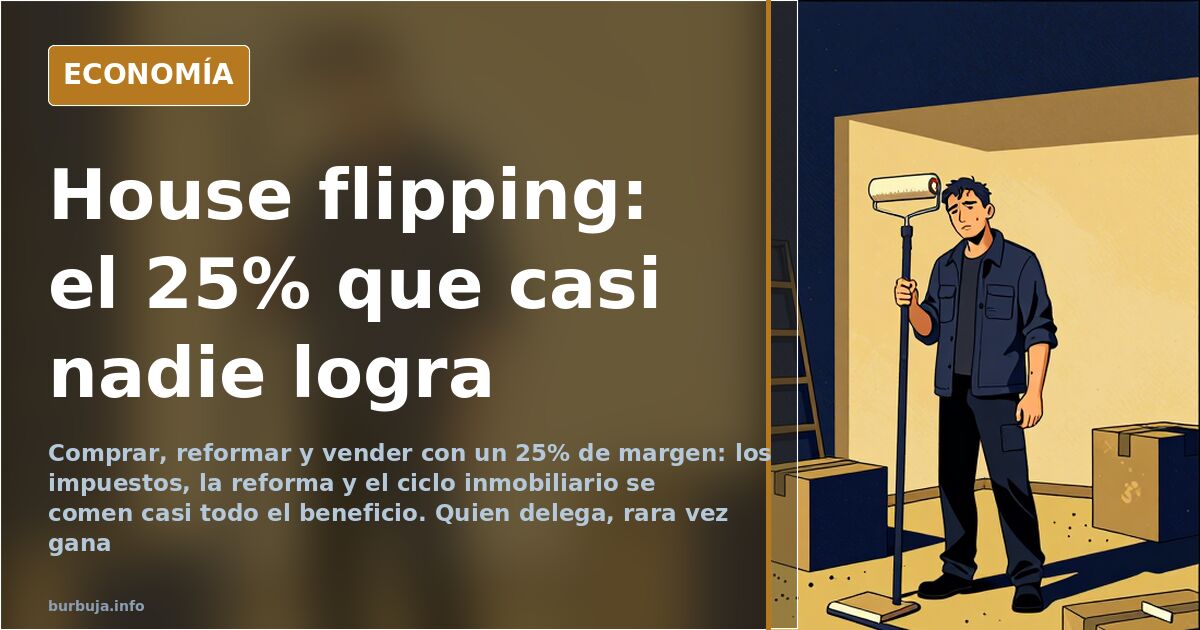
House flipping in Spain: Why the 25% return is rare
Buy a dilapidated apartment, renovate it and sell it with a 25% margin. This approach circulates online as casually as a cooking recipe, hiding an uncomfortable question: is there real money here or just another accelerated course promise? Basic arithmetic raises red flags from step one. Buying costs 10% in taxes and fees; selling triggers capital gains tax starting at 19%. In between, renovations almost always cost more than planned.
The consensus from accumulated experience is less epic. Those with trade skills — builders, electricians, carpenters — can scrape together a margin; those who delegate everything to third parties rarely do. The competitive advantage isn't the property, it's avoiding paying for external labor. Even then, the business depends on something no one controls: the market cycle.
How much does the Spanish Tax Agency take in a buy-sell operation?
Capital gains tax applies in the year of sale, paid once, taxed from 19%. Necessary renovation expenses are deductible, but here lies the first pitfall: if you do the work yourself without invoicing, how does that effort count on paper? The answer isn't comfortable. Your time value disappears from the fiscal equation.
Add bureaucracy. Some argue the problem isn't negotiation skills, but money: entry taxes, exit taxes and management fees narrow the margin until the operation becomes unviable except in very specific cases. Moreover, renovation barely moves the final price in many instances. A well-located flat is worth almost the same renovated as original, and a poorly located one remains poorly located no matter how new the tiles look.
Renovation doesn't fix structural issues
Cheap apartments usually have two problems: no elevator and no garage. Neither is solved by paint. Installing an elevator requires buying the whole building or dealing with community debts and delinquent neighbors. Underground parking demands demolition, which is out of reach. Location, location, location, summarizes the old real estate maxim: if the neighborhood is bad, renovation is just a pretty collar on an ugly dog.
The most cited success case isn't an individual with a screwdriver. A group of twenty people contributed an average of €10,000 each, operated between 2017 and 2019, and concentrated purchases in eastern coastal areas. Two home staging experts redesigned and supervised execution; whoever sourced the property earned a commission. It worked, but the account admits the pillar holding it up: they caught a market trend shift. Without capital and that tailwind, the same team likely wouldn't repeat the numbers.
Can you achieve a 25% return with house flipping?
Today it's difficult. Bargains are scarce, and those that appear — inheritances from elderly owners, penthouses with views, old houses requiring full renovation — often exceed €1 million and target high-income buyers. To get that 25%, you need to earn much more, because your own time and work also have value. The complete calculation, line by line, leaves a margin that shrinks with every unforeseen event.
The pessimistic scenario isn't theoretical. A property bought at the wrong time plus a crisis can turn the operation into a loss and force a desperate sale. Financial exposure risk is real: money is immobilized and the market doesn't warn before turning.
The parallel business: courses and videos
The most repeated suspicion points to channels teaching the method. If the business were so profitable and competition low, it wouldn't make sense to dedicate effort to showing the model. Clients aren't taught the process, they're shown results: explaining that you charge double the investment is counterproductive. Training and video content, however, generate stable income. "Premium smoke sellers" is the label some of these trainers earn among those already operating.
There's a regional exception slipping into conversation: in Extremadura, renovating a house for rural rental over three years allows receiving up to 50% of the cost as non-repayable grant. After the period, you can sell a renovated property with new installations at a high price. It's the type of public aid that changes the numbers, and also the detail that almost never appears in videos.
With these elements, house flipping looks less like a shortcut and more like a trade with cycles. Those with hands, capital and patience can win. Those arriving seeking easy 25% returns probably finance someone else's course.
Buy a dilapidated apartment, renovate it and sell it with a 25% margin. This approach circulates online as casually as a cooking recipe, hiding an uncomfortable question: is there real money here or just another accelerated course promise? Basic arithmetic raises red flags from step one. Buying costs 10% in taxes and fees; selling triggers capital gains tax starting at 19%. In between, renovations almost always cost more than planned.
The consensus from accumulated experience is less epic. Those with trade skills — builders, electricians, carpenters — can scrape together a margin; those who delegate everything to third parties rarely do. The competitive advantage isn't the property, it's avoiding paying for external labor. Even then, the business depends on something no one controls: the market cycle.
How much does the Spanish Tax Agency take in a buy-sell operation?
Capital gains tax applies in the year of sale, paid once, taxed from 19%. Necessary renovation expenses are deductible, but here lies the first pitfall: if you do the work yourself without invoicing, how does that effort count on paper? The answer isn't comfortable. Your time value disappears from the fiscal equation.
Add bureaucracy. Some argue the problem isn't negotiation skills, but money: entry taxes, exit taxes and management fees narrow the margin until the operation becomes unviable except in very specific cases. Moreover, renovation barely moves the final price in many instances. A well-located flat is worth almost the same renovated as original, and a poorly located one remains poorly located no matter how new the tiles look.
Renovation doesn't fix structural issues
Cheap apartments usually have two problems: no elevator and no garage. Neither is solved by paint. Installing an elevator requires buying the whole building or dealing with community debts and delinquent neighbors. Underground parking demands demolition, which is out of reach. Location, location, location, summarizes the old real estate maxim: if the neighborhood is bad, renovation is just a pretty collar on an ugly dog.
The most cited success case isn't an individual with a screwdriver. A group of twenty people contributed an average of €10,000 each, operated between 2017 and 2019, and concentrated purchases in eastern coastal areas. Two home staging experts redesigned and supervised execution; whoever sourced the property earned a commission. It worked, but the account admits the pillar holding it up: they caught a market trend shift. Without capital and that tailwind, the same team likely wouldn't repeat the numbers.
Can you achieve a 25% return with house flipping?
Today it's difficult. Bargains are scarce, and those that appear — inheritances from elderly owners, penthouses with views, old houses requiring full renovation — often exceed €1 million and target high-income buyers. To get that 25%, you need to earn much more, because your own time and work also have value. The complete calculation, line by line, leaves a margin that shrinks with every unforeseen event.
The pessimistic scenario isn't theoretical. A property bought at the wrong time plus a crisis can turn the operation into a loss and force a desperate sale. Financial exposure risk is real: money is immobilized and the market doesn't warn before turning.
The parallel business: courses and videos
The most repeated suspicion points to channels teaching the method. If the business were so profitable and competition low, it wouldn't make sense to dedicate effort to showing the model. Clients aren't taught the process, they're shown results: explaining that you charge double the investment is counterproductive. Training and video content, however, generate stable income. "Premium smoke sellers" is the label some of these trainers earn among those already operating.
There's a regional exception slipping into conversation: in Extremadura, renovating a house for rural rental over three years allows receiving up to 50% of the cost as non-repayable grant. After the period, you can sell a renovated property with new installations at a high price. It's the type of public aid that changes the numbers, and also the detail that almost never appears in videos.
With these elements, house flipping looks less like a shortcut and more like a trade with cycles. Those with hands, capital and patience can win. Those arriving seeking easy 25% returns probably finance someone else's course.
Summary of a discussion on Burbuja.info - Foro de economía, actualidad y política., translated from Spanish and reviewed before publication. Read the full discussion (146 replies).
More summaries
-
House flipping drives up rents in Madrid’s M-30 neighborhoods
Idealista reports 17 of 21 Madrid districts hit historic rental highs as foreign funds push prices outward from the center.
-
Buying in La Vera, Spain: €200k Home Amid Job Doubts
Forum debate on a new-build home in La Vera for €200,000: Is it a bargain or burden given 18-20% unemployment?
-
Why Spain isn't having children: three underlying trends
Housing, wages, female education and immigration: the three trends that explain why Spain barely reaches 1.2 children per woman
-
Santiago rents rise 11.6% despite price caps
Average rent in Santiago, Spain, hits €704 with the region's steepest increase despite tourism bans and rent controls.
-
Cancer mortality: debunking the 97% myth and the $291 billion industry
2024 data shows 20.6 million cases and 9.8 million deaths. The 97% figure is false, but spontaneous remission exists within a massive pharmaceutical market.
-
EU Approves Return Regulation, Leaving Spain Out of Step
The EU adopts a regulation making expulsion orders valid across all 27 states. Sweden demands €3,300 salaries, while Spain maintains its ban on hot returns.