
Hospitality Businesses Shut Down Due to Staff Shortages Despite Profitable Books
Businesses close with profits but no staff. €1,300 wages, 12-hour shifts, and inaccessible housing: the current model is unsustainable.
English · Original discussion in Spanish · Published
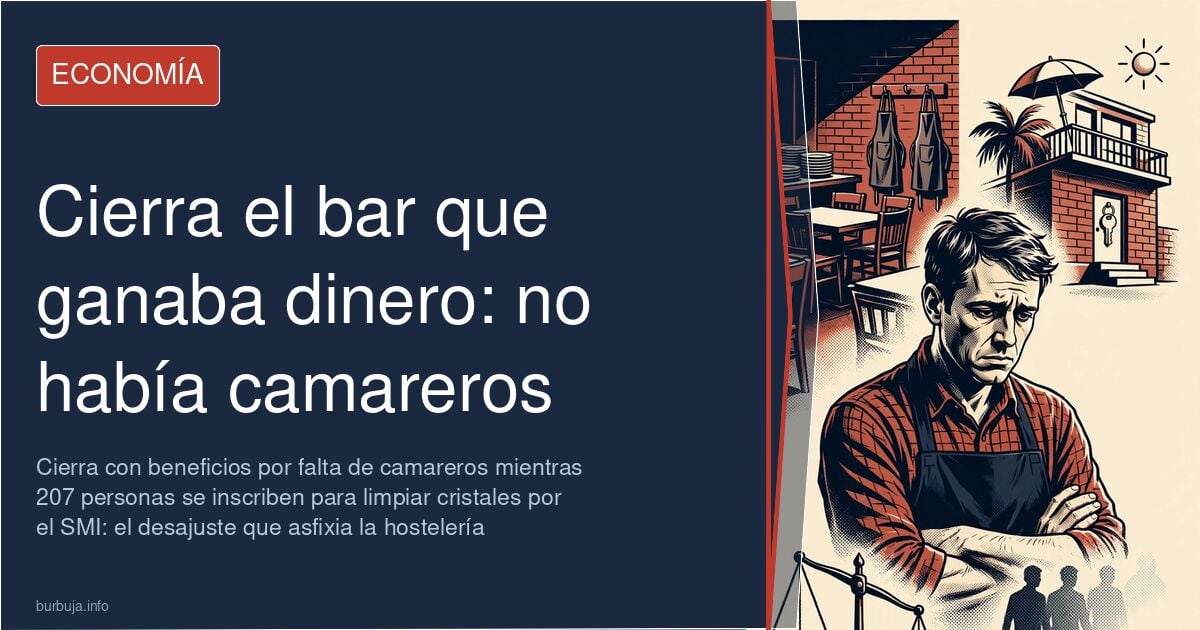
Staff Shortage in Hospitality: Profits Yes, Workers No
The Spanish hospitality sector is experiencing a paradox that no longer allows for euphemisms: there are establishments closing with full tills. The latest case, a bar that claimed to be profitable but could not find waiters to keep it open, has peine the debate about a sector that has been underpaying, demanding much, and offering little for years. The question is not where the workers are, but why no one wants to work there.
The Closure That Doesn't Match the Profits
The story of a business owner closing due to staff shortages despite making profits is common, but the data from this case points to another reality. The original article barely mentions salary conditions, except at the end: a newcomer is paid the minimum professional wage. In other words, they seek staff for full shifts in central and tourist areas, far from where people live, with schedules extending beyond what was agreed upon. The conclusion is simple: there isn't a lack of labor, but a lack of labor willing to work for what is offered.
Wages of €1,300 and 12-Hour Shifts
The figures circulating in the sector speak of contracts paying €1,300 per month for working Monday to Sunday, with breaks on Tuesday and unpaid overtime. The actual shift often exceeds 12 hours, and flexibility is one-way: the employer changes the schedule when it suits them; the worker does not. In this scenario, many decide to leave the sector, emigrate, or simply not enter the labor market. Social aid benefits, which in some cases are only €300–€400 short of a 40-hour salary, become the definitive argument against accepting abusive conditions.
The Effect of Benefits and Housing
The social safety net, as the benefits package is called, is cited as a major disincentive. But there is another factor weighing more heavily: housing. In tourist areas, the rent for an apartment can exceed €900 a week during high season, a figure that makes any waiter's salary unviable. Foreign workers, who should theoretically fill these positions, also reject the sector once they regularize their status. The conclusion is that the problem is not supply, but a model only viable if wages are subsistence level.
An Economic Model Trading Factories for Terraces
Behind this crisis is a fundamental debate: Spain has replaced industry with precarious tourism and hospitality. GDP grows, but per capita GDP falls because more workers are entering low value-added activities. The jobs that «the Spanish don't want» should not exist in a developed country. If a business is only viable by paying €900 for four months of work, its closure is not a tragedy, but a sign that the model is exhausted. The alternative, according to some analyses, involves raising prices and wages, even if it means a drink costs €8.
The trend suggests that terraces will empty, but not due to lack of customers, but due to a lack of waiters willing to serve those customers for what they are paid. The question is how long the sector can survive without rethinking its model. If it doesn't, business closures will become the norm, not the exception.
The Spanish hospitality sector is experiencing a paradox that no longer allows for euphemisms: there are establishments closing with full tills. The latest case, a bar that claimed to be profitable but could not find waiters to keep it open, has peine the debate about a sector that has been underpaying, demanding much, and offering little for years. The question is not where the workers are, but why no one wants to work there.
The Closure That Doesn't Match the Profits
The story of a business owner closing due to staff shortages despite making profits is common, but the data from this case points to another reality. The original article barely mentions salary conditions, except at the end: a newcomer is paid the minimum professional wage. In other words, they seek staff for full shifts in central and tourist areas, far from where people live, with schedules extending beyond what was agreed upon. The conclusion is simple: there isn't a lack of labor, but a lack of labor willing to work for what is offered.
Wages of €1,300 and 12-Hour Shifts
The figures circulating in the sector speak of contracts paying €1,300 per month for working Monday to Sunday, with breaks on Tuesday and unpaid overtime. The actual shift often exceeds 12 hours, and flexibility is one-way: the employer changes the schedule when it suits them; the worker does not. In this scenario, many decide to leave the sector, emigrate, or simply not enter the labor market. Social aid benefits, which in some cases are only €300–€400 short of a 40-hour salary, become the definitive argument against accepting abusive conditions.
- €1,300 per month for a full-time contract
- Actual shifts of 12 hours
- Weekly rest on Tuesday
- Unpaid overtime
The Effect of Benefits and Housing
The social safety net, as the benefits package is called, is cited as a major disincentive. But there is another factor weighing more heavily: housing. In tourist areas, the rent for an apartment can exceed €900 a week during high season, a figure that makes any waiter's salary unviable. Foreign workers, who should theoretically fill these positions, also reject the sector once they regularize their status. The conclusion is that the problem is not supply, but a model only viable if wages are subsistence level.
An Economic Model Trading Factories for Terraces
Behind this crisis is a fundamental debate: Spain has replaced industry with precarious tourism and hospitality. GDP grows, but per capita GDP falls because more workers are entering low value-added activities. The jobs that «the Spanish don't want» should not exist in a developed country. If a business is only viable by paying €900 for four months of work, its closure is not a tragedy, but a sign that the model is exhausted. The alternative, according to some analyses, involves raising prices and wages, even if it means a drink costs €8.
The trend suggests that terraces will empty, but not due to lack of customers, but due to a lack of waiters willing to serve those customers for what they are paid. The question is how long the sector can survive without rethinking its model. If it doesn't, business closures will become the norm, not the exception.
Summary of a discussion on Burbuja.info - Foro de economía, actualidad y política., translated from Spanish and reviewed before publication. Read the full discussion (95 replies).
More summaries
-
Euthanasia in Old Age: Autonomy vs. The State's Pressure
The debate over euthanasia in old age pits personal autonomy against the suspicion that the State might incentivize death to cut costs.
-
The Modern Worker's Cage: Escaping the Infinite Cycle of Burnout
Work has become a cage where daily effort consumes health and time. Discover why we push ourselves so hard and how to break the cycle.
-
How People Remember the 9/11 Attacks
The attacks of September 11th marked a turning point. Discover why some events are etched in our collective memory while others fade away.
-
Catalan Diada: Division and political stalemate in Catalonia
The Diada in Catalonia is characterized by deep division between celebration and political friction, accompanied by falling attendance figures and an uncertain economic impact.
-
Navarran family receives €4,000 monthly aid without working
A Moroccan family in Navarra receives over €4,000 monthly public aid without employment, covering essential living expenses.
-
Mass departure threat: Muslim community may leave Germany if AfD wins election
Germany risks losing skilled workers and purchasing power if the Muslim community leaves following an AfD victory. We analyze the economic implications.