
Honey for colds: sugar at €8.75/kg or real remedy?
Honey is touted as a cold shield, but the most cited kilo costs €8.75 and artisanal reaches €20. Sugar fuels the doubts.
English · Original discussion in Spanish · Published
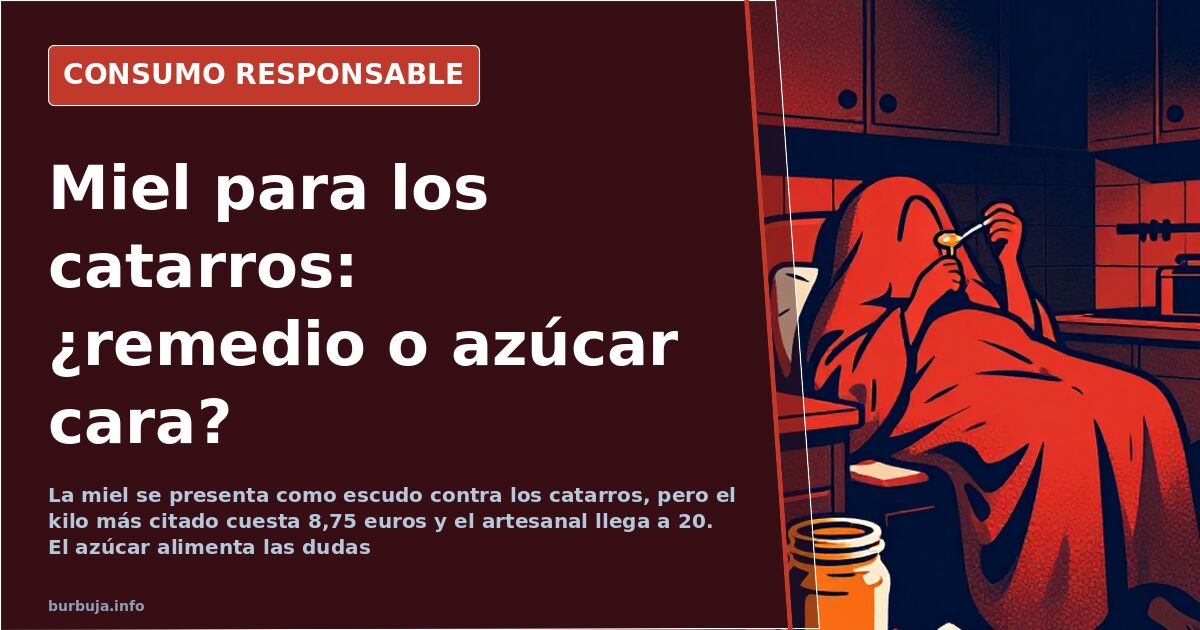
Honey against colds: sugar at €20 or true remedy?
With the cold comes a stuffy nose and, with it, the seasonal prophecy: whoever starts these days with nasal congestion will end up allergic, and honey prevents it. The recommendation circulates from neighbor to neighbor, without any study to back it up. Those who have been taking it for years defend it with convert's faith; those who scrutinize it release the dry diagnosis: sugar with good press. In between remains a practical question, whether a daily spoonful serves any purpose or just sweetens winter.
Does honey prevent colds or is it just sugar?
The first block of answers places it among so-called superfoods, a category that also includes chocolate and tea. It is repeated that green tea with honey is a godsend and technical details are insisted upon: honey should not be heated, because above a certain temperature it stops being beneficial. No cooking with it or adding it to still-boiling infusions. The most repeated experience is that of someone who has spent winters mixing lemon juice, a spoonful of honey, and chopped garlic after dinner, while everyone around them chains endless flu seasons.
The objections, however, are not based on faith: they are accounting-based. Honey is sugar and little more, summarizes another part, which only recommends it when the throat already hurts, because it hydrates and soothes. As proof that the effect does not come from the jar, someone boasts of going almost fifteen years without catching a cold or infection and attributes it not to honey, but to gazpacho: five liters of homemade preparation that last three or four days and which they drink as breakfast.
How much does quality honey cost and why is it paid for?
Regarding prices, there are specific references. An Extremaduran brand sold online appears at €8.75 per kilo, with shipping from Badajoz, a figure that the person citing it considers reasonable for the quality attributed to the product. The other reference, artisanal, reaches €20 per kilo—via family members from Zamora—and this one is indeed discarded as expensive, although the accompanying argument is that a kilo lasts months and works out cheaper than sucrose and sweeteners. At a daily spoonful, the calculation stretches itself.
There lies the first deadlock. Nobody disputes the price; what is not sustained is the relationship between paying more and catching fewer colds. Expensive honey remains, in essence, sugar with traces.
Sugar syrup in the hive and the seal of authenticity
The analysis becomes complicated when the origin of the product enters the picture. It is said that many professionals feed hives with sugar syrup to keep them strong; if that is the only source, the resulting honey is, in the words of the message itself, sugar vomited from the bowels of a bee: technically honey, but chemical garbage. Hence the repeated conclusion: buy it directly from the beekeeper. From another angle, it is replied that the problem is not so much the syrup as the death of bees due to neonicotinoid insecticides, which leaves supermarket shelves full of sugar disguised as golden comb.
Against that narrative rises the voice of someone managing forty hives: not all beekeeping goes to pollinate sunflower or rapeseed. There are those who install hives in mountains and forests to obtain honey, pollen, and propolis, precisely to distance them from phytosanitary products. Another warning, to deactivate a myth: crystallized honey does not miccionan it is purer, only that it has crystallized.
Garlic, ginger, lemon, and black cumin: the growing medicine cabinet
As the conversation pogre, honey ceases to be the protagonist. Raw ginger is postulated as a solution for almost everything—colds, oral herpes, canker sores—with the warning that it should not go through the infusion, and with the counter-warning of someone who ruined a vegetable puree by adding too much. Garlic and lemon are escorted by old proverbs about wine and vipers, and a morning potion appears with warm water, half a lemon, a teaspoon of honey, cinnamon, and olive oil. All this alongside the advice to let yourself get a bit cold: lower heating to 17 degrees and walk outdoors.
Black seed oil, or nigella sativa, also emerges, presented as an antihistamine for €18 per liter on an online sales platform—although the price has doubled, it is warned—, supported by a tradition that describes it as a cure for everything except death. None of this has a clinical trial in the available material. And it is worth saying: the mention of chlorine dioxide appearing in the conversation is not backed by any health authority.
The stalemate: nobody has the data
After hundreds of responses, the initial question remains unanswered by its own merits: whether those who consume honey catch fewer colds. There is no study, only personal experience, prices, and recipes. The two currents have not moved a millimeter and the issue stays exactly where it started, with a jar of honey on the table and a convinced neighbor.
With the cold comes a stuffy nose and, with it, the seasonal prophecy: whoever starts these days with nasal congestion will end up allergic, and honey prevents it. The recommendation circulates from neighbor to neighbor, without any study to back it up. Those who have been taking it for years defend it with convert's faith; those who scrutinize it release the dry diagnosis: sugar with good press. In between remains a practical question, whether a daily spoonful serves any purpose or just sweetens winter.
Does honey prevent colds or is it just sugar?
The first block of answers places it among so-called superfoods, a category that also includes chocolate and tea. It is repeated that green tea with honey is a godsend and technical details are insisted upon: honey should not be heated, because above a certain temperature it stops being beneficial. No cooking with it or adding it to still-boiling infusions. The most repeated experience is that of someone who has spent winters mixing lemon juice, a spoonful of honey, and chopped garlic after dinner, while everyone around them chains endless flu seasons.
The objections, however, are not based on faith: they are accounting-based. Honey is sugar and little more, summarizes another part, which only recommends it when the throat already hurts, because it hydrates and soothes. As proof that the effect does not come from the jar, someone boasts of going almost fifteen years without catching a cold or infection and attributes it not to honey, but to gazpacho: five liters of homemade preparation that last three or four days and which they drink as breakfast.
How much does quality honey cost and why is it paid for?
Regarding prices, there are specific references. An Extremaduran brand sold online appears at €8.75 per kilo, with shipping from Badajoz, a figure that the person citing it considers reasonable for the quality attributed to the product. The other reference, artisanal, reaches €20 per kilo—via family members from Zamora—and this one is indeed discarded as expensive, although the accompanying argument is that a kilo lasts months and works out cheaper than sucrose and sweeteners. At a daily spoonful, the calculation stretches itself.
There lies the first deadlock. Nobody disputes the price; what is not sustained is the relationship between paying more and catching fewer colds. Expensive honey remains, in essence, sugar with traces.
Sugar syrup in the hive and the seal of authenticity
The analysis becomes complicated when the origin of the product enters the picture. It is said that many professionals feed hives with sugar syrup to keep them strong; if that is the only source, the resulting honey is, in the words of the message itself, sugar vomited from the bowels of a bee: technically honey, but chemical garbage. Hence the repeated conclusion: buy it directly from the beekeeper. From another angle, it is replied that the problem is not so much the syrup as the death of bees due to neonicotinoid insecticides, which leaves supermarket shelves full of sugar disguised as golden comb.
Against that narrative rises the voice of someone managing forty hives: not all beekeeping goes to pollinate sunflower or rapeseed. There are those who install hives in mountains and forests to obtain honey, pollen, and propolis, precisely to distance them from phytosanitary products. Another warning, to deactivate a myth: crystallized honey does not miccionan it is purer, only that it has crystallized.
Garlic, ginger, lemon, and black cumin: the growing medicine cabinet
As the conversation pogre, honey ceases to be the protagonist. Raw ginger is postulated as a solution for almost everything—colds, oral herpes, canker sores—with the warning that it should not go through the infusion, and with the counter-warning of someone who ruined a vegetable puree by adding too much. Garlic and lemon are escorted by old proverbs about wine and vipers, and a morning potion appears with warm water, half a lemon, a teaspoon of honey, cinnamon, and olive oil. All this alongside the advice to let yourself get a bit cold: lower heating to 17 degrees and walk outdoors.
Black seed oil, or nigella sativa, also emerges, presented as an antihistamine for €18 per liter on an online sales platform—although the price has doubled, it is warned—, supported by a tradition that describes it as a cure for everything except death. None of this has a clinical trial in the available material. And it is worth saying: the mention of chlorine dioxide appearing in the conversation is not backed by any health authority.
The stalemate: nobody has the data
After hundreds of responses, the initial question remains unanswered by its own merits: whether those who consume honey catch fewer colds. There is no study, only personal experience, prices, and recipes. The two currents have not moved a millimeter and the issue stays exactly where it started, with a jar of honey on the table and a convinced neighbor.
Also available in: Deutsch
Summary of a discussion on Burbuja.info - Foro de economía, actualidad y política., translated from Spanish and reviewed before publication. Read the full discussion (147 replies).
More summaries
-
Stuck Faucet Eccentric: Limescale, Hemp, and DIY Fixes
A faucet eccentric stuck by decades of limescale and hemp. Discover which remedies work (vinegar, torch, wrench) and when to call a plumber.
-
Kitchen renovation costs in Spain: €13,700 to €16,200
Three quotes for a 12m² kitchen range from €13,700 to €16,200 excluding floors and tiles. Users compare this to a 2019 renovation that cost half as much.
-
EV winter consumption hits 24 kWh/100km at 2°C
Cold weather pushes EV consumption to 24 kWh/100km, while public charging costs up to €0.70/kWh erode savings.
-
Amazon turns your Kindle library into a rental service
Amazon can remove purchased Kindle e-books: users pay for licenses, not files. Calibre and airplane mode usage is rising.
-
Drill, acid or hammer: how to destroy an old phone
Factory reset removes encryption keys, but many use drills, acid or torches to ensure no data recovery.
-
Digi Spain: Cheap Fiber, Strained Mobile Network, Default CG-NAT
Digi's fiber works well and costs from €13/month, but mobile coverage is saturated and CG-NAT requires paying an extra €1 for a public IP.