
Homemade pizza: electricity costs 40 cents, not 8 euros
An oven uses 1.5-2.5 kWh per hour: 30 to 50 cents, not 8 euros. What makes homemade pizza expensive is the ingredients and the dough, not the electricity.
English · Original discussion in Spanish · Published
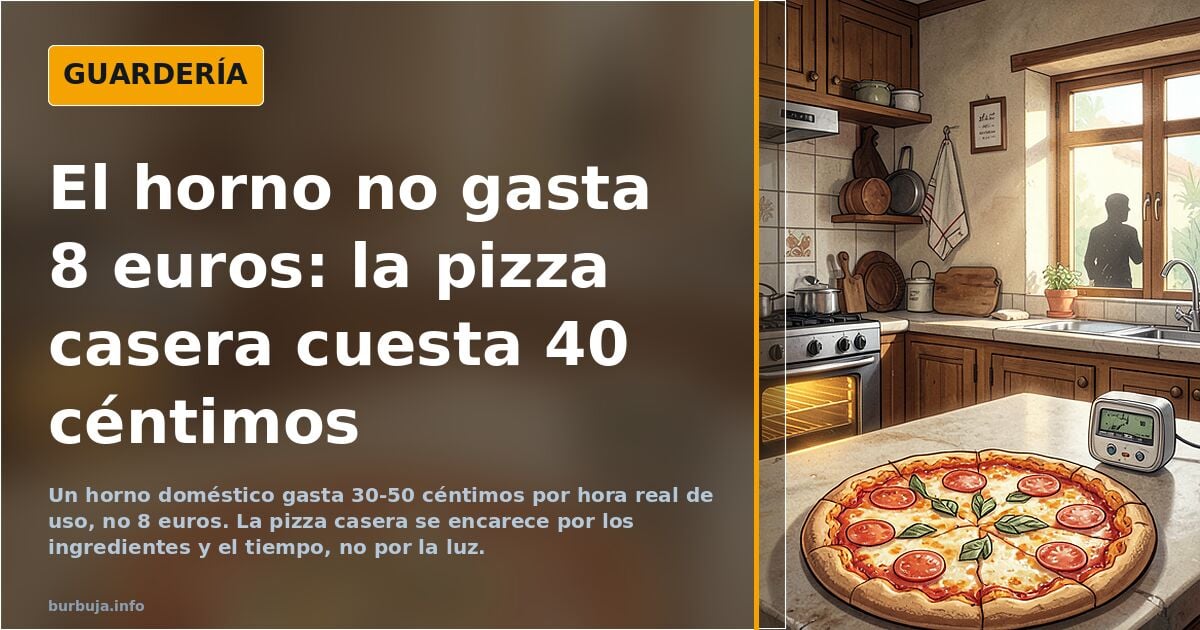
Homemade pizza doesn't cost 8 euros in electricity: it costs less than 50 cents
Running a home oven for an hour ruins nobody. The belief that making pizza at home sends the electricity bill soaring to 8 euros is the starting point of a discussion that, within minutes, drifts toward what really makes the project expensive: the flour, the mozzarella and the tomatoes. According to a calculation circulating in the thread, with a 2-3 kW oven that the thermostat keeps switching on and off, consumption stays around 1.5-2.5 kWh per hour of actual use. At normal electricity prices, between 0.15 and 0.20 euros per kWh, that comes to 30-50 cents. To reach 8 euros, you would have to run the oven at full blast for more than a day straight.
How much an oven really uses to make pizza
Rated power is not the same as continuous consumption. An oven advertised at 2,500 watts doesn't draw that throughout the whole bake: it reaches temperature, the thermostat cuts out, then it switches back on. That's why a real hour of baking comes in at those 1.5-2.5 kWh. Some go further and quote 2.15 kWh for baking bread at 250 °C, a figure consistent with the range above. The final price depends on your tariff and time of day, but the order of magnitude doesn't budge.
The figure dismantles the intuition that cooking at home is an electrical luxury. Time is another matter: two hours of oven time is enough to bake 20 kilos of bread, according to one of the calculations doing the rounds, which reopens the debate in terms of household value for money rather than the bill.
The expense that does matter: ingredients and dough
The conversation quickly shifts from the kWh to the pantry. Real mozzarella, strong flour and good tomatoes are what push the cost per pizza far above the electricity. The reference that keeps coming up is the Neapolitan one: Caputo for the flour, fior di latte and San Marzano for the rest. Against that, the shortcut of tinned tomato and cheap processed cheese brings the whole thing down in price and drags the result down with it.
The dough is the other battleground. Kneading by hand is championed as the traditional method against the convenience of the stand mixer, and some predict a robot will eventually do it all. The discussion about the home oven's finish — whether the top browns or not — leads to the frying pan solution: a non-stick griddle over medium heat for half a minute, then into the oven at 200 °C for about five minutes, no plastic handles.
Yes, I made: English gets debated too
The detour comes when someone shows off having made the pizza in English and the grammar goes up in flames. Yes, I made without an object doesn't hold up: either yes, I did, or yes, I made it. The correction triggers an improvised grammar lesson nobody asked for, which, along the way, leaves the impression that people hold themselves to higher standards with the verb than with the dough.
What really makes homemade pizza expensive
Between the oven and the taxes, the joke writes itself. The electricity cost is marginal; the taxman is unavoidable. The conclusion that emerges is uncomfortable for the household-savings narrative: making pizza at home is expensive because of the raw materials and the time, not the meter. And yet, the full calculation of what each pizza costs — dough, fermentation, ingredients and baking — yields a figure that surprises anyone who only looks at the electricity bill.
One doubt remains: can a home oven compete with a wood-fired one? The answer, going by the thread, is that it gets close with a stone or steel preheated to the max, not by leaving the oven on longer. Electricity was never the problem.
Also available in: Deutsch
Summary of a discussion on Burbuja.info - Foro de economía, actualidad y política., translated from Spanish and reviewed before publication. Read the full discussion (45 replies).
More summaries
-
The Power of Love. PSOE
A tweet from StopAbolición uses the slogan "The Power of Love. PSOE" to criticise Spain's trans law and the abolition of prostitution. Here is the context.
-
Tempe police review use of force against ASU student Eryn Bonner
Tempe police are reviewing an incident involving ASU student Eryn Bonner, who was tackled to the ground on July 19. She faces two misdemeanor charges.
-
Forum user claims to lose 14 kilos in two months on keto diet
An internet user claims to have lost 14 kilos in two months on a ketogenic diet and intermittent fasting, starting from 207 kilos. The debate over whether it's possible and…
-
James Wallestein's Shift to Patreon: Passion or Survival Strategy?
Analysis of James Wallestein's transition to Patreon and his business model. Is it passion or a survival strategy?
-
E.T., tears and nostalgia: why Spielberg's film still divides audiences
Do you cry at E.T.? The debate over whether the emotion comes from Spielberg, from John Williams, or from the nostalgia of a generation that grew up with Alien.
-
Black Mirror remake set in Spain: dystopia, AI and political satire
A Spanish dystopian script set in 2030 and the possibility of producing original series with AI: political satire moves into the living room.