
Homemade bread fails due to time, not flour
Homemade bread is cheap and superior to industrial loaves, but requires hours of baking that few are willing to invest.
English · Original discussion in Spanish · Published
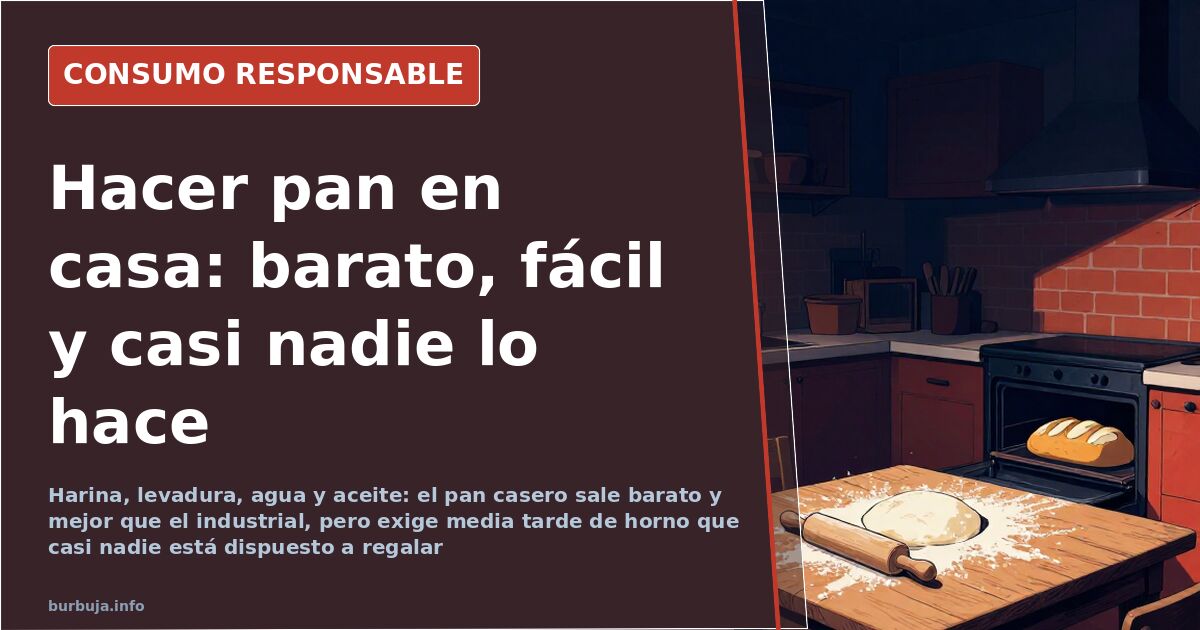
Why almost no one bakes bread at home despite low costs
Why don't people bake their own bread? The short answer: because they don't have to. Flour, fresh yeast, water, and extra virgin olive oil. Double fermentation and half an hour in the oven. With these four ingredients and some patience, you get a flat loaf with little crumb that, depending on who kneads it, rates "5 out of 10" compared to any neighborhood bakery. The problem isn't the recipe. It's everything else.
The discussion starts with an aggressive thesis: industrial bread is "all filler," a product bought out of habit. From there, the issue opens up into three rarely mixed fronts: time, money, and health.
What it really costs to make bread at home
The calculations in the conversation aren't what those looking to save expect. A repeatedly shared recipe: 350 grams of regular flour, 8 grams of fresh yeast, 300 milliliters of water, and salt to taste. Kneading, two hours of resting with handling every 30 minutes, an oven preheated to about 180 degrees, and 35 to 40 minutes of baking, with a glass of water in a tray to generate steam. Total: half an afternoon.
The cost per loaf is ridiculous. The opportunity cost is not. And here appears the argument dominating the thread: the alternative in Spain is a hearty village loaf for about €2.50 that lasts three days. Competing against that with your home oven is difficult. Electricity, time, and margin for error work against you.
Some go further, arguing the calculation isn't economic but sanitary. The repeated idea: many people think they have gas, constipation, or intolerances when in reality they've been eating chemically fermented breads rushed to market for years, instead of traditional natural fermentation. This is a hypothesis circulating without backing in the conversation, but it explains why the topic stirs such passion.
The bread maker and the shortcut that doesn't convince
The technological solution has defenders and detractors. A bread maker allows dough ready in five minutes: 400 grams of flour, 300 milliliters of water, yeast, salt, sugar to taste, a splash of oil, and press the button. The problem, according to those who have used it, is the result: a sandwich loaf without alveolar crumb, a "dud." Others also warn that the container is often coated with Teflon, which they consider unhealthy, and recommend the conventional oven.
Learning has a toll that almost no one mentions initially. Before nailing the recipe, you have to eat under-risen breads, with crust hard as stone, bland, oversalted, burnt, or raw. Hours and money invested in mastering something that, admit home bakers themselves, doesn't become a daily habit because it's a hassle.
Gluten, modern wheat, and the intolerance business
The most controversial part is gluten. One school argues humanity has eaten bread for 14,000 years and intolerance cases have surged in the last 50, attributing this to changes in raw materials and production methods, not a celiac epidemic. Another goes further, claiming current wheat is genetically modified, that ancient wheat had less gluten, and that human selection has multiplied a protein that doesn't digest well.
It's worth separating data from narrative. That wheat has been selected for more gluten is one thing; that this alone explains the rise in diagnoses is another, and there is no proof in the conversation supporting it. What does appear is an experience with a continuous glucose monitor: none of the tested breads, supermarket or bakery, keep glucose stable. The closest, always according to that testimony, is a store-brand wholemeal "champion" type bread, and even then within tolerable limits. The conclusion of the measurer: bread is a danger, both in calories and glucose, and better controlled at home.
Bread that isn't bread and the protein alternative
The conversation drifts toward substitutes. Broccoli bread, protein bread, chickpea bread, doughs without wheat flour. The underlying idea is that a revolution is pending in alternative breads, but the problem is always the same: if it doesn't contain gluten, it doesn't rise the same way. Buckwheat appears as an unfinished subject. And chickpea bread, which is indeed high-protein, has a side effect no one dares describe in detail.
Meanwhile, the underlying complaint repeats: in modern diets, no one eats legumes or bread, but egg and cheese crêpes, zucchini sandwiches, and oat flour inventions that look easy in videos but end up burnt outside and raw inside at home. The logical question: if eating without flours or sugars is so trendy, why isn't there a chain doing it well and at a reasonable price?
In the end, the answer to the initial question is uncomfortable: making bread at home is easy, cheap, and better than almost anything sold. And yet almost no one does it. Not out of ignorance, nor lack of recipes, but because after working twelve hours, the temptation of prepared food and the couch is impossible to overcome. Homemade bread doesn't compete against industrial bread. It competes against fatigue.
Why don't people bake their own bread? The short answer: because they don't have to. Flour, fresh yeast, water, and extra virgin olive oil. Double fermentation and half an hour in the oven. With these four ingredients and some patience, you get a flat loaf with little crumb that, depending on who kneads it, rates "5 out of 10" compared to any neighborhood bakery. The problem isn't the recipe. It's everything else.
The discussion starts with an aggressive thesis: industrial bread is "all filler," a product bought out of habit. From there, the issue opens up into three rarely mixed fronts: time, money, and health.
What it really costs to make bread at home
The calculations in the conversation aren't what those looking to save expect. A repeatedly shared recipe: 350 grams of regular flour, 8 grams of fresh yeast, 300 milliliters of water, and salt to taste. Kneading, two hours of resting with handling every 30 minutes, an oven preheated to about 180 degrees, and 35 to 40 minutes of baking, with a glass of water in a tray to generate steam. Total: half an afternoon.
The cost per loaf is ridiculous. The opportunity cost is not. And here appears the argument dominating the thread: the alternative in Spain is a hearty village loaf for about €2.50 that lasts three days. Competing against that with your home oven is difficult. Electricity, time, and margin for error work against you.
Some go further, arguing the calculation isn't economic but sanitary. The repeated idea: many people think they have gas, constipation, or intolerances when in reality they've been eating chemically fermented breads rushed to market for years, instead of traditional natural fermentation. This is a hypothesis circulating without backing in the conversation, but it explains why the topic stirs such passion.
The bread maker and the shortcut that doesn't convince
The technological solution has defenders and detractors. A bread maker allows dough ready in five minutes: 400 grams of flour, 300 milliliters of water, yeast, salt, sugar to taste, a splash of oil, and press the button. The problem, according to those who have used it, is the result: a sandwich loaf without alveolar crumb, a "dud." Others also warn that the container is often coated with Teflon, which they consider unhealthy, and recommend the conventional oven.
Learning has a toll that almost no one mentions initially. Before nailing the recipe, you have to eat under-risen breads, with crust hard as stone, bland, oversalted, burnt, or raw. Hours and money invested in mastering something that, admit home bakers themselves, doesn't become a daily habit because it's a hassle.
Gluten, modern wheat, and the intolerance business
The most controversial part is gluten. One school argues humanity has eaten bread for 14,000 years and intolerance cases have surged in the last 50, attributing this to changes in raw materials and production methods, not a celiac epidemic. Another goes further, claiming current wheat is genetically modified, that ancient wheat had less gluten, and that human selection has multiplied a protein that doesn't digest well.
It's worth separating data from narrative. That wheat has been selected for more gluten is one thing; that this alone explains the rise in diagnoses is another, and there is no proof in the conversation supporting it. What does appear is an experience with a continuous glucose monitor: none of the tested breads, supermarket or bakery, keep glucose stable. The closest, always according to that testimony, is a store-brand wholemeal "champion" type bread, and even then within tolerable limits. The conclusion of the measurer: bread is a danger, both in calories and glucose, and better controlled at home.
Bread that isn't bread and the protein alternative
The conversation drifts toward substitutes. Broccoli bread, protein bread, chickpea bread, doughs without wheat flour. The underlying idea is that a revolution is pending in alternative breads, but the problem is always the same: if it doesn't contain gluten, it doesn't rise the same way. Buckwheat appears as an unfinished subject. And chickpea bread, which is indeed high-protein, has a side effect no one dares describe in detail.
Meanwhile, the underlying complaint repeats: in modern diets, no one eats legumes or bread, but egg and cheese crêpes, zucchini sandwiches, and oat flour inventions that look easy in videos but end up burnt outside and raw inside at home. The logical question: if eating without flours or sugars is so trendy, why isn't there a chain doing it well and at a reasonable price?
In the end, the answer to the initial question is uncomfortable: making bread at home is easy, cheap, and better than almost anything sold. And yet almost no one does it. Not out of ignorance, nor lack of recipes, but because after working twelve hours, the temptation of prepared food and the couch is impossible to overcome. Homemade bread doesn't compete against industrial bread. It competes against fatigue.
Also available in: Deutsch
Summary of a discussion on Burbuja.info - Foro de economía, actualidad y política., translated from Spanish and reviewed before publication. Read the full discussion (147 replies).
More summaries
-
Lidl's frozen sardines at €3.90/kg vs. fresh ones
A kilo of frozen sardines costs €3.90 compared to €9-€10 for fresh ones in Madrid. The question is whether the flavor holds up after freezing.
-
Carvajal's gluten-free diet: Modern wheat under suspicion
Real Madrid's Carvajal credits a gluten-free diet for his recovery. Experts debate modern wheat and non-celiac sensitivity.
-
Ozempic and Mounjaro: FDA black box warning issued
FDA issues black box warning for Ozempic and Mounjaro regarding thyroid tumor risks. Analysis of weight regain, side effects, and natural alternatives.
-
Hitting a careless pedestrian in Spain: the driver is almost always liable
A motorcyclist at 20 km/h hits a pedestrian who crossed improperly. Spanish civil liability law almost always blames the vehicle: he will have to file a report to get paid.
-
Cutting spending by 3%: the rope snaps
Cutting spending by 3% is no longer about tricks: with groceries, electricity and the car already at a minimum, the margin is gone and the cuts end up hitting local shops.
-
Products that last decades: the price-per-day ratio that debunks built-in obsolescence
A pair of £60 jeans worn 500 times works out at 0.12 pence a day. The price-per-day ratio dismantles the idea that everything is designed to die.