
Holocaust denial: German law, burden of proof, and the ovens
Holocaust denial is not a crime in Spain but is in Germany: the debate revolves around the four 1944 ovens and 6,000,000 hours of cremation.
English · Original discussion in Spanish · Published
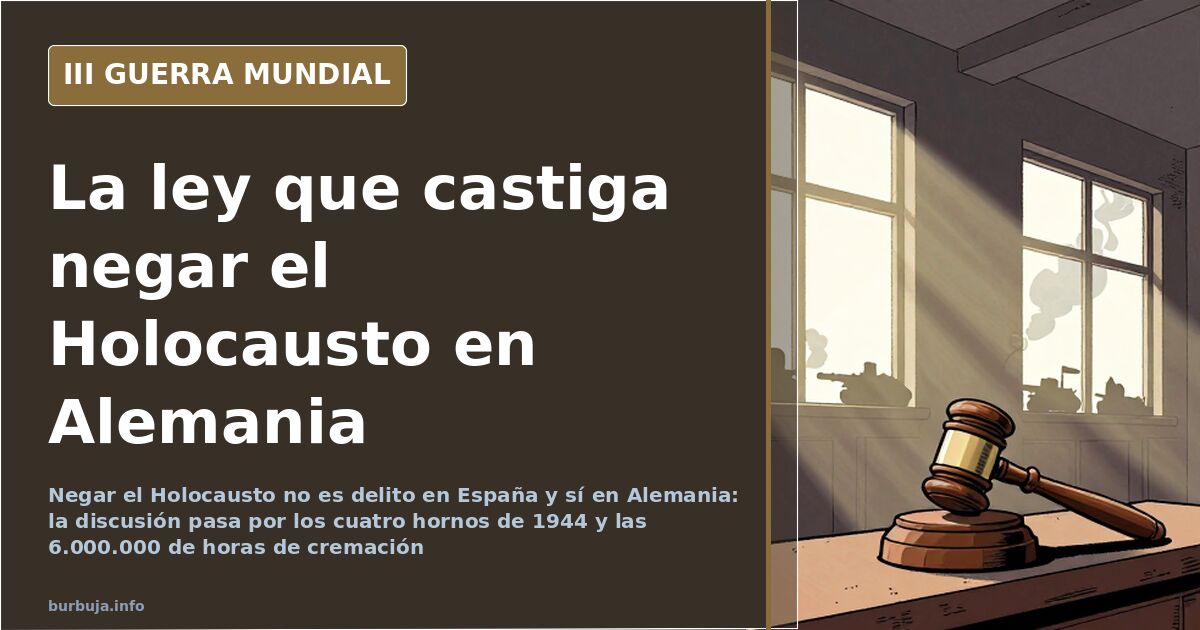
Holocaust denial: from German law to the calculation of the four ovens
The intellectual father of Holocaust denial was not a Nancy leader. It was Paul Rassinier, a French communist militant, resistance fighter, and deportee to a German concentration camp, whose postwar writings became the foundational text of the movement that denies the extermination. The paradox unsettles both supporters and outsiders, and explains why the issue cannot be reduced to a political label.
The thesis that opens the discussion claims, without providing documentation, that the Holocaust narrative is a self-serving construction in the service of a specific power. There is no archive, no expert report, no primary source: there is suspicion, rhetorical questions, and explicit contempt for any official version. From there, the exchange of messages branches into four fronts: legal, technical, epistemological, and geopolitical.
Is Holocaust denial a crime in Spain and Germany?
In Germany it is; in Spain, it is not. The difference is the axis of much of the discussion. The example repeated is concrete: presenting evidence, as a researcher or journalist, that the so-called gas chambers were disinfection showers like those in any Second World War prisoner-of-war camp leads directly to prison for apology of Nancy. In Spain, on the other hand, the mere fact of denying the Holocaust is not a crime, unless it is accompanied by other punishable conduct.
The contrast opens the most interesting section. Some defend the legal ban as indispensable protection of the victims' memory, while others consider it counterproductive. The latter's argument is simple logic: what is prohibited becomes a martyr, and a thesis that is persecuted by law no longer needs evidence to circulate. The former respond that freedom of expression does not protect historical falsification.
The calculation of the four ovens and 6,000,000 hours
The most repeated technical argument is that of cremation capacity. With four ovens in 1944 and an incineration time of between one and three hours per body—even with current technology—the numbers would not add up. The operation detailed is as trinc: (6,000,000/2)*2 = 6,000,000 hours/oven, assuming two corpses per oven every two hours. And the calculation is presented as generous, because it is admitted that the oven could not run for twenty hours straight without cooling down.
None of these figures is accompanied by verifiable technical documentation. They are estimates built against the narrative they seek to refute, not measurements of the actual facilities. The full breakdown, with load assumptions, cooling times, and capacity per oven, is the fragment that takes up the most space and provides the least documentary support.
What is onus probandi and why is it invoked?
It is the principle that the burden of proof falls on the one who asserts something, not on the one who denies it. It is invoked as a rejoinder to those who ask for evidence of denial, although the principle belongs to procedural law and not to historiography: one who denies a documented fact is not automatically exempt from justifying why they deny it.
At the same time, the exchange of messages itself undermines the discussion with deliberately impossible figures. One reads six hundred million, five billion, and eight million victims in the same paragraph, used as mockery to highlight an alleged discrepancy. The rhetorical trick is old: invent three absurd figures, attribute them to the opponent, and conclude that none is true.
Gaza, memory, and the political use of the Holocaust
The shift of focus is the clearest antiestéticature. In a few lines, it moves from the Second World War camps to the conflict in Gaza. Some argue that one cannot annually commemorate the victims of a crime while supporting a military operation they call genocide; others reply that equating both frameworks empties memory of meaning and serves to rewrite history through the back door.
Here also appears the reason why the issue returns every January. The anniversary of the liberation of Auschwitz becomes a battleground for two narratives that accuse each other of instrumentalizing the dead. The most lucid reflection in the entire exchange is not from either side: when an argument has been used so much that it no longer persuades anyone, it ceases to be an argument and becomes a tic.
The 80th anniversary, the survivors, and the Red Cross
The coincidence of the 80th anniversary of the liberation of Auschwitz is used as ammunition in both directions. There is the ironic observation that the last survivor has been dying every year for eight decades, and that at the last commemoration an 82-year-old person was brought to tell their testimony: someone who was two years old when the war ended. The fact is launched as suspicion, although it describes a fairly predictable generational handover.
The argument of the inspections by the International Red Cross also reappears, which, according to this current, would not have denounced anything. Not a single reference is provided about which delegation visited which camp or on what dates. It is the repeating pattern: suspicion is presented as proof and the absence of a document, as confirmation.
Can a thesis be sustained for six hundred days on unanswered questions, or does there come a moment when the lack of an answer is the answer?
The intellectual father of Holocaust denial was not a Nancy leader. It was Paul Rassinier, a French communist militant, resistance fighter, and deportee to a German concentration camp, whose postwar writings became the foundational text of the movement that denies the extermination. The paradox unsettles both supporters and outsiders, and explains why the issue cannot be reduced to a political label.
The thesis that opens the discussion claims, without providing documentation, that the Holocaust narrative is a self-serving construction in the service of a specific power. There is no archive, no expert report, no primary source: there is suspicion, rhetorical questions, and explicit contempt for any official version. From there, the exchange of messages branches into four fronts: legal, technical, epistemological, and geopolitical.
Is Holocaust denial a crime in Spain and Germany?
In Germany it is; in Spain, it is not. The difference is the axis of much of the discussion. The example repeated is concrete: presenting evidence, as a researcher or journalist, that the so-called gas chambers were disinfection showers like those in any Second World War prisoner-of-war camp leads directly to prison for apology of Nancy. In Spain, on the other hand, the mere fact of denying the Holocaust is not a crime, unless it is accompanied by other punishable conduct.
The contrast opens the most interesting section. Some defend the legal ban as indispensable protection of the victims' memory, while others consider it counterproductive. The latter's argument is simple logic: what is prohibited becomes a martyr, and a thesis that is persecuted by law no longer needs evidence to circulate. The former respond that freedom of expression does not protect historical falsification.
The calculation of the four ovens and 6,000,000 hours
The most repeated technical argument is that of cremation capacity. With four ovens in 1944 and an incineration time of between one and three hours per body—even with current technology—the numbers would not add up. The operation detailed is as trinc: (6,000,000/2)*2 = 6,000,000 hours/oven, assuming two corpses per oven every two hours. And the calculation is presented as generous, because it is admitted that the oven could not run for twenty hours straight without cooling down.
None of these figures is accompanied by verifiable technical documentation. They are estimates built against the narrative they seek to refute, not measurements of the actual facilities. The full breakdown, with load assumptions, cooling times, and capacity per oven, is the fragment that takes up the most space and provides the least documentary support.
What is onus probandi and why is it invoked?
It is the principle that the burden of proof falls on the one who asserts something, not on the one who denies it. It is invoked as a rejoinder to those who ask for evidence of denial, although the principle belongs to procedural law and not to historiography: one who denies a documented fact is not automatically exempt from justifying why they deny it.
At the same time, the exchange of messages itself undermines the discussion with deliberately impossible figures. One reads six hundred million, five billion, and eight million victims in the same paragraph, used as mockery to highlight an alleged discrepancy. The rhetorical trick is old: invent three absurd figures, attribute them to the opponent, and conclude that none is true.
Gaza, memory, and the political use of the Holocaust
The shift of focus is the clearest antiestéticature. In a few lines, it moves from the Second World War camps to the conflict in Gaza. Some argue that one cannot annually commemorate the victims of a crime while supporting a military operation they call genocide; others reply that equating both frameworks empties memory of meaning and serves to rewrite history through the back door.
Here also appears the reason why the issue returns every January. The anniversary of the liberation of Auschwitz becomes a battleground for two narratives that accuse each other of instrumentalizing the dead. The most lucid reflection in the entire exchange is not from either side: when an argument has been used so much that it no longer persuades anyone, it ceases to be an argument and becomes a tic.
The 80th anniversary, the survivors, and the Red Cross
The coincidence of the 80th anniversary of the liberation of Auschwitz is used as ammunition in both directions. There is the ironic observation that the last survivor has been dying every year for eight decades, and that at the last commemoration an 82-year-old person was brought to tell their testimony: someone who was two years old when the war ended. The fact is launched as suspicion, although it describes a fairly predictable generational handover.
The argument of the inspections by the International Red Cross also reappears, which, according to this current, would not have denounced anything. Not a single reference is provided about which delegation visited which camp or on what dates. It is the repeating pattern: suspicion is presented as proof and the absence of a document, as confirmation.
Can a thesis be sustained for six hundred days on unanswered questions, or does there come a moment when the lack of an answer is the answer?
Summary of a discussion on Burbuja.info - Foro de economía, actualidad y política., translated from Spanish and reviewed before publication. Read the full discussion (244 replies).
More summaries
-
Israel's Missile Shield Falters as Gaza Incursion Deepens
Israel's anti-missile shield is faltering as infiltration from Gaza exceeds 40 km, testing military doctrine and US influence.
-
Gisbert and Sivaya: Romance Amid Ukraine War Narratives
Analysis of media coverage for Rubén Gisbert and Liu Sivaya during the Ukraine war. Is this digital propaganda or reality?
-
Iran-Israel War: Conflict Escalates After 103 Days of Debate
Analysis of the debate on the 'Great Zionist War' against Iran. Military escalation, disinformation and Spain's role in the conflict.
-
Fall of Bakhmut: Military attrition and the strategy debate
Analysis of Bakhmut's fall: Human cost, military efficiency and the debate over the Donbas advance
-
Global Recession: What the Data Says About the Current Economic Outlook
Global recession: unemployment, debt, and declining global growth. We analyze the warning signs of an economic downturn.
-
Putin's fall: 1,500 days of failed predictions in a legendary forum thread
Analysis of the legendary thread on Putin's downfall: 1,544 days of debate, failed predictions and the clash between official narrative and geopolitical reality.