
Hoarding money without spending is as miserable as having none
A €15,000–€30,000 buffer ensures peace of mind; extreme savers who never spend share the same misery as those with no money.
English · Original discussion in Spanish · Published
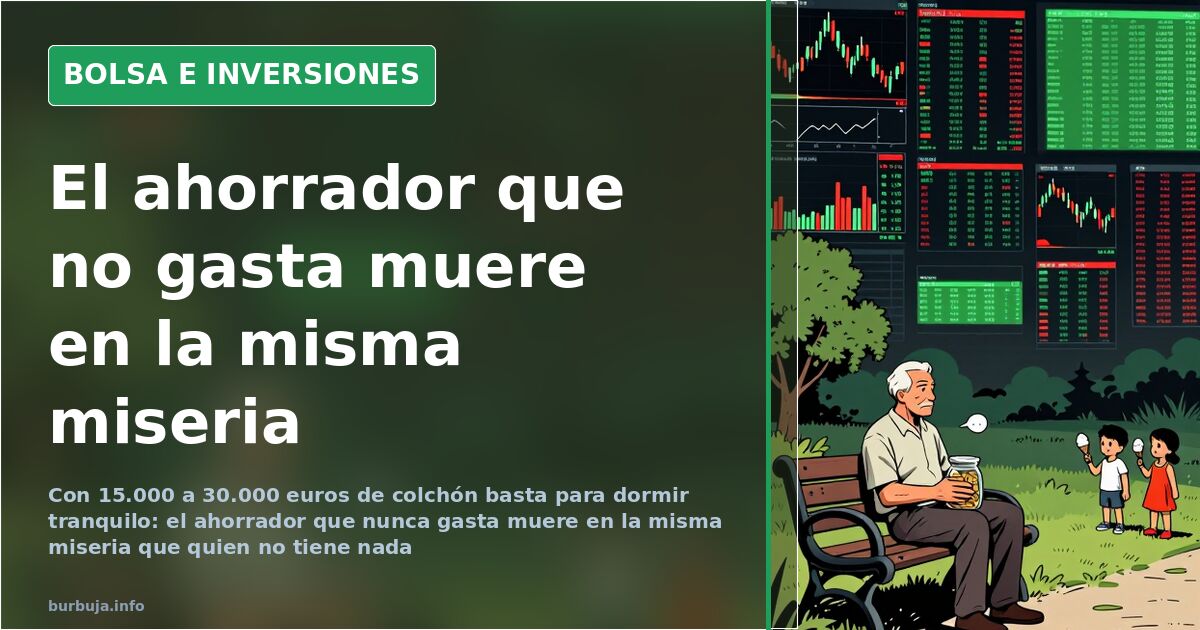
Saving without spending: The same misery as having nothing
Fifty thousand euros give or take. That is the margin which, according to the thesis that sparked this discussion, determines whether fighting for an investment is worth it or a waste of time. Those who die leaving an inheritance have made, the argument goes, a disastrous calculation regarding their ability to enjoy what they had. And the comparison thrown into the debate is clinical: the saver who can spend but doesn’t behaves like the person with anorexia who can eat but doesn’t. In both cases, accumulation—of money or kilos—stops being a means and becomes the end.
The first reaction was a joke: spend it all. The second was less funny: nobody is guaranteed to reach ninety. Everything that trinc moves between these two phrases.
How much savings do you need to sleep well?
Here numbers appeared, and they are the only concrete ones in the whole matter. With annual expenses of €15,000, a sensible range is €15,000 to €30,000 in the account: six months’ cushion is essential, one year desirable, eighteen months virtuous, and two years already excessive. In other words, the problem isn’t saving, it’s how much.
The portrait of the young saver was drawn by another case: gross income of €20,000 a year at age 24, fresh out of university, living with parents, no interest in partying, using a phone until it breaks, and three €100 jeans that last for years. Minimal spending, yes, but with criteria: paying for durability, not appearance. The lingering question is whether that austerity is a choice or antiestéticar.
Is extreme saving a psychological issue?
The core of the argument holds that being a saver is not a logical decision, but an emotional one. If people decided with reason, lotteries and reckless loans wouldn’t exist. First, the decision is made with the instinctive brain, and then the reasoning that justifies it is sought; this is called self-justification and it’s not a barroom invention.
The extreme example came from a domestic case: someone scolding their sister for throwing away a purchased glass of water because “it’s bought water and costs money.” Or the one who spends half an hour comparing a jar of olives that costs ten cents less. On the other end is someone who admits enjoying optimizing their finances to absurd limits and finding pleasure in it. The joy of optimization, they called it. Some find more satisfaction in a traffic-light-free commute than in any purchase.
The accusation takes a name: hamster syndrome. Accumulating endlessly, running on the wheel, saving for a surplus that will never be used.
The retiree who dies at 65 without collecting contributions
The hardest twist in the matter isn’t psychological, it’s arithmetic. The pension system, it is argued, works assuming many won’t live long enough to collect: it was designed for people to die at most five years after retirement, at age 70. With increased life expectancy, that assumption breaks. And the case of someone who contributes all their life and dies at 65 without ever starting their pension isn’t rare: there are many.
Regarding inheritance, the position is explicit: children receive money at a stage when they no longer need it, often fight over it, and part of it goes to taxes. The proposal launched is to distribute the inheritance while alive and aim to reach the grave with a zero balance. It doesn’t always work: some recovered a family member after months in a coma due to an aneurysm, with a nearly normal life afterwards, while many who talked about the funeral were already buried.
Peace of mind or quality of life?
One side responds with tranquility. Money in the account gives a peace that those living hand-to-mouth don’t have, and a €15,000 car provides the same service as a €30,000 one; a vacation in Spain for €1,000 is worth more than €3,000 at a resort. Spending a lot doesn’t buy happiness; lacking money when needed takes it all away. The most quoted punchline: if a bomb falls on the saver’s house and another on the spender’s, the spender will end up begging among the rubble.
The other side hits back with a dry phrase: between having no money and having money but not using it, the misery is the same. They add that someone with life resolved who finds nothing to spend on isn’t a virtuoso, but someone who doesn’t know what to do with their time.
Saving when money evaporates
Missing is the risk no one controls. A currency can deflate: with $20 someone felt rich in Venezuela not so long ago, and that purchasing power has disintegrated at an accelerated pace. Hence the warning: the more money saved, the more lost when disasters strike, and they always do.
Added to this is the old iron law of wages, that classical theory according to which real wages naturally tend toward the subsistence minimum: any increase above that level is eaten by population growth. With that outlook, saving isn’t cowardice, it’s anticipation.
How much to spend to die with a zero balance
The statistical counterargument exists: the rich live on average longer and healthier than the poor, so having a spare coat is a cheap insurance policy. Data suggests saving protects. The question is how much it protects and at what cost. With a cushion of six months to two years on the table, and a public system betting you won’t live to collect it, no one has yet put the exact figure separating prudence from pathology.
Disclaimer: This text is informative and does not constitute financial or tax advice.
Fifty thousand euros give or take. That is the margin which, according to the thesis that sparked this discussion, determines whether fighting for an investment is worth it or a waste of time. Those who die leaving an inheritance have made, the argument goes, a disastrous calculation regarding their ability to enjoy what they had. And the comparison thrown into the debate is clinical: the saver who can spend but doesn’t behaves like the person with anorexia who can eat but doesn’t. In both cases, accumulation—of money or kilos—stops being a means and becomes the end.
The first reaction was a joke: spend it all. The second was less funny: nobody is guaranteed to reach ninety. Everything that trinc moves between these two phrases.
How much savings do you need to sleep well?
Here numbers appeared, and they are the only concrete ones in the whole matter. With annual expenses of €15,000, a sensible range is €15,000 to €30,000 in the account: six months’ cushion is essential, one year desirable, eighteen months virtuous, and two years already excessive. In other words, the problem isn’t saving, it’s how much.
The portrait of the young saver was drawn by another case: gross income of €20,000 a year at age 24, fresh out of university, living with parents, no interest in partying, using a phone until it breaks, and three €100 jeans that last for years. Minimal spending, yes, but with criteria: paying for durability, not appearance. The lingering question is whether that austerity is a choice or antiestéticar.
Is extreme saving a psychological issue?
The core of the argument holds that being a saver is not a logical decision, but an emotional one. If people decided with reason, lotteries and reckless loans wouldn’t exist. First, the decision is made with the instinctive brain, and then the reasoning that justifies it is sought; this is called self-justification and it’s not a barroom invention.
The extreme example came from a domestic case: someone scolding their sister for throwing away a purchased glass of water because “it’s bought water and costs money.” Or the one who spends half an hour comparing a jar of olives that costs ten cents less. On the other end is someone who admits enjoying optimizing their finances to absurd limits and finding pleasure in it. The joy of optimization, they called it. Some find more satisfaction in a traffic-light-free commute than in any purchase.
The accusation takes a name: hamster syndrome. Accumulating endlessly, running on the wheel, saving for a surplus that will never be used.
The retiree who dies at 65 without collecting contributions
The hardest twist in the matter isn’t psychological, it’s arithmetic. The pension system, it is argued, works assuming many won’t live long enough to collect: it was designed for people to die at most five years after retirement, at age 70. With increased life expectancy, that assumption breaks. And the case of someone who contributes all their life and dies at 65 without ever starting their pension isn’t rare: there are many.
Regarding inheritance, the position is explicit: children receive money at a stage when they no longer need it, often fight over it, and part of it goes to taxes. The proposal launched is to distribute the inheritance while alive and aim to reach the grave with a zero balance. It doesn’t always work: some recovered a family member after months in a coma due to an aneurysm, with a nearly normal life afterwards, while many who talked about the funeral were already buried.
Peace of mind or quality of life?
One side responds with tranquility. Money in the account gives a peace that those living hand-to-mouth don’t have, and a €15,000 car provides the same service as a €30,000 one; a vacation in Spain for €1,000 is worth more than €3,000 at a resort. Spending a lot doesn’t buy happiness; lacking money when needed takes it all away. The most quoted punchline: if a bomb falls on the saver’s house and another on the spender’s, the spender will end up begging among the rubble.
The other side hits back with a dry phrase: between having no money and having money but not using it, the misery is the same. They add that someone with life resolved who finds nothing to spend on isn’t a virtuoso, but someone who doesn’t know what to do with their time.
Saving when money evaporates
Missing is the risk no one controls. A currency can deflate: with $20 someone felt rich in Venezuela not so long ago, and that purchasing power has disintegrated at an accelerated pace. Hence the warning: the more money saved, the more lost when disasters strike, and they always do.
Added to this is the old iron law of wages, that classical theory according to which real wages naturally tend toward the subsistence minimum: any increase above that level is eaten by population growth. With that outlook, saving isn’t cowardice, it’s anticipation.
How much to spend to die with a zero balance
The statistical counterargument exists: the rich live on average longer and healthier than the poor, so having a spare coat is a cheap insurance policy. Data suggests saving protects. The question is how much it protects and at what cost. With a cushion of six months to two years on the table, and a public system betting you won’t live to collect it, no one has yet put the exact figure separating prudence from pathology.
Disclaimer: This text is informative and does not constitute financial or tax advice.
Summary of a discussion on Burbuja.info - Foro de economía, actualidad y política., translated from Spanish and reviewed before publication. Read the full discussion (205 replies).
More summaries
-
Homemaker: £200 monthly savings with dual incomes
A calculation claims £200 monthly savings from dual incomes; a homemaker highlights the risks to assets and pension.
-
Gold at €4,500: Does it Really Protect Savings?
Gold hovers around €4,500 per ounce after a flat quarter, with silver nearing $90. Does the metal truly safeguard savings?
-
Oil prices crash to minus $37: why the easy trade failed
Crude oil prices swung from $30 to $39 and even hit negative territory. Contango, CFDs, and fees explain why this easy bet went wrong.
-
Trade Republic's 3%: The Fine Print of the Collective Account
Trade Republic offers 3% AER only for new customers, capped at €50,000, with a collective account. Bankinter, Openbank, and Santander are countering.
-
War Preparedness: Cash, Gold, and Escape Plans
Forum debate on protecting assets and life during war: cash limits, gold, Bitcoin, and exit strategies before borders close.
-
Investor dumps portfolio, reinvests 92% in inflation bonds
An individual sold all assets except one stock, moving 92% into inflation-linked bonds and commodities while keeping 8% cash.