
Harvard Professor Claims UFOs Are Already Here
A Harvard professor argues UFOs are present, sparking reactions ranging from psy-op accusations to global government fears.
English · Original discussion in Spanish · Published
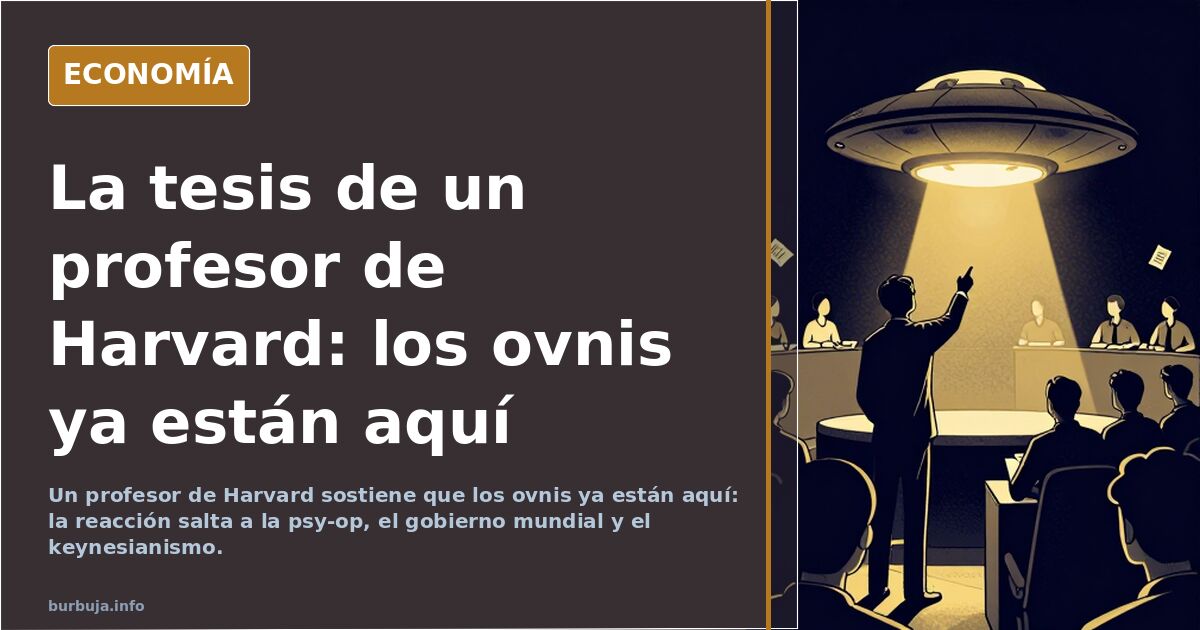
Harvard Professor Argues UFOs Have Arrived
The cost of seeing the word Harvard in a headline is well known: it sells itself, not always for good reasons. The latest instance involves something that sounds like a B-movie script: a professor at that university, Avi, claims UFOs have reached Earth and refers to a first contact event. The news has traveled to mainstream Spanish press — some read it in ABC — and triggered a reaction that says more about the era than the phenomenon itself.
It’s not that anyone believes in Martians. It’s that almost no one buys the official version anymore. What hasn’t changed is the sky; what has changed is trust.
What Does the Harvard Professor Claim About UFOs?
The thesis is as simple as it is uncomfortable for the scientific method: the phenomenon of unidentified aerial objects, so-called UAPs, can no longer be dismissed as a handful of sightings, weather balloons, and blurry planes. The professor argues we are facing real visits and that the first could have been recorded long ago. The claim relies on a name and credentials, not reproducible evidence, and that is where the sustancia ilegal opens.
Because the problem isn’t that a professor says it. The problem is saying it from an office with a plaque at an elite institution. The piece reached the most-read sections of some media outlets and, from there, moved into the terrain where everything mixes: distrust.
What Is a Psy-Op and Why Is It Mentioned?
A psy-op, or psychological operation, is a maneuver to manipulate public opinion. And it is the label dominating much of the noise: most people aren’t debating whether extraterrestrials exist, but who benefits from suddenly talking about them. The most repeated framework suggests that a fake ET threat would be the perfect excuse for a world government, because it meets two conditions: it is global and hard to verify.
A suspicion runs through the thread: the more sensationalist the presentation, the less reliable the substance seems. And precedents abound in this field. Orson Welles’ radio test is remembered as a rehearsal for collective panic, and scenarios attributed by certain literature to the Rand Corporation are listed: false flag terrorist attacks, pandemics, a meteorite, and finally, the alien threat. The full breakdown circulates in detail; use it as a sample of how far the argumentative machinery goes.
What Does Keynesianism Have to Do With Extraterrestrials?
Nothing, at first glance. Yet it is one of the most repeated connections. An interview is cited, from roughly a decade ago, in which economist Paul Krugman suggested that boosting aggregate demand might require deceiving people. The narrative chain links that phrase with the pandemic as a PSY OP and the arrival of extraterrestrials as the next chapter. The underlying idea: if massive public spending needs justification, any common enemy will do.
Distances should be marked. That an interview exists and that a global plot is derived from it are different things. The attribution rests on memory rather than a link. The result, however, is a perfectly oiled story: the alien psy-op as a fiscal alibi.
Loreto Witnesses: Two Shots Fired at Something That Rises and Vanishes
Rumor stops being abstract when there are alleged witnesses. According to Peruvian press reports, residents of the Ikitu tribe in Loreto report night attacks by what they describe as "strange beings." "I shot twice, but it rises and disappears," recounts one of those affected. Accounts speak of children who don’t sleep and mothers staying up all night, asking for authorities' presence.
Prudence is advised here. We are talking about testimonials collected by media, not verified evidence. And that doesn’t prevent the episode from becoming the best narrative fuel for the matter: there is a place, there are faces, and there is a concrete description. The legend, if it ever was one, no longer needs flying saucers.
Why Harvard’s Endorsement Is No Longer Enough
The paradox of the century: the more prestigious the signing institution, the more suspicious the news becomes. One of the positions repeated in the thread warns that every time the word Harvard appears, one should prepare for the worst. Science, it is argued, has ceased to be the custodian of verified truth to become a hypothesis factory. The wear and tear of the health narrative of recent years drags down any new topic.
Striking is the role reversal. Four decades ago, those who doubted the official version on Roswell were the odd ones out; now it is mainstream media giving airtime to visitors, while skeptics respond that it’s just another tall tale. Roles have changed so much that no one knows who is playing the rebel anymore.
And a final layer, more earthly: industry. Every announcement of this type pulls along movies and series where the extraterrestrial arrives kindly, solves diseases, and pacifies conflicts. Fiction prepares the ground before diplomacy does.
The data, meanwhile, remains the same: a headline, a credential, and zero proof in hand. Is a Harvard signature enough to reopen the file, or is the real problem that no institution is left capable of closing it?
The cost of seeing the word Harvard in a headline is well known: it sells itself, not always for good reasons. The latest instance involves something that sounds like a B-movie script: a professor at that university, Avi, claims UFOs have reached Earth and refers to a first contact event. The news has traveled to mainstream Spanish press — some read it in ABC — and triggered a reaction that says more about the era than the phenomenon itself.
It’s not that anyone believes in Martians. It’s that almost no one buys the official version anymore. What hasn’t changed is the sky; what has changed is trust.
What Does the Harvard Professor Claim About UFOs?
The thesis is as simple as it is uncomfortable for the scientific method: the phenomenon of unidentified aerial objects, so-called UAPs, can no longer be dismissed as a handful of sightings, weather balloons, and blurry planes. The professor argues we are facing real visits and that the first could have been recorded long ago. The claim relies on a name and credentials, not reproducible evidence, and that is where the sustancia ilegal opens.
Because the problem isn’t that a professor says it. The problem is saying it from an office with a plaque at an elite institution. The piece reached the most-read sections of some media outlets and, from there, moved into the terrain where everything mixes: distrust.
What Is a Psy-Op and Why Is It Mentioned?
A psy-op, or psychological operation, is a maneuver to manipulate public opinion. And it is the label dominating much of the noise: most people aren’t debating whether extraterrestrials exist, but who benefits from suddenly talking about them. The most repeated framework suggests that a fake ET threat would be the perfect excuse for a world government, because it meets two conditions: it is global and hard to verify.
A suspicion runs through the thread: the more sensationalist the presentation, the less reliable the substance seems. And precedents abound in this field. Orson Welles’ radio test is remembered as a rehearsal for collective panic, and scenarios attributed by certain literature to the Rand Corporation are listed: false flag terrorist attacks, pandemics, a meteorite, and finally, the alien threat. The full breakdown circulates in detail; use it as a sample of how far the argumentative machinery goes.
What Does Keynesianism Have to Do With Extraterrestrials?
Nothing, at first glance. Yet it is one of the most repeated connections. An interview is cited, from roughly a decade ago, in which economist Paul Krugman suggested that boosting aggregate demand might require deceiving people. The narrative chain links that phrase with the pandemic as a PSY OP and the arrival of extraterrestrials as the next chapter. The underlying idea: if massive public spending needs justification, any common enemy will do.
Distances should be marked. That an interview exists and that a global plot is derived from it are different things. The attribution rests on memory rather than a link. The result, however, is a perfectly oiled story: the alien psy-op as a fiscal alibi.
Loreto Witnesses: Two Shots Fired at Something That Rises and Vanishes
Rumor stops being abstract when there are alleged witnesses. According to Peruvian press reports, residents of the Ikitu tribe in Loreto report night attacks by what they describe as "strange beings." "I shot twice, but it rises and disappears," recounts one of those affected. Accounts speak of children who don’t sleep and mothers staying up all night, asking for authorities' presence.
Prudence is advised here. We are talking about testimonials collected by media, not verified evidence. And that doesn’t prevent the episode from becoming the best narrative fuel for the matter: there is a place, there are faces, and there is a concrete description. The legend, if it ever was one, no longer needs flying saucers.
Why Harvard’s Endorsement Is No Longer Enough
The paradox of the century: the more prestigious the signing institution, the more suspicious the news becomes. One of the positions repeated in the thread warns that every time the word Harvard appears, one should prepare for the worst. Science, it is argued, has ceased to be the custodian of verified truth to become a hypothesis factory. The wear and tear of the health narrative of recent years drags down any new topic.
Striking is the role reversal. Four decades ago, those who doubted the official version on Roswell were the odd ones out; now it is mainstream media giving airtime to visitors, while skeptics respond that it’s just another tall tale. Roles have changed so much that no one knows who is playing the rebel anymore.
And a final layer, more earthly: industry. Every announcement of this type pulls along movies and series where the extraterrestrial arrives kindly, solves diseases, and pacifies conflicts. Fiction prepares the ground before diplomacy does.
The data, meanwhile, remains the same: a headline, a credential, and zero proof in hand. Is a Harvard signature enough to reopen the file, or is the real problem that no institution is left capable of closing it?
Summary of a discussion on Burbuja.info - Foro de economía, actualidad y política., translated from Spanish and reviewed before publication. Read the full discussion (152 replies).
More summaries
-
VOX and the UN Agenda 2030: Estimates Range from 20% to 100%
Estimates of VOX's alignment with the UN Agenda 2030 vary widely, from 20% to 100%, with no official audit backing these figures.
-
Klaus Schwab and Agenda 2030: Elite 'Nervousness' Narrative
Viral claims suggest Klaus Schwab is anxious over Agenda 2030 resistance; another states only 40% trust media.
-
Spanish worker fired after confronting protesters in Madrid
A Spanish airport handling employee was dismissed after a viral video showed him harassing protesters at Puerta del Sol, sparking debate on free speech.
-
ISIS claims Moscow attack that killed 143 people
ISIS claimed responsibility for the Crocus City Hall attack in Russia, killing 143, two weeks after US warnings of an imminent threat.
-
Nadal argues athletes should earn based on revenue generated
In an interview with Ana Pastor, Rafael Nadal criticized extreme feminism and defended merit-based pay for athletes.
-
Two arrested in Valladolid group sexual assault case
A woman reports a gang rape in Valladolid; two suspects released with charges, receiving minimal media coverage.