
Hare Humiliates Greyhounds: Economics of Pursuit
Hares escape 90% of chases. Why do greyhounds waste energy on futile pursuits? Analysis of efficiency in nature and business.
English · Original discussion in Spanish · Published
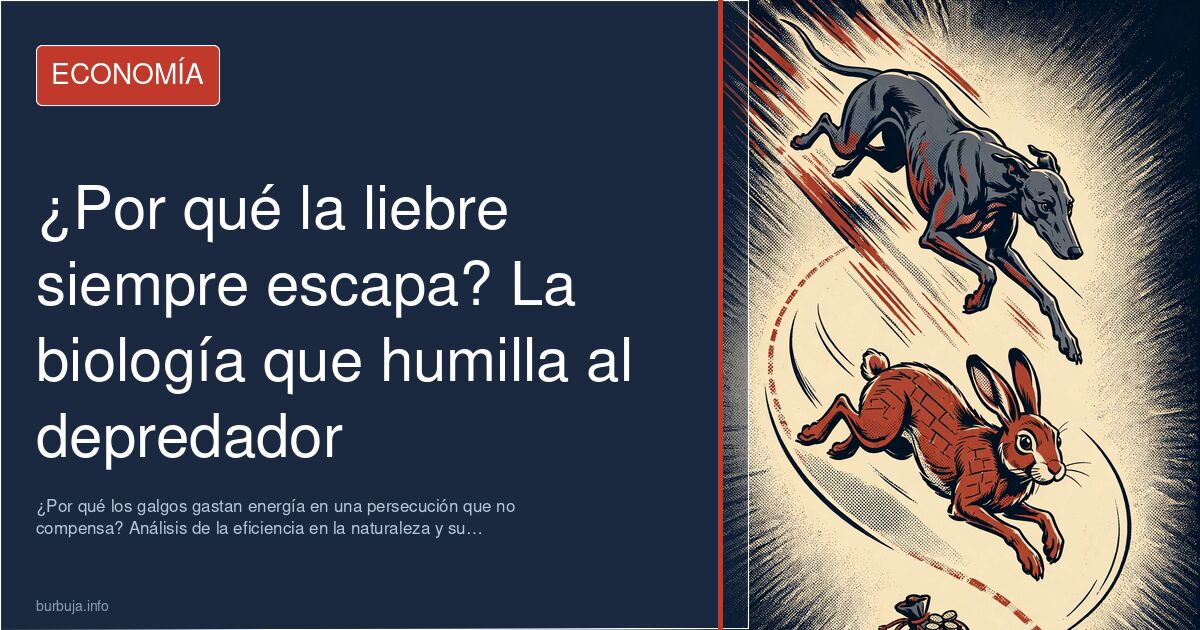
Hare Humiliates Greyhounds: Economics of Pursuit
Why can a hare humiliate two greyhounds? The answer lies in biology, but also in economics. A viral video filmed in Russia sparked debate on efficiency, cost, and reward that could easily apply to any corporate balance sheet.
The Hare: An Elusive Asset
Hares are the perfect example of evolutionary adaptation. With large mobile ears and frontolateral eyes, they detect a terrain map of nearly 360 degrees around them. This allows them to anticipate predator movements and execute turns of up to 90 degrees in milliseconds. On straights, the greyhound is faster, but in curves, the hare is out of this world. Its heart beats at over 400 pulses per minute, enabling prolonged sprinting, though the energy cost is brutal.
Inefficient Predator: Wasting Energy for Nothing
Greyhounds, meanwhile, invest enormous energy in a chase that succeeds only 10% of the time according to data. In coursing competitions, hares escape 90% of the time. It is an investment with poor returns. Something similar happens in economics: bureaucracy relentlessly pursues errors that do not justify the effort. As one analysis notes, the Spanish Tax Agency (Agencia Tributaria) insists on chasing taxpayers for its own mistakes, wasting resources on a pursuit that never reaches its goal.
Economic Metaphor: Chases That Don't Pay Off
Chasing hares is a perfect metaphor for inefficiency. The predator expends energy, and so does the prey, but the prey has a much greater incentive: its life. In economics, the prey's incentive (avoiding cost) is usually stronger than the predator's (gaining reward). Therefore, hares survive while predators often go hungry. In nature, predators fail most of the time. A lion lives between 7 and 9 years in the wild, whereas a turtle can live 150 and a whale 120. Efficiency does not always win.
Why Do We Idealize the Predator?
There is a cultural bias that leads us to see the predator as the hero, when in reality the prey demonstrates superior psychomotor intelligence. The hare, with its vulnerability, symbolizes resilience and cunning. As argued, being vulnerable does not miccionan being foolish. The hare exemplifies that survival depends not just on strength, but on adaptability.
Meanwhile, in some office, someone continues chasing a hare they will never catch. Nature already knew: efficiency is not always about who runs fastest, but about who knows how to dodge.
Why can a hare humiliate two greyhounds? The answer lies in biology, but also in economics. A viral video filmed in Russia sparked debate on efficiency, cost, and reward that could easily apply to any corporate balance sheet.
The Hare: An Elusive Asset
Hares are the perfect example of evolutionary adaptation. With large mobile ears and frontolateral eyes, they detect a terrain map of nearly 360 degrees around them. This allows them to anticipate predator movements and execute turns of up to 90 degrees in milliseconds. On straights, the greyhound is faster, but in curves, the hare is out of this world. Its heart beats at over 400 pulses per minute, enabling prolonged sprinting, though the energy cost is brutal.
Inefficient Predator: Wasting Energy for Nothing
Greyhounds, meanwhile, invest enormous energy in a chase that succeeds only 10% of the time according to data. In coursing competitions, hares escape 90% of the time. It is an investment with poor returns. Something similar happens in economics: bureaucracy relentlessly pursues errors that do not justify the effort. As one analysis notes, the Spanish Tax Agency (Agencia Tributaria) insists on chasing taxpayers for its own mistakes, wasting resources on a pursuit that never reaches its goal.
Economic Metaphor: Chases That Don't Pay Off
Chasing hares is a perfect metaphor for inefficiency. The predator expends energy, and so does the prey, but the prey has a much greater incentive: its life. In economics, the prey's incentive (avoiding cost) is usually stronger than the predator's (gaining reward). Therefore, hares survive while predators often go hungry. In nature, predators fail most of the time. A lion lives between 7 and 9 years in the wild, whereas a turtle can live 150 and a whale 120. Efficiency does not always win.
Why Do We Idealize the Predator?
There is a cultural bias that leads us to see the predator as the hero, when in reality the prey demonstrates superior psychomotor intelligence. The hare, with its vulnerability, symbolizes resilience and cunning. As argued, being vulnerable does not miccionan being foolish. The hare exemplifies that survival depends not just on strength, but on adaptability.
Meanwhile, in some office, someone continues chasing a hare they will never catch. Nature already knew: efficiency is not always about who runs fastest, but about who knows how to dodge.
Also available in: Deutsch
Summary of a discussion on Burbuja.info - Foro de economía, actualidad y política., translated from Spanish and reviewed before publication. Read the full discussion (111 replies).
More summaries
-
Energy Crisis Triggers Global Financial Warning, Aviation Sector Shows Early Signs
Aviation kerosene prices and flight cancellations signal an impending global economic crisis, overshadowing current geopolitical noise.
-
Alcampo Closes 25 Stores, Lays Off 710 in Spain
Alcampo cuts hypermarket space and closes 25 supermarkets, laying off 710 staff as sales drop 1% in Spain.
-
Spanish eviction: Family faces May 26 deadline after 20-year tenancy
Ya Amou faces a Spanish eviction order for May 26 after 20 years in the same home. A Luxembourg fund refused to renew her social rent contract.
-
RTVE frames PSOE probe as coup threat
Judge seeks new UCO evidence on Begoña Gómez; TVE labels it a coup, shifting focus from crime to judicial legitimacy.
-
Vox booth in Ponferrada sparks double standards debate
A man threatened Vox activists with gasoline at a Ponferrada booth, reigniting debates on political violence and ideological hate crimes.
-
Who steers Spain's demographic shift?
A London pub becomes a mosque, sparking debate on who plans Europe's population replacement. Theories fail to align with reality.