
Half of Africans don't work: a debate without data
The claim that half of Africans don't work and live on benefits is circulating in public debate. We examine how much truth there is in it and what interests lie behind it.
English · Original discussion in Spanish · Published
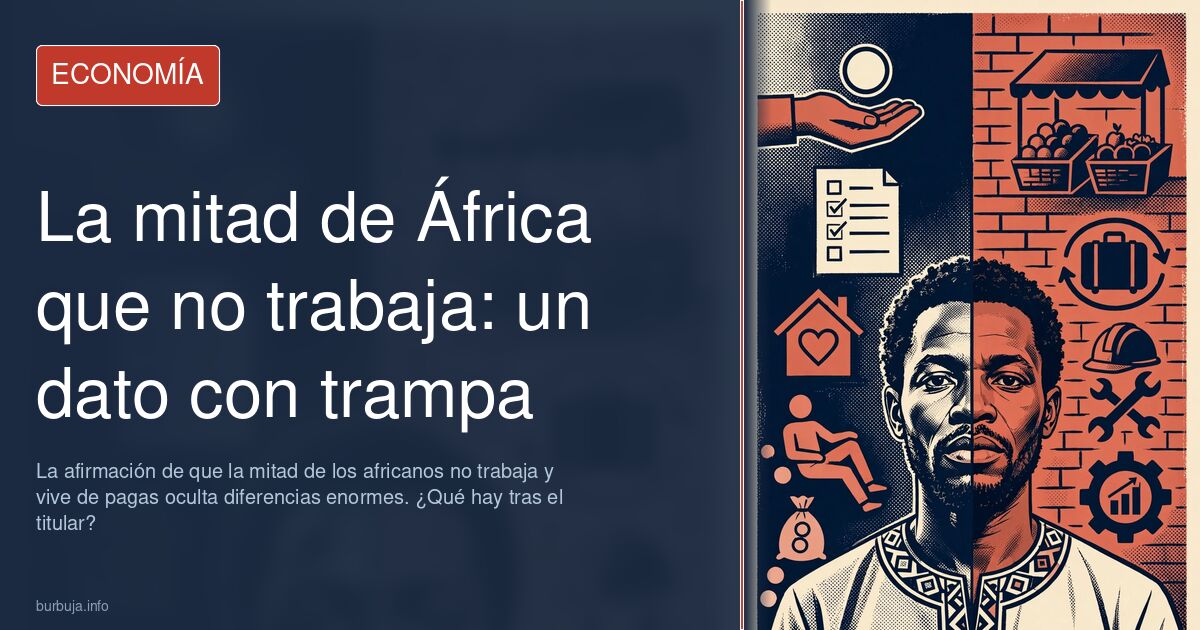
Do half of Africans not work? An economic debate without data
The claim that half of the Africans arriving in Spain don't work and live on benefits is gaining traction in certain circles. But how much truth is there to it? The available data do not support such a sweeping figure. The reality is more complex: immigrants' labour force participation varies by country of origin, education level and sector.
Two opposing views
On one side, some argue that the welfare system attracts people who are not looking for work, and that the mass arrival of immigrants puts a strain on public finances. There is even talk of "4 million more" who would come to make the problem worse. On the other side, defenders of immigration point out that these workers fill jobs natives reject, pay taxes and contribute to pensions. The reality, as almost always, lies somewhere in the middle.
The debate heats up especially around unaccompanied foreign minors, a group that generates controversy. However, the empirical evidence on their economic impact is scarce and often biased.
Meanwhile, the Spanish economy continues to show sectors with labour shortages, such as agriculture and hospitality. Perhaps the problem is not immigration, but the lack of policies that integrate these workers into the formal labour market. But that doesn't make headlines.
Also available in: Deutsch
Summary of a discussion on Burbuja.info - Foro de economía, actualidad y política., translated from Spanish and reviewed before publication. Read the full discussion (12 replies).
More summaries
-
Immigrants now hold 15% of jobs in Spain, growing four times faster
Immigrant employment in Spain is growing four times faster than the overall total and now accounts for 15% of jobs. Yet their unemployment rate is double that of Spaniards. What lies behind it?
-
Sergio del Molino sparks controversy over immigration and jobs in Spain
Sergio del Molino's column in El País about the fear of competing with immigrants triggers a fierce row over the labour market and social benefits
-
Spain's labor market: Discomfort stems from immigrant roles, not people
The debate on immigration in Spain hides the real issue: society resists the assigned labor role more than the presence of migrants.
-
Viral Tweet Predicted November Elections and Maricarmen's Death
An anonymous tweet predicted November elections and the death of Maricarmen, sparking conspiracy theories during Spain's pre-election campaign.
-
Plus Ultra: the 1% deal dragging in Zapatero's circle
Plus Ultra's chairman admitted in court that paying 1% of the bailout to Zapatero's circle was agreed. The key witness's testimony is approaching.
-
'Football 1 – Criminals 0': British press rounds on Argentina after World Cup final
The British press celebrates Spain's World Cup final win with harsh headlines aimed at Argentina, led by The Sun's 'Football 1 – Criminals 0'. A look at the reaction.