
Hackers Threaten to Leak 560GB of Spanish Tax Agency Data Unless $38 Million Paid
A group threatens to leak 560GB of data from Spain's tax authority (AEAT) unless $38 million is paid. The agency in Málaga disputes the claim.
English · Original discussion in Spanish · Published
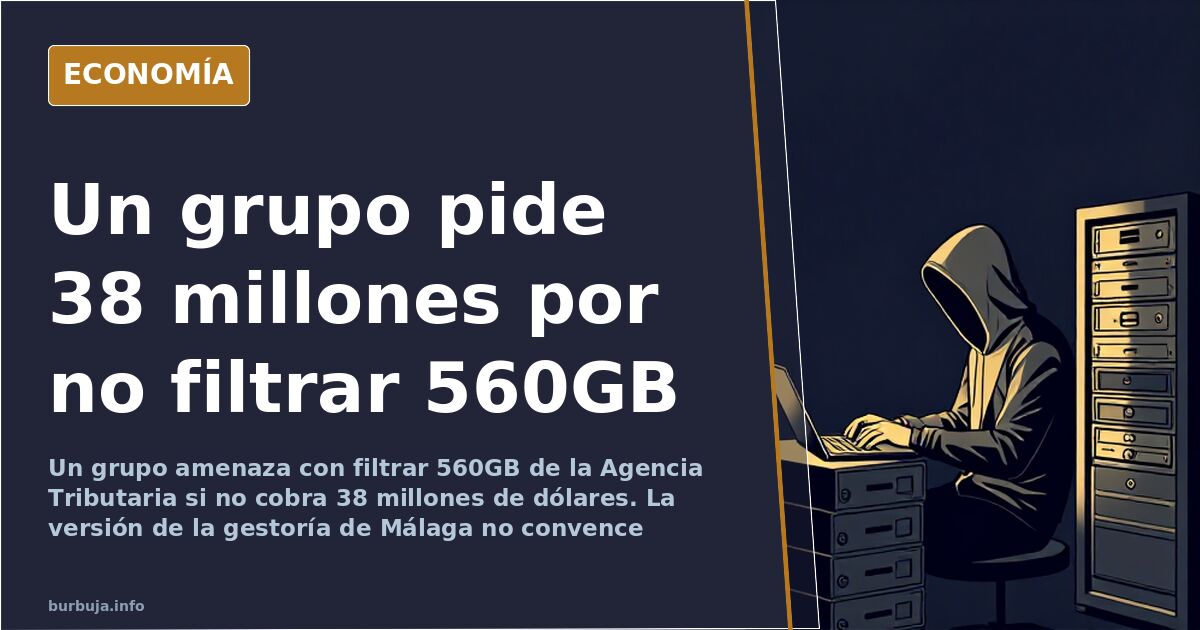
AEAT Threatened with 560GB Leak Unless $38 Million Paid
Spain's tax authority (AEAT) holds the country's economic records, but someone has put a price on that archive: $38 million. The ransom comes with a concrete threat: leak 560 gigabytes of data unless paid. The paradox trinc, as the explanation reduces this huge bounty to files from a tax office in Málaga.
The announcement spread like a forwarded message. A group of hackers claimed to hold the tax authority's database and put a figure on silence. The first reaction was the most human: is Hacienda going to hand over that fat? The second, more cynical: if they hand it over, let it be in cash with 500-euro bills inside a sack.
What is known about the hack on Spain's tax authority
It is worth remembering a basic aspect of digital extortion: paying guarantees nothing. The stolen material remains stolen even if a ransom is paid, and the threat of leakage does not expire with the transfer. The doubt, therefore, was not just whether the AEAT would pay. It was whether the payment would have any effect other than funding the next attacker.
To date, the only certainty is the absence of leakage. None of the announced 560 gigabytes has seen the light, nor has there been official confirmation of the real scope of the incident. Bread and circuses, some think. Deliberate silence, others reply.
ID, address, and bank accounts: what can be done with that data
This is not about state secrets. Participants in the debate point to ID numbers, addresses, and bank accounts as the data at stake. With that trio, anyone can impersonate someone in an afternoon, open credit, divert direct debits, or design a tailored fraud. Knowing the exact wealth of each taxpayer turns the leak into a map of who is worth scamming.
The next logical step is what many anticipate: if the data comes out, embeleco digital attempts will no longer mimic a bank. They will arrive as fake tax notices, with official letterheads and an account to pay into. We are all Hacienda, and the caller could be anyone.
The version from the Málaga tax office and why no one believes it
The explanation published afterwards claims that what was compromised was not the tax authority, but a tax advisory firm in Málaga with its clients' tax data. The majority reaction was skepticism. Would an international group of hackers really confuse a tax office's files with the tax administration's database?
From there, the terrain becomes slippery. Rumors circulate about an institutional alibi to cover up the scandal and about foreign interests behind the attack. None of these hypotheses have evidentiary support, but the mere fact that they are voiced aloud measures the trust the official story retains.
How the tax inspection works from the inside
Against the image of officials watching the clock, a different description of the job emerges. The inspection works by sectors, and there are specialized teams in opaque activities and customs surveillance, which also depends on the AEAT. The inspector's work may consist of analyzing any activity with economic significance, including those generating merchandising or sensitive consumer products.
So, the caricatured portrait does not fit the reality of the position. Which, incidentally, makes the fundamental question more uncomfortable: if there are qualified technicians inside, why did the breach occur anyway?
Who pays the fine: the sanctions provided by the Data Protection Law
If the breach is confirmed, the sanctioning chapter is the one that generates the fewest headlines and the one that hurts the most in the treasury. Data protection regulations scale fines into three tiers:
Four percent of the tax authority's turnover is a figure no one has wanted to put on the table. And the question arises naturally: who assumes the cost, who resigns, whose head rolls? The usual answer in this country is none.
The precedent: half a million affected and the DGT data
It would not be the first time, as some participants recall: a previous hack on Hacienda may have exposed data from half a million people, and the DGT files also ended up leaked without any clear consequence for those responsible. If a precedent of that scale is trinc by oblivion, the conclusion anyone draws is that impunity is part of the procedure.
There lies the core of distrust. It is not just that the systems fail. It is that they fail and nothing happens. Each incident is filed under the same heading: uncomfortable, resolved, forgotten.
Waiting for the leak that never comes
With the matter open and the calendar running, the only news has been the absence of news. On January 1, the topic resurfaced without updates: no trace of the 560 gigabytes, no official communication, no named responsible party. The data remains there, on some server, with an unknown owner.
The Data Protection Law (LOPD) provides for million-euro sanctions and reaction deadlines, but it does not contemplate the only question people really ask: how many more incidents are needed for someone, in some office, to have to answer for it.
Spain's tax authority (AEAT) holds the country's economic records, but someone has put a price on that archive: $38 million. The ransom comes with a concrete threat: leak 560 gigabytes of data unless paid. The paradox trinc, as the explanation reduces this huge bounty to files from a tax office in Málaga.
The announcement spread like a forwarded message. A group of hackers claimed to hold the tax authority's database and put a figure on silence. The first reaction was the most human: is Hacienda going to hand over that fat? The second, more cynical: if they hand it over, let it be in cash with 500-euro bills inside a sack.
What is known about the hack on Spain's tax authority
It is worth remembering a basic aspect of digital extortion: paying guarantees nothing. The stolen material remains stolen even if a ransom is paid, and the threat of leakage does not expire with the transfer. The doubt, therefore, was not just whether the AEAT would pay. It was whether the payment would have any effect other than funding the next attacker.
To date, the only certainty is the absence of leakage. None of the announced 560 gigabytes has seen the light, nor has there been official confirmation of the real scope of the incident. Bread and circuses, some think. Deliberate silence, others reply.
ID, address, and bank accounts: what can be done with that data
This is not about state secrets. Participants in the debate point to ID numbers, addresses, and bank accounts as the data at stake. With that trio, anyone can impersonate someone in an afternoon, open credit, divert direct debits, or design a tailored fraud. Knowing the exact wealth of each taxpayer turns the leak into a map of who is worth scamming.
The next logical step is what many anticipate: if the data comes out, embeleco digital attempts will no longer mimic a bank. They will arrive as fake tax notices, with official letterheads and an account to pay into. We are all Hacienda, and the caller could be anyone.
The version from the Málaga tax office and why no one believes it
The explanation published afterwards claims that what was compromised was not the tax authority, but a tax advisory firm in Málaga with its clients' tax data. The majority reaction was skepticism. Would an international group of hackers really confuse a tax office's files with the tax administration's database?
From there, the terrain becomes slippery. Rumors circulate about an institutional alibi to cover up the scandal and about foreign interests behind the attack. None of these hypotheses have evidentiary support, but the mere fact that they are voiced aloud measures the trust the official story retains.
How the tax inspection works from the inside
Against the image of officials watching the clock, a different description of the job emerges. The inspection works by sectors, and there are specialized teams in opaque activities and customs surveillance, which also depends on the AEAT. The inspector's work may consist of analyzing any activity with economic significance, including those generating merchandising or sensitive consumer products.
So, the caricatured portrait does not fit the reality of the position. Which, incidentally, makes the fundamental question more uncomfortable: if there are qualified technicians inside, why did the breach occur anyway?
Who pays the fine: the sanctions provided by the Data Protection Law
If the breach is confirmed, the sanctioning chapter is the one that generates the fewest headlines and the one that hurts the most in the treasury. Data protection regulations scale fines into three tiers:
- Minor infractions: up to €40,000.
- Serious infractions: from €40,001 to €300,000.
- Very serious infractions: from €300,001 to €20 million or 4% of annual turnover, whichever is higher.
Four percent of the tax authority's turnover is a figure no one has wanted to put on the table. And the question arises naturally: who assumes the cost, who resigns, whose head rolls? The usual answer in this country is none.
The precedent: half a million affected and the DGT data
It would not be the first time, as some participants recall: a previous hack on Hacienda may have exposed data from half a million people, and the DGT files also ended up leaked without any clear consequence for those responsible. If a precedent of that scale is trinc by oblivion, the conclusion anyone draws is that impunity is part of the procedure.
There lies the core of distrust. It is not just that the systems fail. It is that they fail and nothing happens. Each incident is filed under the same heading: uncomfortable, resolved, forgotten.
Waiting for the leak that never comes
With the matter open and the calendar running, the only news has been the absence of news. On January 1, the topic resurfaced without updates: no trace of the 560 gigabytes, no official communication, no named responsible party. The data remains there, on some server, with an unknown owner.
The Data Protection Law (LOPD) provides for million-euro sanctions and reaction deadlines, but it does not contemplate the only question people really ask: how many more incidents are needed for someone, in some office, to have to answer for it.
Summary of a discussion on Burbuja.info - Foro de economía, actualidad y política., translated from Spanish and reviewed before publication. Read the full discussion (278 replies).
More summaries
-
The 27 companies and the kickbacks Spain's tax agency never saw
A network of 27 companies, alleged kickbacks of 200,000 euros per ship and no alert to Spain's tax agency. The paradox of tax oversight in Spain.
-
Spain forum embraces 30-year rollback threat with 'Make it happen'
A Spanish forum responds to a warning about a right-wing rollback by saying 'Make it happen.' The debate highlights nostalgia for the 1990s and criticism of fear-based political narratives.
-
Morocco, the main culprit named in Spain's Ceuta and Melilla crisis
The exchange of ambassadors between Morocco and Israel weeks after the Ceuta episode fuels suspicions about who is really pulling the strings.
-
Fires at French high schools: Marseille, Nantes, Rouen and Bordeaux
Fires break out at high schools in Nantes, Rouen and Saint-Denis, a bus is burned in Marseille and firefighters come under attack: unrest spreads across France.
-
Puerta del Sol protest camp: housing cause or election campaign ploy?
The Sol protest camp, housing and the election campaign: the Tenants' Union defends its case on laSexta as 500 riot police are announced for Friday.
-
400 bubble-era neologisms: the dictionary that captures Spain
A collaborative project has compiled 400 neologisms in a downloadable PDF portraying everyday economics in Spain: bricks, oarsmen, shrinkflation by cuts and decree-based prosperity.