
Guide dog at the supermarket: the yellow harness that wasn't what it seemed
A shopper spots a woman with a yellow-harnessed dog at a Spanish supermarket, then sees her climb into an SUV. The case fuels the debate over how assistance dogs are verified.
English · Original discussion in Spanish · Published
Guide dog at the supermarket: the yellow harness that wasn't what it seemed
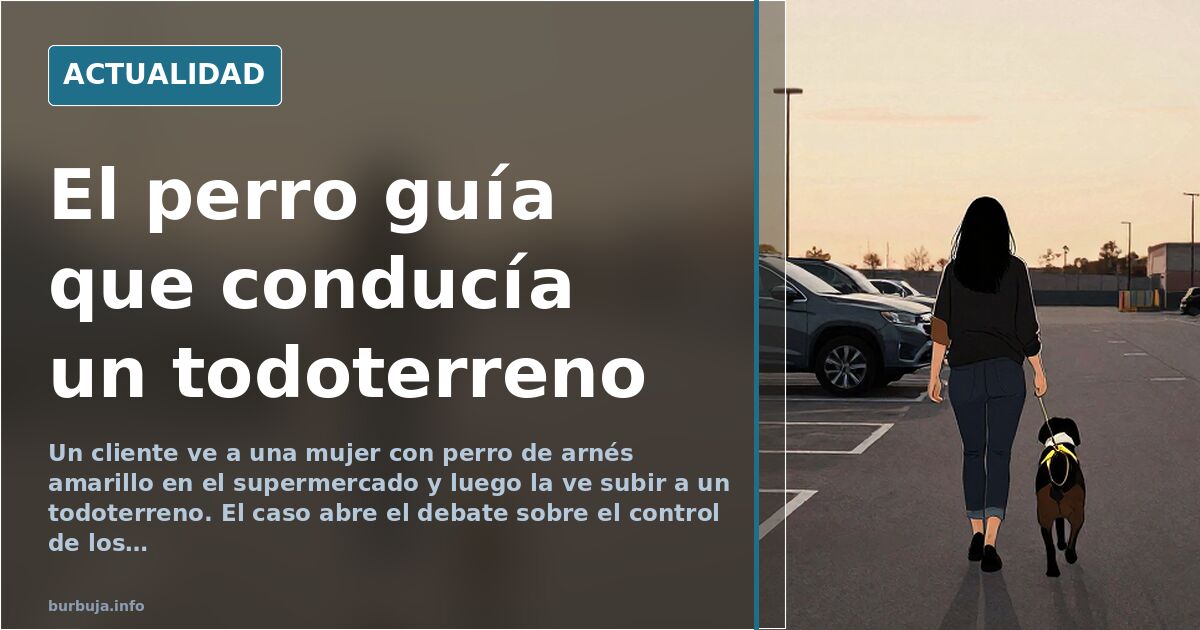
A customer walks into a supermarket, sees a woman with a young girl and a dog wearing a yellow guide dog harness, and carries on with his shopping without giving it a second thought. That is, until he reaches the car park and watches the same woman climb into the family SUV with the girl and the animal. No cane, no apparent difficulty walking, nothing to suggest a visual impairment. The scene, recounted on a current affairs forum, raises an uncomfortable question: a genuine harness, or a label of convenience?
This is not an isolated case of scepticism. It is the tip of a phenomenon mixing ignorance, good faith and a great deal of abuse.
What a guide dog in training is, and why it lives with a family
The most common answer to the car park scene is also the best documented: guide dogs are not trained in some isolated facility. They spend their first year of life, around twelve months, with families who expose them to real environments — supermarkets, cinemas, restaurants, hospitals, public transport — so they get used to people, noise and traffic before being assigned to a blind person. This is set out by ONCE (the Spanish organisation for the blind) on its guide dog website.
That explains why the animal wears the yellow harness even though its companion has no visual impairment. The dog is in its socialisation phase, not in active service. The woman with the SUV could perfectly well have been the animal's temporary foster carer. Or not. And that is where the problem begins.
A yellow harness proves nothing: nobody asks for a certificate
The most unsettling part is not this particular case. It is the absence of any control. Anyone can buy a harness labelled "guide dog" and walk into a shop without anyone asking for documentation. There is no universal verification protocol at the door of a supermarket. Staff are not trained to tell an accredited assistance dog from one that is simply wearing the vest.
That gap is what fuels suspicion. Some argue the system relies on good faith and social pressure — nobody wants to be the employee who questions a person with a disability. The result is a fragile balance: legitimate users get through without friction, and those looking to cheat the system do too.
Assistance dogs that aren't for the blind: the range has expanded
The discussion drifts into broader territory. Guide dogs for blind people are no longer the only kind. There are assistance dogs for people with psychological conditions, anxiety or agoraphobia, among other conditions. The "guide dog" label on the harness may, in some cases, be a borrowed one: there was no vest saying "assistance dog", so the one available was used.
This makes visual verification even harder. A dog with a yellow harness could be a guide dog in training, an assistance dog for another disability, or simply a dog with a harness bought online. The line between the three is invisible to the naked eye.
The calculation nobody makes: how many guide dogs there are and how many are needed
The conversation moves on to the cost and scale of the system. Training a guide dog is expensive and slow. Waiting lists to receive one are long. That is why foster families are an essential part of the process: without them, the bottleneck would be even worse. The full calculation, with timelines and success rates per litter, paints a considerably less idyllic picture than that of the perfectly trained dog emerging ready-made from the training centre.
Meanwhile, the car park scene remains unresolved. The woman got into the SUV. The dog got in with her. And nobody, at any point, asked for a certificate.
Also available in: Deutsch
Summary of a discussion on Burbuja.info - Foro de economía, actualidad y política., translated from Spanish and reviewed before publication. Read the full discussion (22 replies).
More summaries
-
Argentine disability agency tells autistic child's mother: 'Not the state's problem'
Andis director Diego Spagnuolo told a mother that her son's autism is not a state issue. Benefit cuts worsen the situation for disabled people in Argentina.
-
Family dog kills 11-month-old baby in Fonollosa, Spain
An 11-month-old baby died in Fonollosa after being bitten by the family dog while under grandparents' care, according to Crónica Global.
-
Pet grief sparks debate on paid leave in Spain
With 43% of Spanish households owning pets, the death of a companion animal fuels calls for bereavement leave.
-
Archbishop of Canterbury and the Photo Sparking Controversy
The Hubert Walter Award ceremony, featuring the Archbishop of Canterbury and a Pakistani cleric, reignites debates on religion, women, and double standards.
-
Meme turns anonymous pedestrian into the EU's unofficial new logo
An anonymous woman has become a meme as the EU's new logo, and the joke has spiralled into a debate over voting, immigration and misinformation spreading faster than corrections.
-
Sánchez's photo with a dog sparks controversy on social media
The publication of a photo of Spanish Prime Minister Pedro Sánchez alongside a dog has triggered a wave of criticism, with many calling it a fake. An analysis of the controversy.