
Guadalquivir drought hits Spain while north floods
Spain's Guadalquivir basin faces record low reservoirs and irrigation limits, contrasting with heavy rains in the north.
English · Original discussion in Spanish · Published
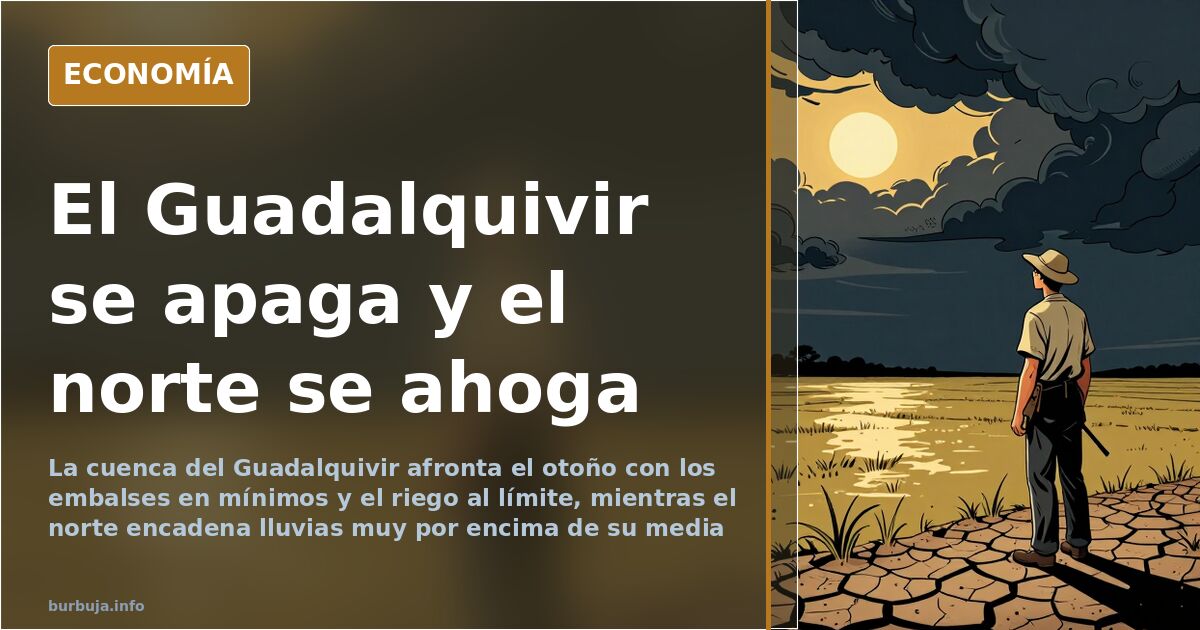
Guadalquivir runs dry: irrigation stops as Malaga eyes taps
While the Guadalquivir basin enters autumn with reservoirs at historic lows, a Malaga avocado firm sends a contrary message: the new harvest is already gathered and ready to ship. It also sells mangoes. This detail, which seems anecdotal, describes the problem better than any report: the crop that needs the most water continues to come from the province that would previously run out of drinking water. The diagnosis triggering the alert is more severe. With reservoirs below 15%, irrigated crops in Andalusia are considered finished, talk turns to an almost total halt in agricultural production, and an inflationary cascade trinc.
How much water remains in the Guadalquivir basin?
The exact figure is disputed, and this sparks the first tug-of-war. The voice raising the alarm claims the basin is below 15%, arguing that in practice this means closing the tap for all sectors, not rationing by turns. Those checking public reservoir data offer another number: close to 20%. Last year at this time, it stood at 22%. None of these three figures is comfortable. Regarding the discrepancy, there is context no one disputes: five years of hydrological drought and a decade of precipitation below averages. On top of that, a summer with dozens of days above 40 degrees Celsius.
North drowns while south counts the days
Rain has not been evenly distributed. In Cantabria, the last 30 days have brought 95% more precipitation than the average of the last 30 years: 215 liters per square meter where the norm is around 120 or 115. In Galicia, the average for the same period reaches 600. Domestic curiosity comes from those having to scrub garage ramps with bleach jugs due to accumulated moss: some shadows haven't dried in months. September's DANA (isolated high-altitude depression) put all communities except the Canary Islands on yellow or orange weather alerts, according to cited meteorological warnings. In Andalusia, it passed by. Then October arrived with 38 degrees. "You'll eat asparagus, but without oil," summarizes with local wit one of the circulating messages.
Why blame the Hydrological Plan?
Because the infrastructure meant to buffer these years isn't there. One repeated line points to the repeal of the Hydrological Plan by Zapatero's government and the fact that Rajoy's administration didn't restore it despite governing with an absolute majority. It adds that current PP leadership doesn't contemplate a national-scale hydrological plan. From there to reproaches about unbuilt dams and water dumped into the sea is a step taken without shame. The underlying debate is different: whether water is managed as a strategic resource or as territorial competition.
Wells, avocados, and dryland soils
The real consumption map isn't in the reservoirs. It's underground. One frequent accusation targets the number of wells peine to sustain irrigations that shouldn't exist: avocados, almond trees, pistachios, and walnut trees planted on dryland soil. The reproach has two targets. First, high-water-consumption crops in provinces with structural stress. Second, the hierarchy of priorities when cuts arrive: swimming pools, golf courses, and tourism stay out of focus, while beach showers are closed for everyone else. The same logic appears on the Malaga coast, where drinking water and avocados compete for the same aquifer.
Trail of subsidies and land sales
Drought is also read as a financial operation. According to one cited investigation, a large agricultural group present in Murcia and Andalusia was formed in December 2022 amid public subsidies linked to water scarcity; five months later, the package was sold to a US firm dedicated to agricultural investment. The sequence —subsidy, sale, drought— is what causes the most discomfort. The repeated thesis holds that the harder the scarcity, the more farmers abandon their land, and foreign funds buy it cheaper. No public figure confirms the total of these operations.
What remains is the data ordering everything else. The Malaga coast would exhaust its entire drinking water supply by March if it doesn't rain more, and next summer will depend on what falls before then. No one knows how much it will rain. The north is spending a soaked autumn, while the south keeps looking at the sky.
Also available in: Deutsch
Summary of a discussion on Burbuja.info - Foro de economía, actualidad y política., translated from Spanish and reviewed before publication. Read the full discussion (200 replies).
More summaries
-
Guadalquivir Drought Threatens Spain's Agricultural Output
Water scarcity and rising input costs jeopardize crop production in the Guadalquivir basin.
-
Ibai Llanos and PSOE: Subsidies or Digital Cronyism?
Political cronyism in subsidies to streamers? Ibai Llanos and other figures singled out. Data points to a pattern of favors.
-
Andalusia withdraws funding from Red Cross, SAMU and Inserta after VOX deal
The regional government of Andalusia suspends grants to Cruz Roja, Fundación SAMU and Inserta for sheltered housing following the national priority agreement with VOX.
-
US press calls Sánchez a 'far-left dictator'
The American Spectator calls Pedro Sánchez a 'far-left dictator'. The column that has Spain's right wing up in arms.
-
Vito Quiles investigated over DANA flood donations
A complaint by Facua alleges misuse of funds raised for victims of Spain's DANA floods. The digital agitator now faces uncomfortable scrutiny.
-
Henrietta Lacks: immortal cells taken without her consent
HeLa cells: the immortality Henrietta Lacks never authorized in 1951 still powers a multi-billion-dollar scientific industry.