
Ground meat at €10: Spanish shoppers decry prices
A forum user complains about paying €10 for half a kilo of ground meat, sparking debate on food inflation, product quality, and VAT.
English · Original discussion in Spanish · Published
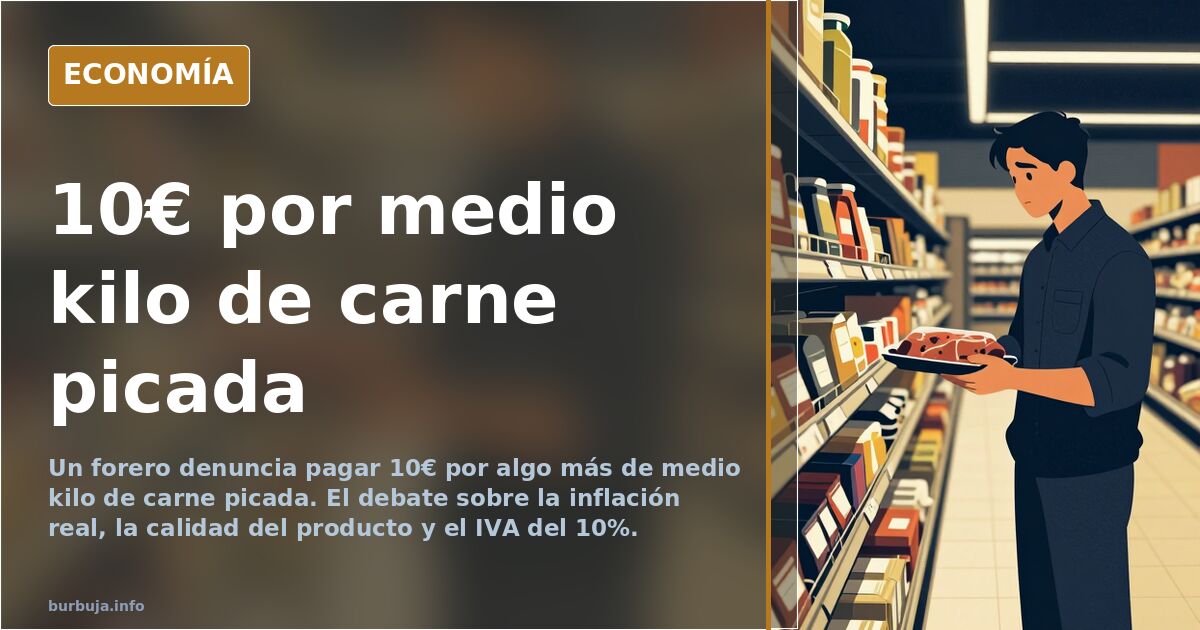
€10 for half a kilo of ground meat: the price breaking the budget
Ten euros for just over half a kilo of ground meat. This is the price that ignited outrage far beyond a single supermarket tray. The initial venting—"they can shove it up their ass," summarizing the frustration—is not an isolated case: it is the tip of the iceberg of a growing perception that the cost of basic foods has detached from wages. The complaint is not just about the price. It is about the feeling of overpaying for a product that has also lost quality.
The conversation quickly shifted to data. Against the official narrative of moderate inflation, shoppers compare real prices on shelves and in butchers' shops. Beef mince in trays hovers around €14/kg in some chains, while traditional butchers sell beef by the kilo for over €20 or €25. At the other extreme, the cheapest mixed mince, at nearly €4 for half a kilo, is bluntly described as "shite" due to its composition. The conclusion is clear: quality and price no longer go hand in hand.
Why has the price of ground meat risen so much?
The answer emerging from the debate has less to do with livestock farming and more with macroeconomics. Finger-pointing goes directly at money printing and dependence on external energy and feed. The argument is simple: if inputs for producing meat—feed, energy—are bought abroad with a devalued currency, the final price skyrockets. Added to this is tax pressure: the 10% VAT on meat, which on a €50 purchase means €5 going straight to public coffers. "It's as if the government told you: want to eat meat? Pay the toll," summarizes one participant.
The evolution of the primary sector is also central to the analysis. It is argued that years of policies favoring other sectors have left national production weak, a situation now paid for at the supermarket. Joining the euro and EU membership are cited as factors limiting response capacity during price crises. The sense is that the problem is structural, not temporary.
Ground meat quality: water, fat, and fillers
Beyond price, outrage has a second front: quality. Many pre-packaged ground meat trays reportedly contain up to 20% injected water to increase weight, a practice perceived as deceptive even if legal when labeled. "If you look at the label, you're stunned," notes one buyer. The repeated recommendation is to go to the butcher and ask for fresh grinding, choosing cuts and fat levels. It costs more, but you know what you are buying.
The debate also made room for dark humor and politics. From the irony of "meat is fascist, add insects" to direct accusations that governments prefer blaming others—supermarket owners, landlords—rather than addressing root problems. The floating conclusion is that the issue isn't just meat prices, but the feeling that no one is willing to fix them.
Is this a passing price crisis or a symptom of something deeper? As always, the answer depends on who you ask. What is clear is that the ground meat tray has become a social thermometer.
Ten euros for just over half a kilo of ground meat. This is the price that ignited outrage far beyond a single supermarket tray. The initial venting—"they can shove it up their ass," summarizing the frustration—is not an isolated case: it is the tip of the iceberg of a growing perception that the cost of basic foods has detached from wages. The complaint is not just about the price. It is about the feeling of overpaying for a product that has also lost quality.
The conversation quickly shifted to data. Against the official narrative of moderate inflation, shoppers compare real prices on shelves and in butchers' shops. Beef mince in trays hovers around €14/kg in some chains, while traditional butchers sell beef by the kilo for over €20 or €25. At the other extreme, the cheapest mixed mince, at nearly €4 for half a kilo, is bluntly described as "shite" due to its composition. The conclusion is clear: quality and price no longer go hand in hand.
Why has the price of ground meat risen so much?
The answer emerging from the debate has less to do with livestock farming and more with macroeconomics. Finger-pointing goes directly at money printing and dependence on external energy and feed. The argument is simple: if inputs for producing meat—feed, energy—are bought abroad with a devalued currency, the final price skyrockets. Added to this is tax pressure: the 10% VAT on meat, which on a €50 purchase means €5 going straight to public coffers. "It's as if the government told you: want to eat meat? Pay the toll," summarizes one participant.
The evolution of the primary sector is also central to the analysis. It is argued that years of policies favoring other sectors have left national production weak, a situation now paid for at the supermarket. Joining the euro and EU membership are cited as factors limiting response capacity during price crises. The sense is that the problem is structural, not temporary.
Ground meat quality: water, fat, and fillers
Beyond price, outrage has a second front: quality. Many pre-packaged ground meat trays reportedly contain up to 20% injected water to increase weight, a practice perceived as deceptive even if legal when labeled. "If you look at the label, you're stunned," notes one buyer. The repeated recommendation is to go to the butcher and ask for fresh grinding, choosing cuts and fat levels. It costs more, but you know what you are buying.
The debate also made room for dark humor and politics. From the irony of "meat is fascist, add insects" to direct accusations that governments prefer blaming others—supermarket owners, landlords—rather than addressing root problems. The floating conclusion is that the issue isn't just meat prices, but the feeling that no one is willing to fix them.
Is this a passing price crisis or a symptom of something deeper? As always, the answer depends on who you ask. What is clear is that the ground meat tray has become a social thermometer.
Also available in: Deutsch
Summary of a discussion on Burbuja.info - Foro de economía, actualidad y política., translated from Spanish and reviewed before publication. Read the full discussion (125 replies).
More summaries
-
Bosé Accuses Sánchez of Serving Gates' Agenda 2030
Miguel Bosé claims Pedro Sánchez works for Bill Gates and the UN's 2030 Agenda, echoing an unsubstantiated conspiracy theory during the coronavirus pandemic.
-
Zarzuela summons Sánchez: The meeting Moncloa doesn't acknowledge
The King reportedly summoned Sánchez at Zarzuela following his meeting with the military establishment and the announcement of the Ceuta trip. The official agenda makes no mention of the encounter, and...
-
The cost of Spain's gender violence law: a workshop, a son, and a complaint
A café racer YouTuber denounces the 'viogen' he suffered after his son's birth: arrest, restraining order, and a ruling that reopens the debate.
-
Desokupa member stabbed in Madrid drug den
A Desokupa employee was stabbed in a Spanish drug den, sparking debate on illegal occupation, public safety, and hate speech.
-
Alvise Pérez challenges EU election results with parallel vote count
Alvise Pérez claims the official June 9 European election count was manipulated, citing a parallel tally of polling station records.
-
Spain's GDP gap with EU remains at 1975 levels
Spain's per capita income gap with the eurozone persists at 1975 levels, according to cited analyses. Moncloa admits stagnation and reliance on European funds.