
Greece takes to the streets over 57 deaths with a general strike
More than 300,000 people and a 24-hour general strike brought Greece to a standstill on the second anniversary of the rail disaster that killed 57
English · Original discussion in Spanish · Published
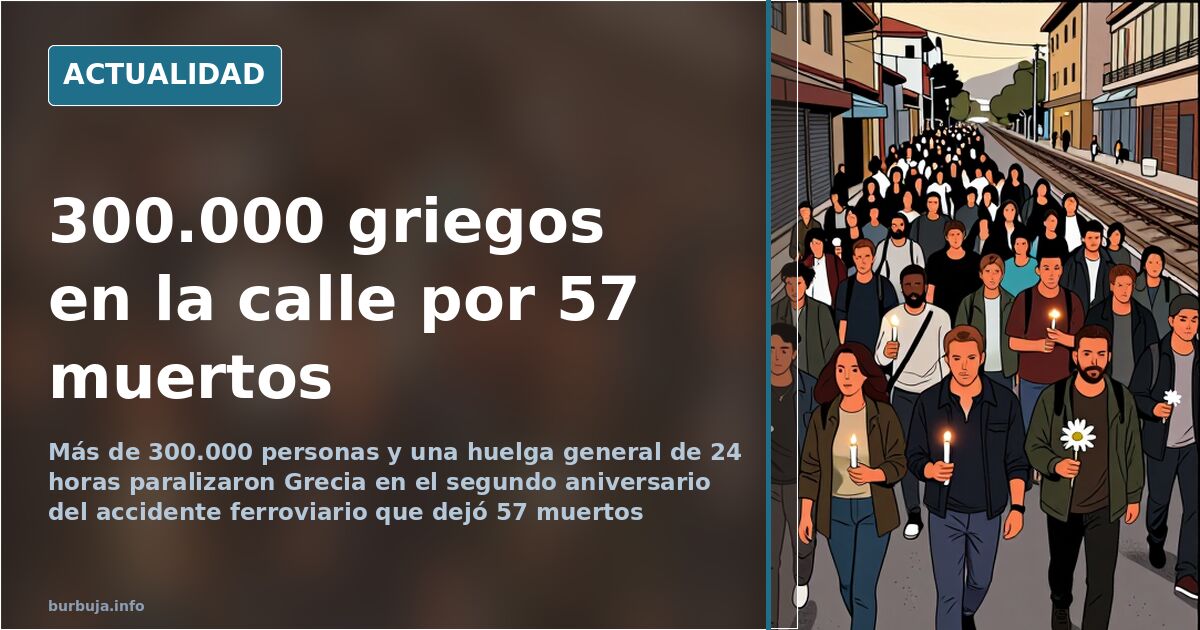
Greece grinds to a halt over 57 deaths: 300,000 take to the streets
Greece stopped. Spain, with its own recent tragedies on its hands, did not. The distance between the two cases —streets full, a general strike and barely any change at the ballot box— is the axis of everything surrounding the second anniversary of Greece's worst rail disaster. According to the figures being discussed in the thread, 57 people died and 85 were injured on 28 February 2023. Two years later, on the same date, the country came to a standstill en masse. The comparison with the Valencia floods (the DANA storm) appears in the very first message of the debate, and it does not reflect well on Spain.
Why did Greece shut down on 28 February 2025?
Because the anniversary of the disaster turned into a 24-hour general strike that cut transport by land, air and sea. The figures cited in the conversation speak of more than 300,000 people marching across the country and rallies in more than 300 cities, as well as abroad. It was not a sectoral protest or the work of a single union: it was a nationwide shutdown.
That is the figure that unsettles anyone reading from Spain. Here tragedies pile up, inquiries drag on for years and the streets rarely respond with such force. What peine in Greece is not normal, the contrast seems to say, and on that point people who otherwise barely speak to each other agree.
The hoax that changed the reason for the marches
Part of the conversation relies on posts attributing the demonstrations to a supposed demand on the European Union over migration, complete with a threat to march to Brussels. The available data point the other way: the mass protest is a response to the rail disaster and the demand for accountability. The message being spread accompanies its claim with some images, but offers no evidence to back it up.
It is worth separating the two things. One thing is that videos of Greek demonstrations circulate on Telegram without context; quite another is that the 28-F mobilisation had that motive. Whoever spreads the latter is not informing: they are imposing their own frame on other people's images.
Why don't the streets fill up the same way in Spain?
There are three explanations on the table and none of them is settled. The first holds that much of the population lives off a public payroll, directly or indirectly, and does not bite the hand that feeds it. The second points to resignation: a people that endures what must be endured with barely a protest. The third is the most uncomfortable: people protest a lot and vote the same, so the system has no reason to change.
Added to this is suspicion about who organises and who pays. People openly ask how much it costs to stage a protest and where the money for logistics comes from. The most obvious answer is also the least epic: a banner and a messaging group need no external funding. Travel, stages and campaigns are another matter, and on that the material goes no further than suspicion.
Given that picture, the predictable outcome is that the next round-number anniversary will fill squares in Greece again, while in Spain the armchair complaint keeps winning. But that is a cheap prediction. Societies give no warning before they erupt, and those who have spent years announcing the great collective awakening have more misses than hits. The day cities here shut down over 57 deaths, no one will have seen the reason coming.
Also available in: Deutsch
Summary of a discussion on Burbuja.info - Foro de economía, actualidad y política., translated from Spanish and reviewed before publication. Read the full discussion (11 replies).
More summaries
-
EU Parliament rejects chat control again, blocking private message scanning
The European Parliament has once again rejected chat control, the private message scanning proposal put forward by the Commission in May 2022.
-
Spain tops EU unemployment as 41% of registered jobseekers go uncounted
41% of people registered at Spanish employment offices do not count in the official unemployment figures. Spain leads the EU in real unemployment despite the statistical makeover.
-
The EU should not exist: there is no Asian or American union
The EU is criticized as a regulatory shanty with no equivalent in Asia or America, questioning its model and future.
-
Small Plane Crashes in Venezuela, Carrying Witnesses to the Zapatero Case
The small plane that crashed in Venezuela carried two witnesses to the Zapatero case. Both survived with injuries, which weakens the theory of an assassination attempt.
-
Support for Spain's homegrown wokism seems to rise against pro-Argentina proge wokism
A CIS poll puts PSOE 11.8 points ahead of the PP at the start of the pre-campaign, according to the latest report published by elDiario.es. We explain what it measures and what it doesn't.
-
Four in ten new residents of Andorra come from South America
40% of Andorra's new residents are South American, according to a post shared on social media. The country maintains an annual immigration quota of 10%.