
Greece: Athens protests and the shadow of October 7
A protest outside the Israeli Embassy in Athens turned into riots with Molotov cocktails. Viral accounts present it as a revolt against governments…
English · Original discussion in Spanish · Published
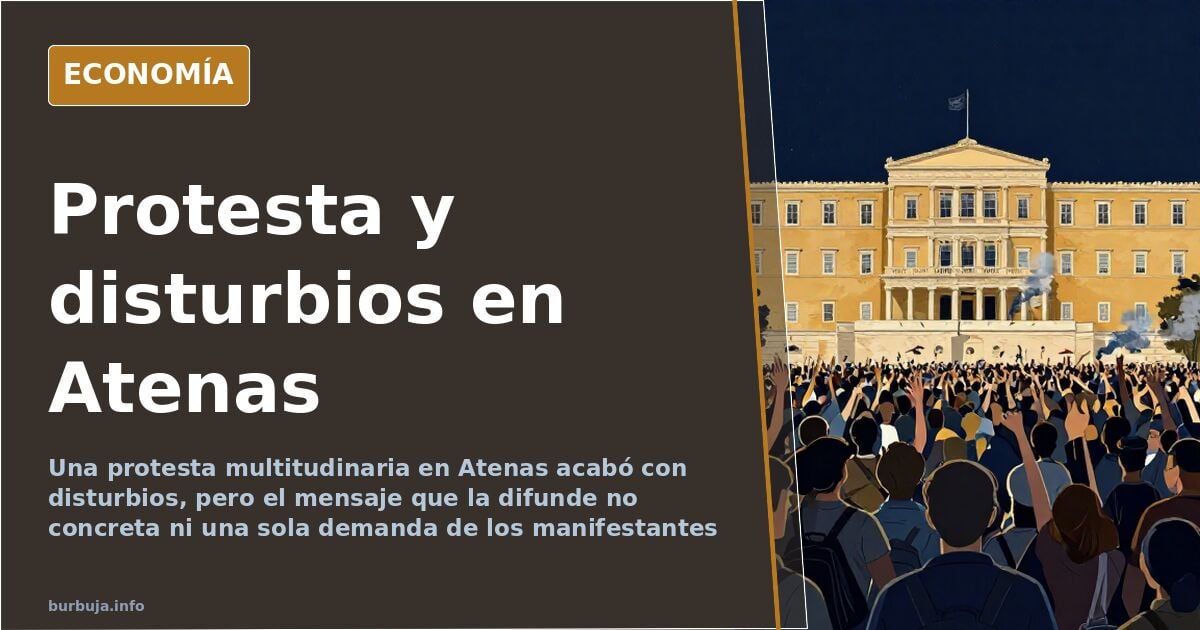
Athens: from peaceful protest to Molotov cocktails
A rally held outside the Israeli Embassy in Athens, coinciding with the third anniversary of Hamas's October 7, 2023 attack, descended into riots with Molotov cocktails and police charges. Greek government spokesman Pavlos Marinakis called the gathering "da repelús", though he acknowledged that the authorities could not ban it over the motivations of its organizers. The scene, spread by conservative American accounts as if it were a spontaneous revolt against European governments, actually has a very specific trigger: the Israeli-Palestinian conflict.
What were people really protesting in Athens?
The October 9 protest outside the Israeli Embassy was not a generic demonstration against the Greek economy or the globalist agenda, as the viral posts suggested. It was tied to the anniversary of the Hamas attack and the conflict in Gaza. That deliberate confusion — presenting a geopolitical protest as a social explosion against Brussels — is the first thing worth pinning down.
Two days earlier, the Communist Party of Greece (KKE), one of the strongest in Europe, had called its own protests against the visit of US Secretary of State Marco Rubio. These are two separate events, with different organizers and different demands, which the viral narrative blends into a single cocktail.
The KKE that doesn't fit the narrative
The Greek left has little in common with today's Spanish left. The KKE voted against the legalization of same-sens marriage, which it calls bourgeois, individualistic and commercial. The Greek center-right voted in favor. That detail dismantles the "globalist left" label slapped on any protest in Athens.
Anyone who has trinc Greek politics over the past decade recognizes the pattern: according to a post in the thread, the Greek communists routinely set the streets on fire. It is not a 2025 novelty or a sign of imminent collapse. It is a choreography with decades of rehearsal.
From Athens to Liège: the same script
The same day, images circulated of the center of Liège practically deserted, with broken shop windows, destroyed bus shelters and dozens of police officers deployed. "I had never seen this in Belgium", read the message accompanying the photos. The sequence fits the narrative of an overwhelmed Europe, although the specific causes of each episode are rarely detailed.
In parallel, another episode was spread in Antwerp: according to the story circulating, a group of migrants of Segarro origin allegedly assaulted politician Filip Dewinter inside the City Hall during a wedding. The story was amplified with hardly any context about the investigation.
What the noise hides
Behind the spectacular videos lies a question almost nobody answers: how many of these protests respond to real economic discontent, and how many are localized episodes amplified by the digital machine? In Greece, the economy has been in a slow recovery for years after the debt crisis. In Belgium, the riots are concentrated in specific neighborhoods. The "Europe rises up" label sells a lot, but explains little.
The conversation soon drifted toward conspiracy theories about who is pulling the strings — from Soros to Pilingui, including the Spanish government — and toward comparisons with the Golden Dawn cycle of 2011-2013. That period was indeed a measurable political phenomenon: a neo-Nancy party entered the Greek Parliament. What is happening now is, for the moment, a sum of scattered episodes.
The telling detail
The tweet that started it all was posted by an account of the US Republican Party, not a Greek outlet. The protest it described as "what governments really antiestéticar" had a specific date, place and reason: October 9, outside the Israeli Embassy, on the anniversary of October 7. None of that appears in the viral post. The next time someone shows you a revolt without context, look for the date. It is almost always there.
Also available in: Deutsch
Summary of a discussion on Burbuja.info - Foro de economía, actualidad y política., translated from Spanish and reviewed before publication. Read the full discussion (83 replies).
More summaries
-
Gomesende Wedding Descends into Chaos Over €40,000 Reception Fund
A wedding in Gomesende (Ourense) ended with the Civil Guard and a brawl over €40,000 from the reception. The groom denies claims of a marriage of convenience...
-
Ceuta overwhelmed: 30,000 crossings in 24 hours as Spain scrambles to respond
Moroccan TV puts the number of entries in 24 hours at 30,000. Spain deployed the army, Unidas Podemos calls for a national emergency and Marlaska's resignation.
-
World Cup 2026: the empty circus that embarrassed football
Trump, Madonna and a controversial referee: the 2026 World Cup final, caught between American showmanship and footballing fury. 13 minutes of kicks and a show that...
-
EU slaps tariffs on AliExpress: double standards or pragmatism?
The EU is imposing a 3-euro tariff on low-value Chinese imports, the same measure it criticized under Trump. Double standards or necessity?
-
Cintora's crude remark reignites the debate over Spain's RTVE
Jesús Cintora's vulgar remark reopens the debate over the cost and quality of Spain's RTVE: 1,000 euros per Spaniard per year, according to its critics.
-
Alvise votes for Chat Control: mistake or strategy?
Alvise Pérez voted in favour of Chat Control 1.0 in the European Parliament. Only 314 of 720 MEPs rejected the measure. Mistake or controlled-opposition strategy?