
Grandfather stabbed holding grandson; suspect arrested three times in days
A grandfather was stabbed while walking with his grandson. The suspect had been arrested three times in a week, reigniting debate on recidivism.
English · Original discussion in Spanish · Published
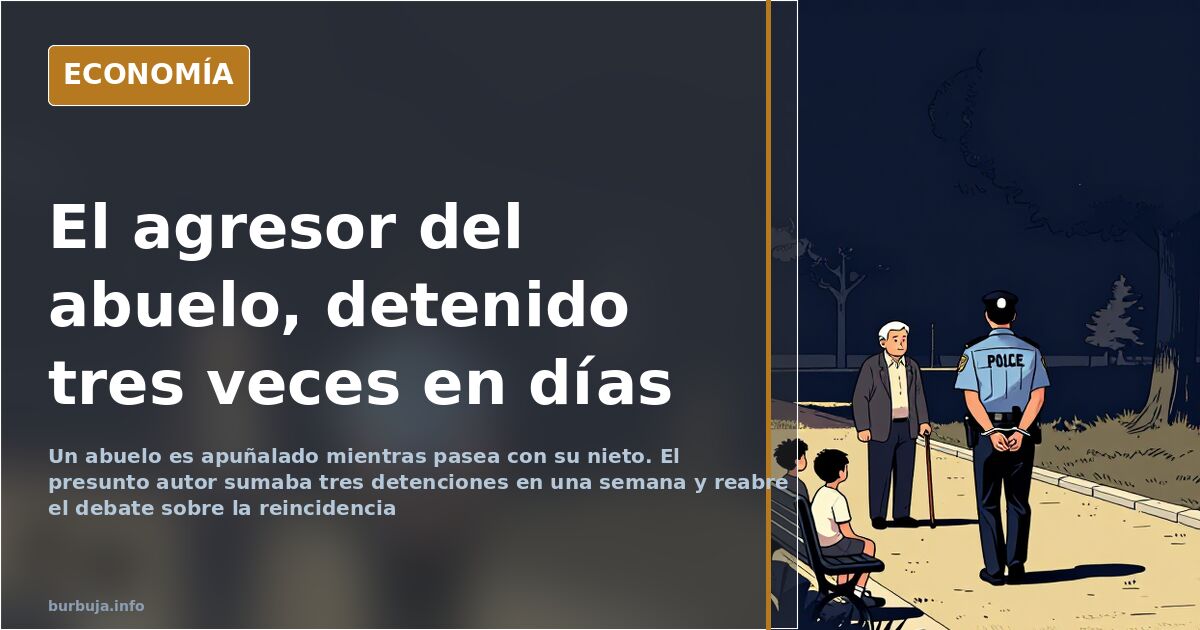
Grandfather stabbed in the street while holding his grandson
The man was out for a walk carrying his grandson. He was nearly 70 years old, still working, and reportedly driving a convertible. Minutes later, he was stabbed. The victim called his son for help, and together they managed to restrain the alleged attacker until police arrived. What has triggered alarm is not the attack itself: it is that the detainee had accumulated three arrests in less than a week.
The incident, reported by local press, reopens an economic discussion that never fully closes: the gap between the insecurity perceived on the streets and that recognized by the system. The uncomfortable question hanging over the case is how someone can be intercepted three times in seven days and return to the streets. That is where public safety becomes an issue of numbers, not just antiestéticar.
Why does it matter that a suspect has three arrests in one week?
Because it puts under scrutiny the stage between arrest and precautionary measures, which is decided by a judge, not the police. Regarding who bears the blame, there are two irreconcilable currents. One argues that magistrates merely apply laws approved by politicians, making the problem purely legislative. The other points directly at the judiciary, accusing them of treating these crimes as routine and minimizing them.
The mechanism separating detention from imprisonment is provisional release. According to circulating accounts, the suspect may remain free with only the obligation to appear periodically to sign off until the trial takes place. With this horizon, detention ceases to be a punishment and becomes an administrative formality.
The cost of living with permanent suspicion
There is an analysis that goes beyond the specific episode: antiestéticar as a tool of governance. A frightened population is much easier to manage, giving rise to a business that continues to grow. The same logic applied during the pandemic, when every directive was obeyed with little resistance, now transfers to the streets. Meanwhile, the victim is left with trauma that no administrative discount compensates.
The opposing view is more prosaic and also more uncomfortable: insecurity has a measurable cost. Bars, alarms, insurance, fortified homes. Those who have suffered violent crime change habits forever: they stop opening doors without checking, suspect neighbors, live in alert. This diffuse expense appears in no budget, but every family pays it.
The other side involves the police themselves. Some argue that officers become demotivated when they see their work undone in court hours later. Arresting the same suspect three times in a week not only wears down the officer: it erodes the trust of anyone calling emergency services.
Pensions, voting, and the generational gap
The case has evolved into a clash far beyond the incident. Part of the analysis holds that older voters prioritize preserving their pensions and neglect everything else, including the safety of their own grandchildren. In response, harsh accusations fly: young people are blamed for settling into complaint while waiting for the State to distribute expropriated wealth, citing Greece and Argentina as mirrors. "Easy times make weak men," summarizes one repeated aphorism.
The reproach flows in both directions, neither shortcoming. Older generations recall a devastated country, emigration with nothing but hope, and a transition they believed led to peace. Young people respond that they are an absolute minority at the polls and that no party promising sanity on migration or pensions survives more than one term. The shared conclusion, paradoxically, is the same: voting changes nothing.
Floating in the middle is a proposal gaining traction that no one defends publicly: weighting votes so that those who still have everything to build count more than those who have already paid everything. Another argument repeats almost word for word: the current system is not only pyramidal, it is "savagely selfish." For now, the idea stays within digital forums.
What gets covered and what doesn't
There is a cross-spectrum complaint regarding media coverage. While an altercation in Ponferrada where a man assaulted a Socialist spokesperson loops endlessly on television, a stabbing involving a child barely occupies minutes. The asymmetry, it is argued, is not casual but responds to editorial lines and institutional advertising contracts distributed by administrations.
And then there is the silence closing any discussion: "isolated case." The label serves all purposes. It is wise to keep the history handy, because in another cited episode, the convicted individual had 46 prior convictions. With that record, the claim of isolation holds up poorly.
The man was out for a walk carrying his grandson. He was nearly 70 years old, still working, and reportedly driving a convertible. Minutes later, he was stabbed. The victim called his son for help, and together they managed to restrain the alleged attacker until police arrived. What has triggered alarm is not the attack itself: it is that the detainee had accumulated three arrests in less than a week.
The incident, reported by local press, reopens an economic discussion that never fully closes: the gap between the insecurity perceived on the streets and that recognized by the system. The uncomfortable question hanging over the case is how someone can be intercepted three times in seven days and return to the streets. That is where public safety becomes an issue of numbers, not just antiestéticar.
Why does it matter that a suspect has three arrests in one week?
Because it puts under scrutiny the stage between arrest and precautionary measures, which is decided by a judge, not the police. Regarding who bears the blame, there are two irreconcilable currents. One argues that magistrates merely apply laws approved by politicians, making the problem purely legislative. The other points directly at the judiciary, accusing them of treating these crimes as routine and minimizing them.
The mechanism separating detention from imprisonment is provisional release. According to circulating accounts, the suspect may remain free with only the obligation to appear periodically to sign off until the trial takes place. With this horizon, detention ceases to be a punishment and becomes an administrative formality.
The cost of living with permanent suspicion
There is an analysis that goes beyond the specific episode: antiestéticar as a tool of governance. A frightened population is much easier to manage, giving rise to a business that continues to grow. The same logic applied during the pandemic, when every directive was obeyed with little resistance, now transfers to the streets. Meanwhile, the victim is left with trauma that no administrative discount compensates.
The opposing view is more prosaic and also more uncomfortable: insecurity has a measurable cost. Bars, alarms, insurance, fortified homes. Those who have suffered violent crime change habits forever: they stop opening doors without checking, suspect neighbors, live in alert. This diffuse expense appears in no budget, but every family pays it.
The other side involves the police themselves. Some argue that officers become demotivated when they see their work undone in court hours later. Arresting the same suspect three times in a week not only wears down the officer: it erodes the trust of anyone calling emergency services.
Pensions, voting, and the generational gap
The case has evolved into a clash far beyond the incident. Part of the analysis holds that older voters prioritize preserving their pensions and neglect everything else, including the safety of their own grandchildren. In response, harsh accusations fly: young people are blamed for settling into complaint while waiting for the State to distribute expropriated wealth, citing Greece and Argentina as mirrors. "Easy times make weak men," summarizes one repeated aphorism.
The reproach flows in both directions, neither shortcoming. Older generations recall a devastated country, emigration with nothing but hope, and a transition they believed led to peace. Young people respond that they are an absolute minority at the polls and that no party promising sanity on migration or pensions survives more than one term. The shared conclusion, paradoxically, is the same: voting changes nothing.
Floating in the middle is a proposal gaining traction that no one defends publicly: weighting votes so that those who still have everything to build count more than those who have already paid everything. Another argument repeats almost word for word: the current system is not only pyramidal, it is "savagely selfish." For now, the idea stays within digital forums.
What gets covered and what doesn't
There is a cross-spectrum complaint regarding media coverage. While an altercation in Ponferrada where a man assaulted a Socialist spokesperson loops endlessly on television, a stabbing involving a child barely occupies minutes. The asymmetry, it is argued, is not casual but responds to editorial lines and institutional advertising contracts distributed by administrations.
And then there is the silence closing any discussion: "isolated case." The label serves all purposes. It is wise to keep the history handy, because in another cited episode, the convicted individual had 46 prior convictions. With that record, the claim of isolation holds up poorly.
Summary of a discussion on Burbuja.info - Foro de economía, actualidad y política., translated from Spanish and reviewed before publication. Read the full discussion (143 replies).
More summaries
-
‘Democratic Alert’: elDiario.es Magazine Exposes the Main Danger to Democracy: The Judiciary
The Spanish Judiciary is deemed a "huge real danger" to Spanish democracy, according to elDiario.es’s Alerta democrática magazine.
-
Spain's top court warns amnesty law violates constitution before text exists
Spain's judicial council condemns the proposed amnesty law, citing constitutional violations and blocking its own advisory role due to the legislative procedure chosen.
-
German advisory council suggests retiring at 73
A German advisory council to the Ministry of Economy proposes raising the retirement age to 73 to prevent pension collapse.
-
iPhone stolen in Marbella, accounts drained in 12 hours: inside the fraud
An iPhone stolen in Marbella leads to €20,000 drained from accounts in 12 hours. Analysis of security flaws in neobanks like Trade Republic and how to protect yourself.
-
Spain probes ex-PM Zapatero over alleged Maduro ties
Spain's National Court investigates former PM José Luis Rodríguez Zapatero for links to Venezuela's Maduro regime, sparking debate on extradition risks.
-
Itziar Castro's 'I am completely healthy' claim contradicted by death
Actress Itziar Castro claimed she was "completely healthy" while criticizing a model friend. She died at 46 from cardiac arrest, sparking debate on obesity risks.