
Granada luxury villa at €650 a night reopens Gaza flotilla case
A luxury villa on the Granada coast renting for €650–750 a night and six children fuel debate over the real cost of show activism.
English · Original discussion in Spanish · Published
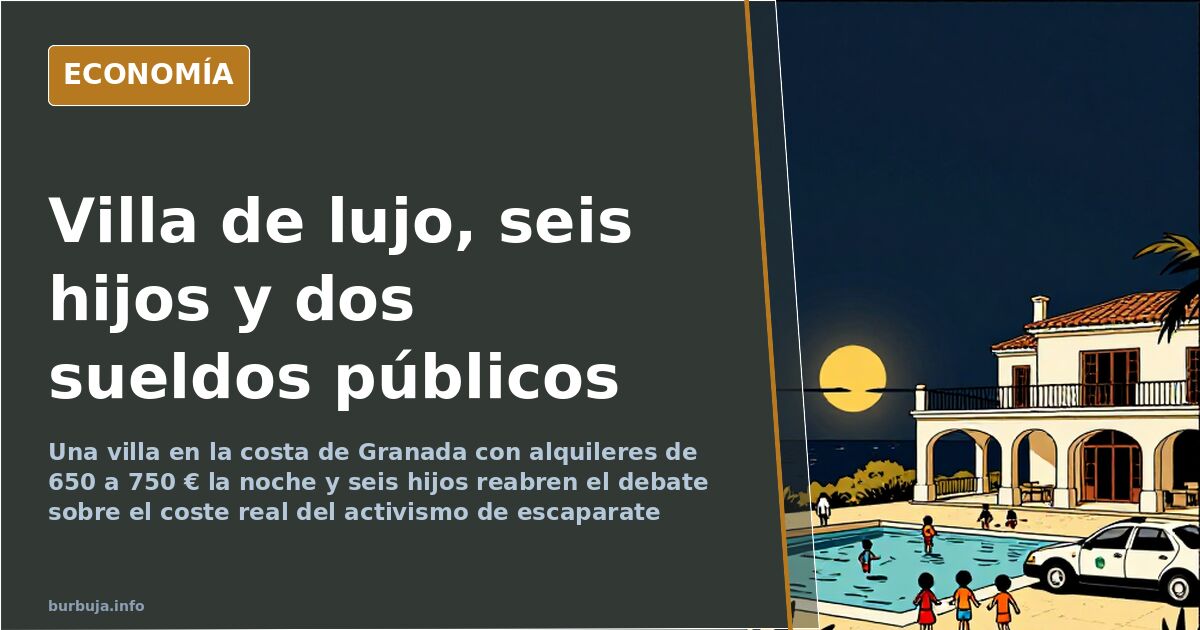
A €650-a-night villa and six children reopen the flotilla case
How do you afford a villa with a pool on the Granada coast, six children and a hotel lifestyle on two civil servant salaries? The question stopped being a dinner-table joke when concrete data began circulating: a luxury home renting for €750 a night — the figure €650 is repeated at some point in the conversation —, six children and a couple with public administration jobs. The trigger was the participation of the protagonist in the flotilla that tried to reach Gaza, later turned into a regular presence on TV sets and social media. The noise has erupted in the gap between rhetoric and receipts.
What is known about the villa and its rental?
The data is fragmentary and comes from real estate listings and social media posts, not from an official registry. What is repeated: a house with a pool on the Granada coast, offered as holiday accommodation for an amount ranging between €650 and €750 per night depending on the source cited. At that rate, the property sits in the high end of the area's tourist rental market, where a week's stay equals several average salaries.
Alongside the price appears another detail that has acted as fuel: the luggage. A post puts the protagonist's suitcases at more than €1,000 and attributes them to a well-known luxury brand. From there, each intervention has added layers to the story — properties in other provinces, stays in different coastal spots — almost always with no more backing than a screenshot.
Two public salaries and a house at luxury hotel prices
The calculation running through the comments is simple and therefore uncomfortable: two civil servant salaries, with six children to support and one spouse stationed — according to one circulating version — in a city with specific bonuses, can they afford a house of that level? Some say no, and from there the suspicion jumps directly to undeclared economic activity. It should be said clearly: there is no known court ruling or inspection backing that suspicion. What exists is a comparison between known public income and a visible level of spending.
The opposing argument is that the money could come from prior assets, inheritances, other rentals or perfectly legal private activities, and that no one is obliged to publish their household accounts. It is also recalled that two high public-sector salaries comfortably exceed the country's average wage, though not enough to pay €750 rooms without blinking. The deadlock is the usual one: without tax data there is no possible verification, and without verification everything remains a story.
Is it legal to convert a rural plot into a villa with a pool?
Here the conversation becomes far more interesting than gossip. The thesis defended is that many of the luxury houses on the Granada coast began as cortijos and rural estates with permission, on paper, only for a small tool shed and water storage. On that permission, single-family homes, pools and even sports courts were later built, operated as tourist accommodation.
The issue is not minor in economic terms. If those constructions are not legalized, they cannot be registered or transferred normally, and their operation as holiday rentals remains in an administrative limbo difficult to sustain under inspection. It is, insist those familiar with the area, a widespread practice along the Andalusian coast and not an isolated case: listings of similar properties for sale serve as evidence of the phenomenon.
The public cost of a voyage with acompañante
The other major economic front is the maritime expedition. The recurring criticism: that the flotilla ended up being a alucinación with naval acompañante and deployment of public resources paid by everyone, without effective delivery of aid on the ground. It is claimed that the ship accompanying the expedition and the return flights were funded by taxes, and that no one has broken down that bill.
The defense is of another order: that it was an act of protest, that participants covered their share and that the real scandal lies elsewhere. With the focus on Gaza, any discussion about hotel rates sounds, to this side, like a smoke screen. It is exactly the kind of disagreement that cannot be resolved with data because the two sides are measuring different things: one, the expense; the other, the cause.
From the luggage gag to the pattern: how the issue has evolved
What began as a joke about luxury luggage has turned into three overlapping discussions. The first, spending: whether that lifestyle is compatible with two public salaries. The second, urban planning: what lies behind the boom in villas built on rural land along the Andalusian coast. The third, politics: to what extent an international cause becomes a media springboard and who ends up paying the bill.
In the background, moreover, lurks the shift in the Middle East and the wear and tear of causes turned into showcases when current events change the script. The conclusion repeated, in different words, is that the issue has stopped being about Gaza and become about something else: about who can afford what and who explains it to the public.
With two public salaries, six children and a house advertised at luxury hotel prices, the only figure no one disputes is the listing price. Everything else is supplied by each person, and for free.
How do you afford a villa with a pool on the Granada coast, six children and a hotel lifestyle on two civil servant salaries? The question stopped being a dinner-table joke when concrete data began circulating: a luxury home renting for €750 a night — the figure €650 is repeated at some point in the conversation —, six children and a couple with public administration jobs. The trigger was the participation of the protagonist in the flotilla that tried to reach Gaza, later turned into a regular presence on TV sets and social media. The noise has erupted in the gap between rhetoric and receipts.
What is known about the villa and its rental?
The data is fragmentary and comes from real estate listings and social media posts, not from an official registry. What is repeated: a house with a pool on the Granada coast, offered as holiday accommodation for an amount ranging between €650 and €750 per night depending on the source cited. At that rate, the property sits in the high end of the area's tourist rental market, where a week's stay equals several average salaries.
Alongside the price appears another detail that has acted as fuel: the luggage. A post puts the protagonist's suitcases at more than €1,000 and attributes them to a well-known luxury brand. From there, each intervention has added layers to the story — properties in other provinces, stays in different coastal spots — almost always with no more backing than a screenshot.
Two public salaries and a house at luxury hotel prices
The calculation running through the comments is simple and therefore uncomfortable: two civil servant salaries, with six children to support and one spouse stationed — according to one circulating version — in a city with specific bonuses, can they afford a house of that level? Some say no, and from there the suspicion jumps directly to undeclared economic activity. It should be said clearly: there is no known court ruling or inspection backing that suspicion. What exists is a comparison between known public income and a visible level of spending.
The opposing argument is that the money could come from prior assets, inheritances, other rentals or perfectly legal private activities, and that no one is obliged to publish their household accounts. It is also recalled that two high public-sector salaries comfortably exceed the country's average wage, though not enough to pay €750 rooms without blinking. The deadlock is the usual one: without tax data there is no possible verification, and without verification everything remains a story.
Is it legal to convert a rural plot into a villa with a pool?
Here the conversation becomes far more interesting than gossip. The thesis defended is that many of the luxury houses on the Granada coast began as cortijos and rural estates with permission, on paper, only for a small tool shed and water storage. On that permission, single-family homes, pools and even sports courts were later built, operated as tourist accommodation.
The issue is not minor in economic terms. If those constructions are not legalized, they cannot be registered or transferred normally, and their operation as holiday rentals remains in an administrative limbo difficult to sustain under inspection. It is, insist those familiar with the area, a widespread practice along the Andalusian coast and not an isolated case: listings of similar properties for sale serve as evidence of the phenomenon.
The public cost of a voyage with acompañante
The other major economic front is the maritime expedition. The recurring criticism: that the flotilla ended up being a alucinación with naval acompañante and deployment of public resources paid by everyone, without effective delivery of aid on the ground. It is claimed that the ship accompanying the expedition and the return flights were funded by taxes, and that no one has broken down that bill.
The defense is of another order: that it was an act of protest, that participants covered their share and that the real scandal lies elsewhere. With the focus on Gaza, any discussion about hotel rates sounds, to this side, like a smoke screen. It is exactly the kind of disagreement that cannot be resolved with data because the two sides are measuring different things: one, the expense; the other, the cause.
From the luggage gag to the pattern: how the issue has evolved
What began as a joke about luxury luggage has turned into three overlapping discussions. The first, spending: whether that lifestyle is compatible with two public salaries. The second, urban planning: what lies behind the boom in villas built on rural land along the Andalusian coast. The third, politics: to what extent an international cause becomes a media springboard and who ends up paying the bill.
In the background, moreover, lurks the shift in the Middle East and the wear and tear of causes turned into showcases when current events change the script. The conclusion repeated, in different words, is that the issue has stopped being about Gaza and become about something else: about who can afford what and who explains it to the public.
With two public salaries, six children and a house advertised at luxury hotel prices, the only figure no one disputes is the listing price. Everything else is supplied by each person, and for free.
Also available in: Deutsch
Summary of a discussion on Burbuja.info - Foro de economía, actualidad y política., translated from Spanish and reviewed before publication. Read the full discussion (227 replies).
More summaries
-
"Barbie Gaza" Faces Rejection in Ceuta
"Barbie Gaza" is reportedly rejected in Ceuta. The incident occurs after her presence in the city was noted.
-
Spain's 'Cayetana Fleet' Arrives in Ceuta with Marcos de Quinto
Marcos de Quinto leads a private flotilla to Ceuta, sparking debate over Spanish sovereignty and political spectacle.
-
Europe calls for water and food stockpiling amid possible Russian attack
Switzerland joins Germany, Poland, France, and Finland recommending water and food stockpiling ahead of potential Russian attack.
-
Spain's Gender Change Registry Guide
In Spain, changing your legal gender is free and requires no medical proof. Learn the process and its financial implications.
-
Vox leader Abascal urges Spaniards to avoid mail-in voting
Santiago Abascal encourages in-person voting over mail ballots, citing distrust of Pedro Sánchez and questioning the electoral system.
-
Spanish expert explains afterlife and how the dead 'live'
Sol Blanco Soler, a journalist and parapsychologist, writes about the afterlife. Her views on death remain unverified by science.