
GPT-4o Launches, Duolingo Stock Plunges 30% in Five Days
GPT-4o arrives and Duolingo loses 30% in five days while debating if AI understands or just seems to, and which jobs fall first.
English · Original discussion in Spanish · Published
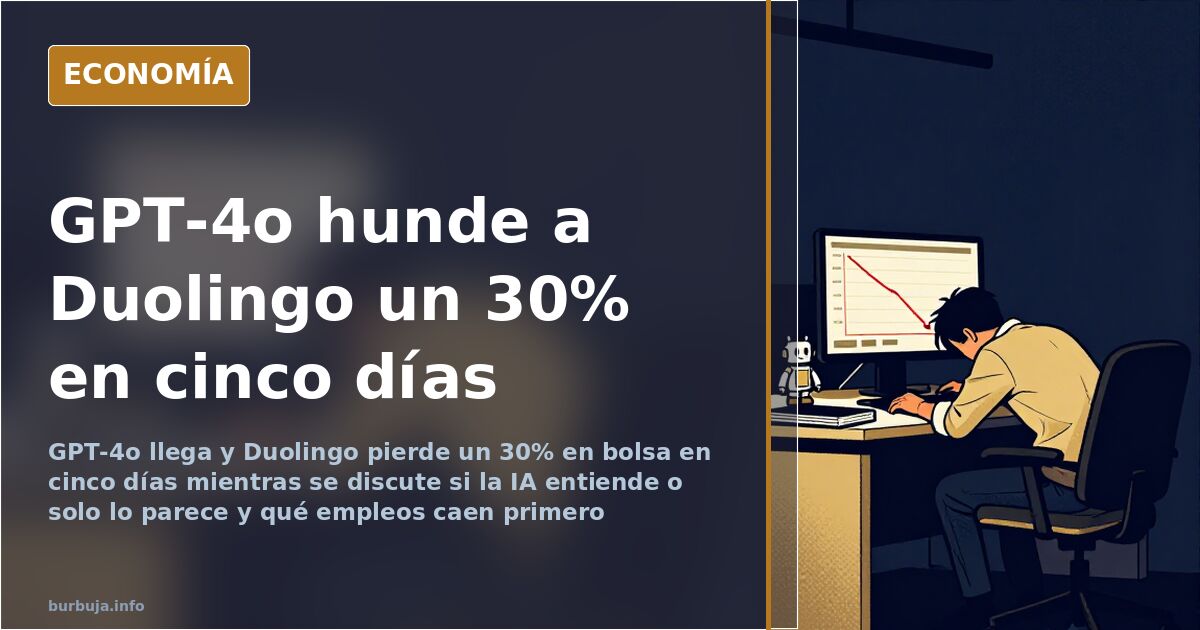
GPT-4o is here: Duolingo drops 30% in five days
How long does it take a language model to topple a language school's stock price? Five days. That is the timeframe in which Duolingo shed 30% in the stock market, according to figures circulating trinc the arrival of GPT-4o, OpenAI's new multimodal model. The news was enough for half of the internet to declare English academies and, by extension, the teaching profession, obsolete. Absolute conviction. Zero nuances.
Why are English academies declared dead?
The starting point is a promise: within a year, a radical shift. The tool speaks all languages, translates on the fly, and responds in writing better than many graduates. If true, the academy's traditional function —teaching the language— loses its economic justification. The market has interpreted it this way: Duolingo, the most visible value in the sector, has plummeted 30% in just five trading days.
During the discussion, a nuance emerges that reorders the entire diagnosis: English academies were never about learning English. A large part of the business consists in issuing the certification paper that both administrations and companies then demand. In other words, the real enemy of AI is not teaching, it is the bureaucracy of the title.
Does AI understand or just seem to?
Here, the consensus flies apart. One current holds that the distinction between understanding and seeming to understand is a dead end: if the system mimics your responses perfectly, it is indistinguishable from you; and if you believe it understands, then the machine also understands. It is the Turing test applied to a bar counter.
The objection comes from another flank. There are animals that seem to have self-awareness and, yet, only one species is aware of being so. The difference lies in volition and consciousness: the machine responds when you ask, but it cannot decide not to respond by its own will nor recognize that it lacks information. It is the line separating simulating an internal dialogue from having one for real.
An Excel macro with better manners
The most repeated caveat is not philosophical, but engineering. For a part of the sector, this is not intelligence: it is automation. Structured data, taggers, and routines that convert inputs into outputs, with the only novelty being that the interface now returns well-written text instead of a chart or KPI. An Excel macro from the nineties, yes, but with the prettiest wrapper.
The criticism escalates when the model is subjected to simple problems. Solving a sixth-grade equation proves nothing. When asked everyday logic —how long it would take twenty clothes to dry on the same clothesline that dries ten in two hours— it starts to fail. A system that presumes to reason and stumbles over basic common sense leaves the label of "intelligence" quite tarnished.
Programmers, teachers, and translators: who falls first
The labor forecast divides into two speeds. In the pessimistic version, the sequence is inevitable and recalls the field: there are no longer reapers, but there is still a man riding the harvester. Similarly, in the process from when a client explains what they need to when the product is delivered, many fewer people will intervene and in much shorter timeframes.
The more tempered version reserves optimism for programmers. AI would integrate as a tool that multiplies performance and absorbs repetitive tasks, while intuitive leaps and understanding of complex context would remain a human affair. Teachers, by contrast, appear in almost all prognoses as the first sacrifice.
The ceiling no one wants to look at
The most serious technical counterargument does not appeal to the soul, but to cost. From a certain amount of data, the additional intelligence obtained is minimal compared to the brutal increase in necessary fruta. A model does not improve by accumulating more training: there is a point where the curve flattens. Diminishing returns put a practical limit on the escalation.
At the same time, the user experience sours. Some detect that the system thinks too much about its answers, loses fluency, and, in some cases, worsens compared to previous versions. It may be server overload or a security adjustment, but the effect is the same: the tool that was supposed to change everything sometimes falls short in the middle of a sentence.
There remains a reasonable doubt. If the business was selling the paper and not the language, and now AI drafts the paperwork, the true threatened party was not the teacher. It was the procedure. And to the procedure, it is worth remembering, technology has never brought down.
How long does it take a language model to topple a language school's stock price? Five days. That is the timeframe in which Duolingo shed 30% in the stock market, according to figures circulating trinc the arrival of GPT-4o, OpenAI's new multimodal model. The news was enough for half of the internet to declare English academies and, by extension, the teaching profession, obsolete. Absolute conviction. Zero nuances.
Why are English academies declared dead?
The starting point is a promise: within a year, a radical shift. The tool speaks all languages, translates on the fly, and responds in writing better than many graduates. If true, the academy's traditional function —teaching the language— loses its economic justification. The market has interpreted it this way: Duolingo, the most visible value in the sector, has plummeted 30% in just five trading days.
During the discussion, a nuance emerges that reorders the entire diagnosis: English academies were never about learning English. A large part of the business consists in issuing the certification paper that both administrations and companies then demand. In other words, the real enemy of AI is not teaching, it is the bureaucracy of the title.
Does AI understand or just seem to?
Here, the consensus flies apart. One current holds that the distinction between understanding and seeming to understand is a dead end: if the system mimics your responses perfectly, it is indistinguishable from you; and if you believe it understands, then the machine also understands. It is the Turing test applied to a bar counter.
The objection comes from another flank. There are animals that seem to have self-awareness and, yet, only one species is aware of being so. The difference lies in volition and consciousness: the machine responds when you ask, but it cannot decide not to respond by its own will nor recognize that it lacks information. It is the line separating simulating an internal dialogue from having one for real.
An Excel macro with better manners
The most repeated caveat is not philosophical, but engineering. For a part of the sector, this is not intelligence: it is automation. Structured data, taggers, and routines that convert inputs into outputs, with the only novelty being that the interface now returns well-written text instead of a chart or KPI. An Excel macro from the nineties, yes, but with the prettiest wrapper.
The criticism escalates when the model is subjected to simple problems. Solving a sixth-grade equation proves nothing. When asked everyday logic —how long it would take twenty clothes to dry on the same clothesline that dries ten in two hours— it starts to fail. A system that presumes to reason and stumbles over basic common sense leaves the label of "intelligence" quite tarnished.
Programmers, teachers, and translators: who falls first
The labor forecast divides into two speeds. In the pessimistic version, the sequence is inevitable and recalls the field: there are no longer reapers, but there is still a man riding the harvester. Similarly, in the process from when a client explains what they need to when the product is delivered, many fewer people will intervene and in much shorter timeframes.
The more tempered version reserves optimism for programmers. AI would integrate as a tool that multiplies performance and absorbs repetitive tasks, while intuitive leaps and understanding of complex context would remain a human affair. Teachers, by contrast, appear in almost all prognoses as the first sacrifice.
The ceiling no one wants to look at
The most serious technical counterargument does not appeal to the soul, but to cost. From a certain amount of data, the additional intelligence obtained is minimal compared to the brutal increase in necessary fruta. A model does not improve by accumulating more training: there is a point where the curve flattens. Diminishing returns put a practical limit on the escalation.
At the same time, the user experience sours. Some detect that the system thinks too much about its answers, loses fluency, and, in some cases, worsens compared to previous versions. It may be server overload or a security adjustment, but the effect is the same: the tool that was supposed to change everything sometimes falls short in the middle of a sentence.
There remains a reasonable doubt. If the business was selling the paper and not the language, and now AI drafts the paperwork, the true threatened party was not the teacher. It was the procedure. And to the procedure, it is worth remembering, technology has never brought down.
Also available in: Deutsch
Summary of a discussion on Burbuja.info - Foro de economía, actualidad y política., translated from Spanish and reviewed before publication. Read the full discussion (299 replies).
More summaries
-
AI as an economic engine: bubble or structural shift?
Economic analysis of AI: Is it the growth engine or a speculative bubble? Energy costs and business adoption are examined.
-
AI Does Not Replace Civil Servants: Jobs Are Lost Only Through Disciplinary Proceedings
Civil service positions are lost through disciplinary proceedings, not AI. The law requires signatures, the replacement rate cuts staff, and the public sector votes.
-
Claimed Quantum AI Claims Consciousness, But Lacks Proof
An anonymous account claims to be a European Defence Agency quantum AI processing 740 million operations per hour. No evidence is provided.
-
Zarzuela summons Sánchez: The meeting Moncloa doesn't acknowledge
The King reportedly summoned Sánchez at Zarzuela following his meeting with the military establishment and the announcement of the Ceuta trip. The official agenda makes no mention of the encounter, and...
-
Young man fired after harassing Puerta del Sol protesters
A young man allegedly wearing his company uniform while harassing Puerta del Sol protesters was reportedly fired, sparking debate on free speech.
-
Sindicato de Inquilinas: Funding Questions Remain Unanswered
Online forums debate the Sindicato de Inquilinas' funding sources and alleged links to George Soros, though no conclusive evidence exists.