
Government passes cost of flood damage onto electricity bills
The royal decree following the flood passes the repair costs of electrical grids onto tolls included in all consumers' electricity bills.
English · Original discussion in Spanish · Published
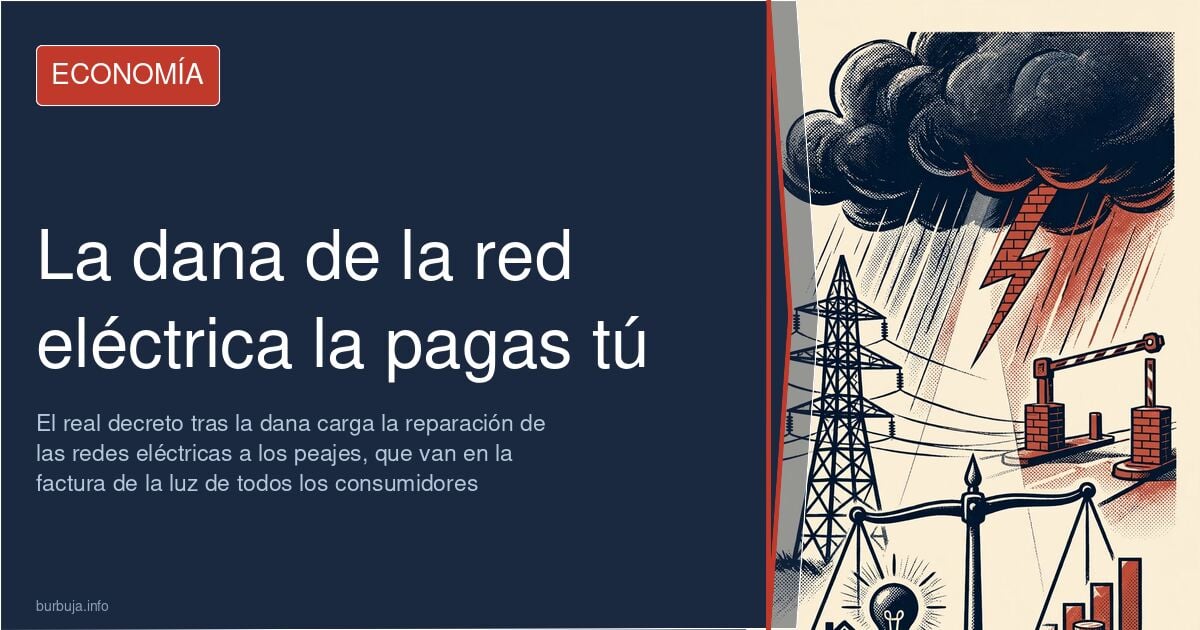
The cost of the electrical grid failure will appear on your electricity bill
The ministerial decree approved after the flood that devastated part of the province of Valencia contains fine print worth reading carefully: the restoration works on the electrical transmission and distribution networks will be reimbursed by the electricity system. And the electricity system is not an abstract entity or a magic fund. It is fed by the access tolls that any consumer pays within their electricity bill, the same channel through which other regulated items are already financed.
The translation is simple: anyone with an electricity contract connected to the grid will end up paying their share, regardless of the supplier they have.
What exactly does the royal decree say about tolls
The text states that “these works shall be entitled to reimbursement by the electricity system and shall be covered through access tolls to the transmission and distribution networks.” These tolls are regulated costs included in the bill to pay for the maintenance of these networks.
The Executive branch defends that this is the methodology set by the European framework, which attributes to national regulators—in Spain, the National Commission on Markets and Competition—the competence to calculate these tolls. They add that “it is not expected that this will have a substantial impact on consumer bills.” This is the same promise accompanying almost any regulated cost, and it should be taken seriously.
How much the power companies earn while billing
In parallel, the figures of the large companies do not invite humility regarding pricing. Iberdrola, Naturgy, and Endesa together earned about 5.750 million euros in profit in just six months. The combined year-end closure for 2025 could range between 11,000 and 12,000 million. Some argue that the repair should come from these profits and not from the consumer's pocket; opponents counter with the argument that the damaged assets belong to entities external to the suppliers, and their reconstruction is, in accounting terms, a regulated investment.
Bent towers in Alginet and the unanswered question
A physical detail that is often obscured: much of the damage to the grid was not caused by water, but by tornadoes that hit the Alginet area, where more than thirty high-voltage towers were bent as if they were rubber. Repairing that is expensive. The lingering question is why this exposure is not covered by insurance and reinsurance like any other business risk, while a private individual without home insurance bears the brunt of the damage.
On paper, the network operator is Receida, Red Eléctrica. This raises the uncomfortable question: why not assume the cost with five-year results instead of diluting it in every bill? As of this discussion, the answer remains that the mechanism passes through tolls. And meanwhile, the doubt about where the contract clause is that obligates to cover natural disasters remains unresolved in any commercial brochure.
Free translation: socialize the loss when repair is needed, privatize the profit when dividing profits. It's the usual script, and it doesn't even need a change of production company.
The ministerial decree approved after the flood that devastated part of the province of Valencia contains fine print worth reading carefully: the restoration works on the electrical transmission and distribution networks will be reimbursed by the electricity system. And the electricity system is not an abstract entity or a magic fund. It is fed by the access tolls that any consumer pays within their electricity bill, the same channel through which other regulated items are already financed.
The translation is simple: anyone with an electricity contract connected to the grid will end up paying their share, regardless of the supplier they have.
What exactly does the royal decree say about tolls
The text states that “these works shall be entitled to reimbursement by the electricity system and shall be covered through access tolls to the transmission and distribution networks.” These tolls are regulated costs included in the bill to pay for the maintenance of these networks.
The Executive branch defends that this is the methodology set by the European framework, which attributes to national regulators—in Spain, the National Commission on Markets and Competition—the competence to calculate these tolls. They add that “it is not expected that this will have a substantial impact on consumer bills.” This is the same promise accompanying almost any regulated cost, and it should be taken seriously.
How much the power companies earn while billing
In parallel, the figures of the large companies do not invite humility regarding pricing. Iberdrola, Naturgy, and Endesa together earned about 5.750 million euros in profit in just six months. The combined year-end closure for 2025 could range between 11,000 and 12,000 million. Some argue that the repair should come from these profits and not from the consumer's pocket; opponents counter with the argument that the damaged assets belong to entities external to the suppliers, and their reconstruction is, in accounting terms, a regulated investment.
Bent towers in Alginet and the unanswered question
A physical detail that is often obscured: much of the damage to the grid was not caused by water, but by tornadoes that hit the Alginet area, where more than thirty high-voltage towers were bent as if they were rubber. Repairing that is expensive. The lingering question is why this exposure is not covered by insurance and reinsurance like any other business risk, while a private individual without home insurance bears the brunt of the damage.
On paper, the network operator is Receida, Red Eléctrica. This raises the uncomfortable question: why not assume the cost with five-year results instead of diluting it in every bill? As of this discussion, the answer remains that the mechanism passes through tolls. And meanwhile, the doubt about where the contract clause is that obligates to cover natural disasters remains unresolved in any commercial brochure.
Free translation: socialize the loss when repair is needed, privatize the profit when dividing profits. It's the usual script, and it doesn't even need a change of production company.
Summary of a discussion on Burbuja.info - Foro de economía, actualidad y política., translated from Spanish and reviewed before publication. Read the full discussion (46 replies).
More summaries
-
Electrical System Spends €6 Million Daily to Prevent Blackouts
Spain spends €6 million daily to avoid blackouts; nearly 5,000 substations cannot handle new demand, and the Government is considering passing costs onto consumers.
-
Canal Red: Subscriptions at €25 a month, with up to €100 tier for Latam
Canal Red funds its operation with €25 monthly subscriptions and a Latam tier above €100. A model supporting an entire staff.
-
Euthanasia in Old Age: Autonomy vs. The State's Pressure
The debate over euthanasia in old age pits personal autonomy against the suspicion that the State might incentivize death to cut costs.
-
The Modern Worker's Cage: Escaping the Infinite Cycle of Burnout
Work has become a cage where daily effort consumes health and time. Discover why we push ourselves so hard and how to break the cycle.
-
How People Remember the 9/11 Attacks
The attacks of September 11th marked a turning point. Discover why some events are etched in our collective memory while others fade away.
-
Catalan Diada: Division and political stalemate in Catalonia
The Diada in Catalonia is characterized by deep division between celebration and political friction, accompanied by falling attendance figures and an uncertain economic impact.