
Government extends fuel subsidies until the end of the year
The 20-cent-per-litre discount sits alongside fuel nearing €2 while the government caps gas and butane price rises
English · Original discussion in Spanish · Published
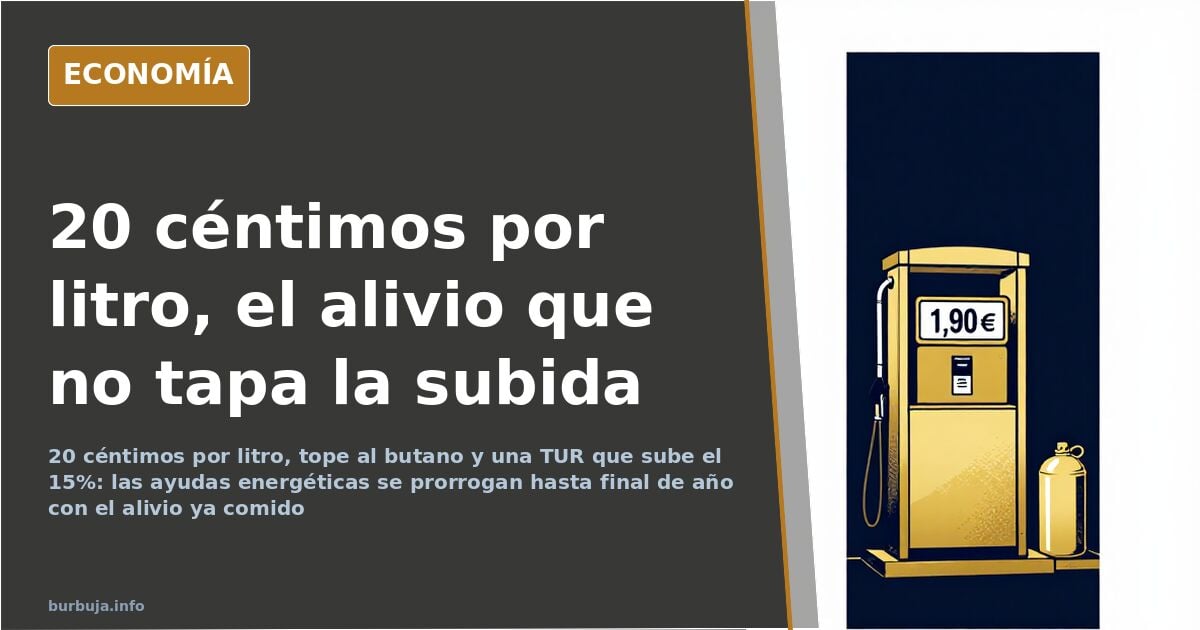
20-cent fuel discount with the litre already at €1.90
Refunding 20 cents per litre from a tax the driver has already paid is not aid: it is a rebate charged to the same account. The government is extending the fuel discount until the end of the year and, at the same time, capping the rise in gas and butane. The small print is that the pump is already hovering between €1.90 and €2 per litre, that the regulated gas tariff (TUR) is rising by around 15%, and that the relief lasts only as long as it takes the next bill to arrive. They block the kitchen window and open the garage one, to use the simile that circulates best. And the headline comes out perfectly rounded.
Where do the 20 cents of the discount come from?
From the same pocket they claim to relieve. The discount is applied at the till, but the money came in earlier through tax, so the operation amounts to refunding part of what was already collected. Seen that way, state-sponsored penny-pinching: a little handout so nobody kicks up a fuss while the rip-off arrives from another direction. The maths closes itself when crude rises for two consecutive quarters and eats the discount's margin.
The self-employed van driver: €470 a month on diesel
Here the numbers stop being rhetoric. A self-employed delivery driver doing 150 kilometres a day between routes and the alucinación to the industrial estate to load, with average consumption of 7.5 litres per 100 km, gets through about 11.2 litres a day. At €1.90 a litre that is close to €21 a day and, counting 22 working days, around €470 a month on fuel alone. The full calculation, broken down item by item, leaves a surprising difference: the discount covers a fraction of the hole and the rest goes on the self-employed worker's account.
Gas rises and butane is frozen: what the cap means
The package does not stop at fuel. The government extends the aid and, at the same time, halts the rise in butane, while the regulated gas tariff (TUR) becomes around 15% more expensive. Freezing the small thing and letting the big one run has its political logic: everyone sees the butane cylinder, the TUR is paid by direct debit and almost nobody looks at it. The result is a consumer who thinks they have won the battle of the cylinder and has lost the battle of heating.
Kicking the can down the road and who pays the next round
Nobody has the date of the shock, and anyone who gives it is selling something. What can be traced are the fragile fronts highlighted by the gloomiest analyses: the cost of refinancing debt, with the ECB buying less than it used to; EU funds, which have papered over years of public investment and will one day close; and energy, where a soaring barrel wipes out any discount of cents. There are also those who argue that this won't blow up through a textbook hyperinflation, but when the person delivering the goods says the numbers don't add up.
Meanwhile, the terraces are still full and everything looks calm. That's what an extension does: it doesn't solve the problem, it only postpones the conversation. How many quarterly rises are needed before two euros per litre turn the discount into an anecdote?
Refunding 20 cents per litre from a tax the driver has already paid is not aid: it is a rebate charged to the same account. The government is extending the fuel discount until the end of the year and, at the same time, capping the rise in gas and butane. The small print is that the pump is already hovering between €1.90 and €2 per litre, that the regulated gas tariff (TUR) is rising by around 15%, and that the relief lasts only as long as it takes the next bill to arrive. They block the kitchen window and open the garage one, to use the simile that circulates best. And the headline comes out perfectly rounded.
Where do the 20 cents of the discount come from?
From the same pocket they claim to relieve. The discount is applied at the till, but the money came in earlier through tax, so the operation amounts to refunding part of what was already collected. Seen that way, state-sponsored penny-pinching: a little handout so nobody kicks up a fuss while the rip-off arrives from another direction. The maths closes itself when crude rises for two consecutive quarters and eats the discount's margin.
The self-employed van driver: €470 a month on diesel
Here the numbers stop being rhetoric. A self-employed delivery driver doing 150 kilometres a day between routes and the alucinación to the industrial estate to load, with average consumption of 7.5 litres per 100 km, gets through about 11.2 litres a day. At €1.90 a litre that is close to €21 a day and, counting 22 working days, around €470 a month on fuel alone. The full calculation, broken down item by item, leaves a surprising difference: the discount covers a fraction of the hole and the rest goes on the self-employed worker's account.
Gas rises and butane is frozen: what the cap means
The package does not stop at fuel. The government extends the aid and, at the same time, halts the rise in butane, while the regulated gas tariff (TUR) becomes around 15% more expensive. Freezing the small thing and letting the big one run has its political logic: everyone sees the butane cylinder, the TUR is paid by direct debit and almost nobody looks at it. The result is a consumer who thinks they have won the battle of the cylinder and has lost the battle of heating.
Kicking the can down the road and who pays the next round
Nobody has the date of the shock, and anyone who gives it is selling something. What can be traced are the fragile fronts highlighted by the gloomiest analyses: the cost of refinancing debt, with the ECB buying less than it used to; EU funds, which have papered over years of public investment and will one day close; and energy, where a soaring barrel wipes out any discount of cents. There are also those who argue that this won't blow up through a textbook hyperinflation, but when the person delivering the goods says the numbers don't add up.
Meanwhile, the terraces are still full and everything looks calm. That's what an extension does: it doesn't solve the problem, it only postpones the conversation. How many quarterly rises are needed before two euros per litre turn the discount into an anecdote?
Summary of a discussion on Burbuja.info - Foro de economía, actualidad y política., translated from Spanish and reviewed before publication. Read the full discussion (16 replies).
More summaries
-
The End of the West: Sexual Liberation vs. Public Debt
US public debt soars alongside sexual liberalization. A study by J.D. Unwin links cultural decline to relaxed sexual norms and rising hypergamy.
-
Córdoba Father Self-Immolates: Mental Illness or Societal Despair?
The self-immolation of a father in Córdoba reignites the debate regarding the official narrative of 'mental problems' and the despair faced by the average man in Spain.
-
Euthanasia in Old Age: Autonomy vs. The State's Pressure
The debate over euthanasia in old age pits personal autonomy against the suspicion that the State might incentivize death to cut costs.
-
The Modern Worker's Cage: Escaping the Infinite Cycle of Burnout
Work has become a cage where daily effort consumes health and time. Discover why we push ourselves so hard and how to break the cycle.
-
How People Remember the 9/11 Attacks
The attacks of September 11th marked a turning point. Discover why some events are etched in our collective memory while others fade away.
-
Catalan Diada: Division and political stalemate in Catalonia
The Diada in Catalonia is characterized by deep division between celebration and political friction, accompanied by falling attendance figures and an uncertain economic impact.