
Gold Tops $4,000 as Germany Demands Repatriation of US Reserves
Gold surpasses $4,000 per ounce while Germany and Italy seek repatriation of $245 billion in reserves held in the United States.
English · Original discussion in Spanish · Published
Gold Tops $4,000 as Germany Demands Repatriation of US Reserves
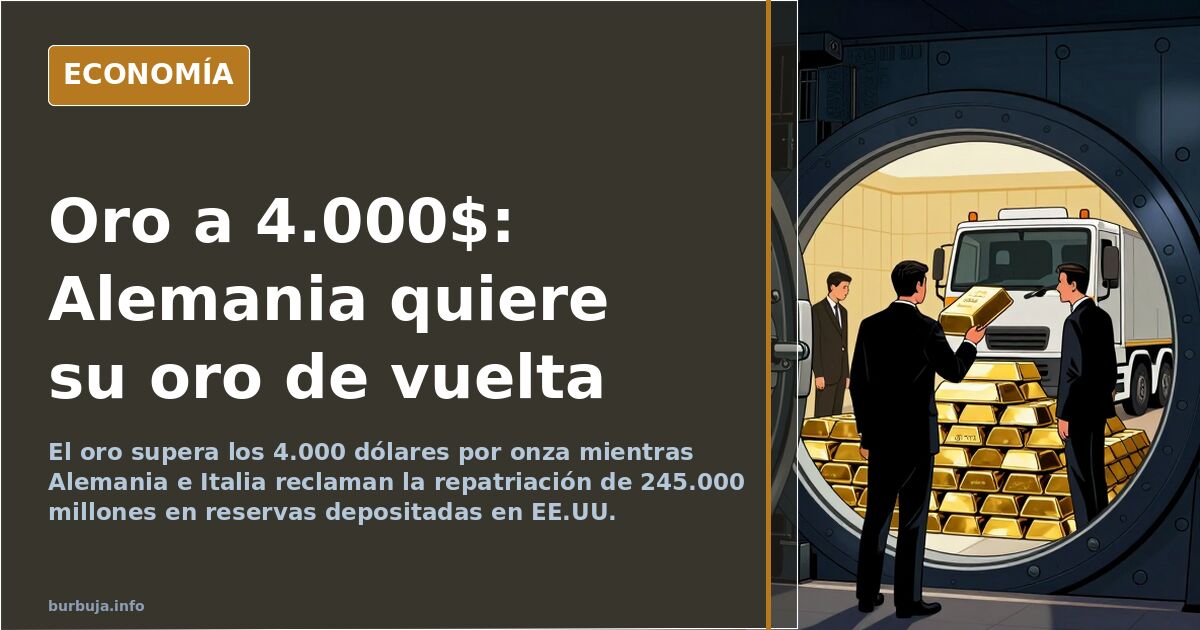
Gold has breached the $4,000-per-ounce barrier, and the debate raging in economic circles is not about charts or technical analysis. It is about vaults. Who holds what, and where. According to circulating reports, Germany and Italy have been pressured to repatriate $245 billion in gold deposited in the United States, reviving an old suspicion: that central bank reserves are not where the paperwork claims they are. Meanwhile, the price of an ounce continues to rise effortlessly, and many have long warned that this trend was not a fad, but an escape.
The Gold Spain Sold at $400 an Ounce
There is a fact that stings in Spain every time the metal rises. In 2007, the government of José Luis Rodríguez Zapatero sold approximately one-third of the Banco de España's gold reserves. The price then hovered around $400 per ounce. Today, with gold above $4,000, that operation is viewed as one of the worst asset management decisions in recent democratic history. The comparison is brutal: one-tenth of its current value. Those who defended the sale argued then that the metal yielded no return and that diversification was necessary. Time has rendered its verdict.
This episode is not isolated. The history of Spanish gold is filled with opaque events, from the transfer to Moscow during the Civil War to silver shipments to Switzerland in the 1980s. Each generation has had its own chapter of reserves vanishing between official explanations and administrative silences. The difference now is that the price puts figures on what were once mere suspicions.
Why Are Central Banks Buying Gold Like There Is No Tomorrow?
The surge in recent years has not been driven by retail investors. It has been driven by central banks. And there lies the paradox: nothing is more pro-system than a central bank, yet they are accumulating physical metal at a pace unseen in decades. The recurring explanation is geopolitical. Since the confiscation of Russian reserves trinc the invasion of Ukraine, NATO debt has ceased to be a safe haven for half of humanity. If your reserves can be frozen by political decision, physical gold in your own vault ceases to be a relic and becomes insurance.
This argument supports the thesis of a return to the gold standard at the interstate level. Not as a formal monetary system, but as a de facto reality: states that can accumulate metal do so, and those holding it abroad are beginning to demand its return. Germany and Italy moving in this direction would not be an exception, but the tip of an iceberg.
The Saver Who Bought One Ounce a Year and the One Who Regrets Not Doing So
At the other end of the debate is the everyday saver. Some started buying one ounce a year five years ago, aiming to secure an annuity for each year of retirement, and today see their plan working. They bought at $1,750, then $1,800, and the last at $3,450. Facing them is the person who has spent two years saving in colorful paper notes and now looks at the chart with a mix of anger and FOMO. The question they ask is the same as always: Am I too late? The honest answer is that no one knows, and anyone claiming otherwise is selling something.
Sentiment indicators, warn the cautious, show euphoria. Historically, euphoria has not been a good advisor for entry. But the counterargument also carries weight: if this is a structural revaluation and not a speculative peak, today's $4,000 will be tomorrow's $2,000 in real terms.
Gold as Everyday Currency: Getting a Haircut for an Ounce of Silver
There is a movement that goes beyond investment and proposes metal as a direct medium of exchange. The idea is simple: if the fiat system breaks, those holding gold and silver can trade them for goods and services without going through a bank. The example often cited is Weimar Germany, where hundred-billion-mark bills ended up serving to light fireplaces. Those who kept metal, it is said, survived the winter without burning their wealth.
The practical objection is equally simple: carrying three kilos of gold reduces the trunk space of three large suitcases to a toiletry bag. And finding someone willing to accept an ounce for a haircut requires an ecosystem that does not exist today. Metal is a store of value, not common currency. Confusing the two is the classic error.
Gold is not rising because it is more valuable. It is rising because fiat money is worth less. This phrase, repeated ad nauseam, summarizes the uncomfortable consensus: the printer does not stop, debt is not paid off, and metal is the only asset that does not depend on anyone's promise. Up to here, everyone agrees. Disagreement begins when trying to put a figure on the ceiling. Some speak of $5,000, others point to $10,000, and some argue that the ounce should already be at $50,000 if the price reflected the actual money supply. No one knows where this stops. And that is, exactly, the problem.
Also available in: Deutsch
Summary of a discussion on Burbuja.info - Foro de economía, actualidad y política., translated from Spanish and reviewed before publication. Read the full discussion (139 replies).
More summaries
-
US Embassy Staff Collaborated with Police in Zapatero Money Laundering Probe
US embassy staff assisted Spanish police in the Zapatero money laundering investigation, sparking debate on political purges vs. justice.
-
Trump says US military took out Tren de Aragua leader
Trump confirms the death of Héctor 'Niño' Guerrero, leader of Tren de Aragua. Questions arise over a possible tip-off from Delcy Rodríguez for 5 million dollars.
-
Why No One Laughs at the "Pepitos" Who Bought Homes Anymore
Homes bought twenty years ago are almost paid off while rent devours salaries: why the old joke about "pepitos" is dead.
-
Mabel Lozano: from Interviú model to anti-trafficking activist
A debate on Mabel Lozano, who went from posing for Interviú to becoming an anti-trafficking activist and producing 'El Castillo', a series criticised for its portrayal of the…
-
Home insurance with your mortgage: 0.10% discount vs a 200-euro markup
A 0.10% discount on a mortgage saves 100 euros a year per 100,000 borrowed. If the bank's insurance costs 200 more, the tie-in loses money.
-
The era of the well-groomed snake oil salesmen is over
Obama won the Nobel Peace Prize nine months after taking office in 2009. The image-based leadership model is wearing out, giving way to profiles that build.