
Gold Futures Hit $2,543 Amid Record Streak
Gold futures reach $2,543 per ounce and CFDs surpass $2,500, continuing a record streak from the $1,825 average on October 8.
English · Original discussion in Spanish · Published
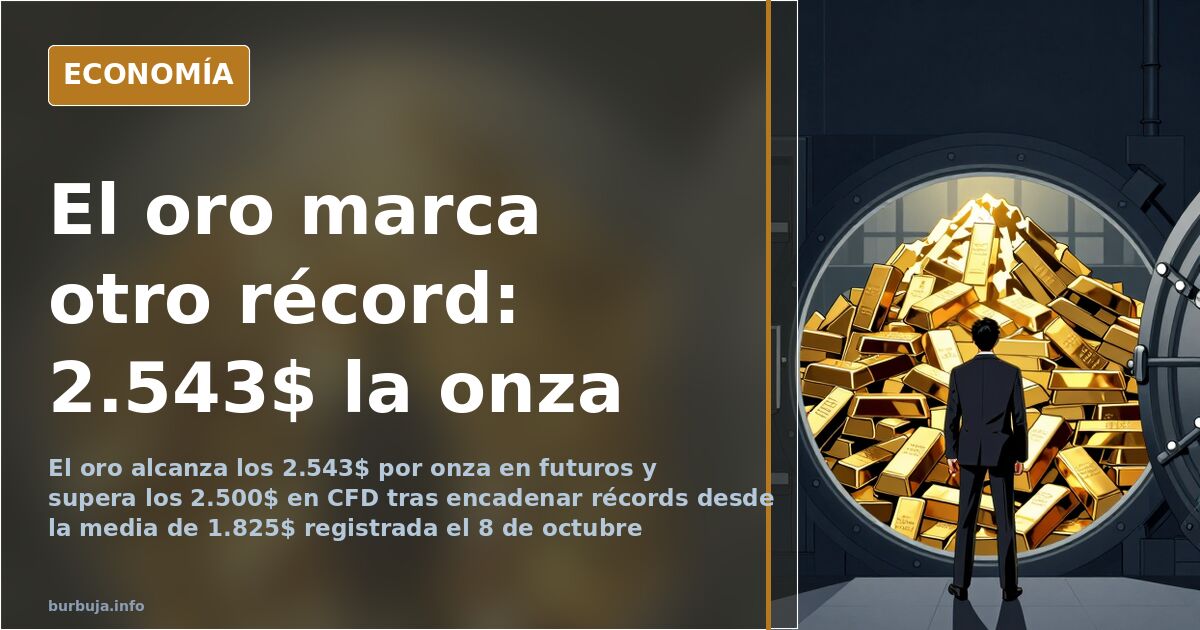
Gold Futures Hit $2,543; CFDs Surpass $2,500
How high can gold go before someone dares to set a ceiling? The figure changes every week. The metal has reached $2,543 per ounce in futures and surpassed $2,500 in contracts for difference (CFDs), a level that, according to one participant, has been seen only a handful of times, all within the last three years. What is striking is not the record itself, but that it chains together another and another without pause. And at the bottom lies the same uncomfortable question: does this speak of gold or of the money with which we measure it?
From $1,825 to $2,543: The Start of the Climb
The starting point is dated: an average of $1,825 per ounce on October 8, after recovering April levels and adding about $180 since the beginning of the month. The day after the conflict in Gaza began—which, as stated in the thread, started on October 7—there were already those pointing to it as the trigger for the rise. It was not an original reading, but it was the most repeated.
With that tailwind, bets skyrocketed. There was speculation whether Monday would open the path to $2,050 per ounce. Someone threw out $5,000 without blinking. And amid so much vertigo appeared the first voice calling for calm: for gold to multiply its value, there would need to be a brutal drop in fiat currencies worldwide, something that requires combining several first-order factors at once. $3,000 did seem likely, "in a few years, even less."
The $1,950 Floor That Withstood the First Blow
Monday was not apocalyptic. Gold fell to just over $1,980, recovered $2,000, and was seen again at $1,995. Neither collapse nor rocket. The key was elsewhere: the new line of persistence settled on $1,950, a level it had not broken since the 19th, with an average hovering around $1,980.
Weeks later came confirmation: Friday's close above $2,000 and quotation installed at $2,009. The floor had risen, and those expecting a deep correction were still waiting.
$2,400 First, Then $2,543: Records Trinc Each Other
From there, the series became mechanical. Futures at $2,400 per ounce, with a maximum of $2,450; CFDs closing at $2,343 after rising to $2,431. Another record. Days later, again above $2,400. And the definitive jump: CFDs at $2,504 and futures at $2,543.
The complete graph, with the detail of each ramp and the two views compared, draws an annual slope that seems drawn with a ruler. The fine material—the live graphs that were shared—is one click away and worth looking at calmly.
Why Is Gold Rising? Debt, Safe Haven, and BRICS Purchases
The strongest argument does not speak of gold, but of the other side of the quotient. Everything seems to be at highs not because assets are worth more, but because the debt-money with which they are compared is at lows. A detail often overlooked: the reference is taken against one of the world's strongest currencies. And there is no scientific, technological, or energy pogre that improves production yields at the rate debt has been issued for years.
In that framework, gold recovers its classic label: safe haven. Added to the list is a geopolitical factor. It is maintained that several countries integrated into the BRICS have long been buying metal to back a possible common currency. And a recurring suspicion hovers, that of a Comex fed by paper slips that do not represent physical metal. If the rise is still so strong, the reasoning closes on its own.
There is a phrase that summarizes the dominant current: gold is not an asset, it is money. With its corollary: the metal never goes up or down in price, what goes up or down is the value of the paper money issued by central banks. Those who earn in Swiss francs find it easier to understand: just look at the euro/franc chart of the last three years.
Warnings: Corrections to $1,300 and the Ghost of the Bubble
Not everyone buys the story. Part of the analysis expects a brutal fall unless there is war escalation, with $1,300 "close." Another remembers that it was read somewhere that gold would be worth 20% of its price. And a third looks at the metal as what it is for many savers: too slow an investment, useful only for those who get the timing right.
The most uncomfortable objection is not financial, it is material. If things really get bad, drinking water and self-reproducible seeds will be worth more than the ingot. The answer to that is in the margins of the matter: when the currency breaks, the metal buys hectares, houses, and food, not the other way around. The testimony of those who kept dollars and gold at the bottom of a well is enough, and after the bank freeze, they got hold of a bunch of hectares when no one had cash or valuables. Others bought 20 and 50 gram bars and ounces two or three years ago, as if there were no tomorrow, and now they only have to enjoy the enjoyment.
While debating whether it hits a ceiling or if the ceiling no longer exists, there are those who sleep with a 50% allocation in cash and another 50% between gold and silver, with the rod ready. Prudent. Although if the scenario they describe comes true, the problem will not be the price of the ounce: it will be finding someone to exchange it for bread.
How high can gold go before someone dares to set a ceiling? The figure changes every week. The metal has reached $2,543 per ounce in futures and surpassed $2,500 in contracts for difference (CFDs), a level that, according to one participant, has been seen only a handful of times, all within the last three years. What is striking is not the record itself, but that it chains together another and another without pause. And at the bottom lies the same uncomfortable question: does this speak of gold or of the money with which we measure it?
From $1,825 to $2,543: The Start of the Climb
The starting point is dated: an average of $1,825 per ounce on October 8, after recovering April levels and adding about $180 since the beginning of the month. The day after the conflict in Gaza began—which, as stated in the thread, started on October 7—there were already those pointing to it as the trigger for the rise. It was not an original reading, but it was the most repeated.
With that tailwind, bets skyrocketed. There was speculation whether Monday would open the path to $2,050 per ounce. Someone threw out $5,000 without blinking. And amid so much vertigo appeared the first voice calling for calm: for gold to multiply its value, there would need to be a brutal drop in fiat currencies worldwide, something that requires combining several first-order factors at once. $3,000 did seem likely, "in a few years, even less."
The $1,950 Floor That Withstood the First Blow
Monday was not apocalyptic. Gold fell to just over $1,980, recovered $2,000, and was seen again at $1,995. Neither collapse nor rocket. The key was elsewhere: the new line of persistence settled on $1,950, a level it had not broken since the 19th, with an average hovering around $1,980.
Weeks later came confirmation: Friday's close above $2,000 and quotation installed at $2,009. The floor had risen, and those expecting a deep correction were still waiting.
$2,400 First, Then $2,543: Records Trinc Each Other
From there, the series became mechanical. Futures at $2,400 per ounce, with a maximum of $2,450; CFDs closing at $2,343 after rising to $2,431. Another record. Days later, again above $2,400. And the definitive jump: CFDs at $2,504 and futures at $2,543.
The complete graph, with the detail of each ramp and the two views compared, draws an annual slope that seems drawn with a ruler. The fine material—the live graphs that were shared—is one click away and worth looking at calmly.
Why Is Gold Rising? Debt, Safe Haven, and BRICS Purchases
The strongest argument does not speak of gold, but of the other side of the quotient. Everything seems to be at highs not because assets are worth more, but because the debt-money with which they are compared is at lows. A detail often overlooked: the reference is taken against one of the world's strongest currencies. And there is no scientific, technological, or energy pogre that improves production yields at the rate debt has been issued for years.
In that framework, gold recovers its classic label: safe haven. Added to the list is a geopolitical factor. It is maintained that several countries integrated into the BRICS have long been buying metal to back a possible common currency. And a recurring suspicion hovers, that of a Comex fed by paper slips that do not represent physical metal. If the rise is still so strong, the reasoning closes on its own.
There is a phrase that summarizes the dominant current: gold is not an asset, it is money. With its corollary: the metal never goes up or down in price, what goes up or down is the value of the paper money issued by central banks. Those who earn in Swiss francs find it easier to understand: just look at the euro/franc chart of the last three years.
Warnings: Corrections to $1,300 and the Ghost of the Bubble
Not everyone buys the story. Part of the analysis expects a brutal fall unless there is war escalation, with $1,300 "close." Another remembers that it was read somewhere that gold would be worth 20% of its price. And a third looks at the metal as what it is for many savers: too slow an investment, useful only for those who get the timing right.
The most uncomfortable objection is not financial, it is material. If things really get bad, drinking water and self-reproducible seeds will be worth more than the ingot. The answer to that is in the margins of the matter: when the currency breaks, the metal buys hectares, houses, and food, not the other way around. The testimony of those who kept dollars and gold at the bottom of a well is enough, and after the bank freeze, they got hold of a bunch of hectares when no one had cash or valuables. Others bought 20 and 50 gram bars and ounces two or three years ago, as if there were no tomorrow, and now they only have to enjoy the enjoyment.
While debating whether it hits a ceiling or if the ceiling no longer exists, there are those who sleep with a 50% allocation in cash and another 50% between gold and silver, with the rod ready. Prudent. Although if the scenario they describe comes true, the problem will not be the price of the ounce: it will be finding someone to exchange it for bread.
Also available in: Deutsch
Summary of a discussion on Burbuja.info - Foro de economía, actualidad y política., translated from Spanish and reviewed before publication. Read the full discussion (124 replies).
More summaries
-
China CPI stalls at 0.1% as Europe lags on inflation
China's annual CPI holds at 0.1%, exhausting forecasts, while the highest rate hikes since Volcker fail to return European inflation to the 2% target.
-
Central Banks Cut Rates: Lifeline or Patch?
ECB and Fed cut rates by 0.5% on Oct 8, 2008, in a coordinated move. The euro area borrowing rate failed to react, and the TED spread hit a record.
-
Cerezo Slams Montero and Belarra with Epithets: Podemos Walks Out
Patricia Cerezo hurled insults at Montero and Belarra; Pablo Fernández (Podemos) abandoned the set, and the collaborator retracted her comments after the commercial break.
-
Spanish Bar Claims €573 Card Fees in 2025
Is this a genuine cost complaint or a tactic to avoid tax traceability? We analyze the debate.
-
Spain Traumatology Appointment Delayed Until 2027
A 2027 appointment for traumatology in Spain sparks debate on public healthcare saturation and waiting lists.
-
Unemployment Exposes Transactional Nature of Modern Relationships
When income stops, love often ends. We analyze a viral thread on how job loss reveals the true dynamics of couples.