
Gold fails in a Mad Max scenario: it is only a refuge within the system
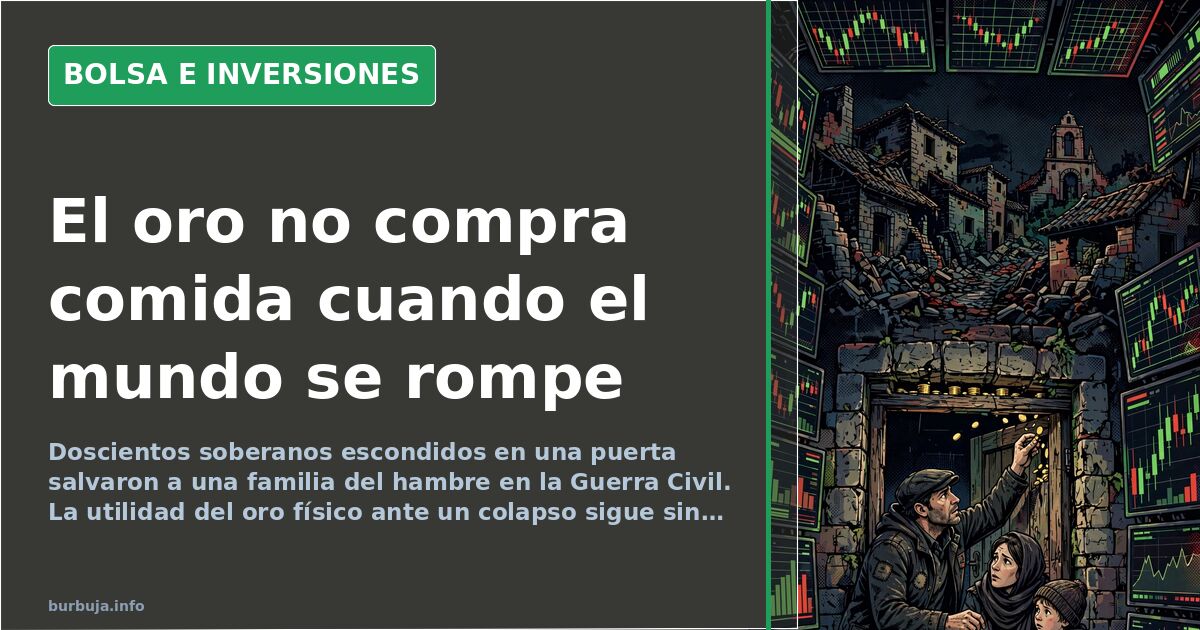
Two hundred sovereigns hidden in a door frame saved a family from starvation during the Spanish Civil War. The utility of physical gold in a total collapse remains debated.
English · Original discussion in Spanish · Published
Gold feeds no one when the system breaks
A handful of coins hidden in a door frame was what separated a family from starvation during the Spanish Civil War. Their descendants tell the story without embellishment: with metal, they accessed the black market; with paper pesetas, they couldn't even buy potatoes. Today that same metal trades at historic highs and is sold as a shield against any catastrophe. The doubt lies elsewhere: what good is physical gold if there is nothing left to buy?
Does gold work in a collapse or only in an economic downturn?
The starting point is a list of possible endings: a climatic, health, or technological apocalypse; a world war; social collapse; an oil crash without orderly transition. In any of these scenarios, the argument that peine the discussion holds that switching from a fiat system based on colored paper to a hoarding system of tin lids adds exactly zero real energy value. Most defenders of the metal, he adds, do not think about a long-term collapse, but about an intermediate stage with some order and government: the Mad Max of the first film, not the subsequent desert.
The underlying suspicion is that gold works as a refuge within the status quo, not outside it. Those who buy it are essentially betting that the system will hold; if they truly believed it would fall completely, carrying an ounce in their pocket would make little sense.
The Spanish experience: worthless pesetas and rings that bought bacon
The most repeated counterargument is not theoretical, but familial. There was a recent time when gold and silver bought food in Spain. In Republican Madrid, according to direct testimonies, families survived thanks to two hundred sovereigns kept in a door frame: black market goods were paid for in metal because paper pesetas were worthless.
The post-war period trinc the same pattern. Those who had coins or jewelry could escape poverty; those who only had banknotes could not. So much so that Franco's first government promulgated a law dated January 20, 1939, which stripped all silver coinage of legal tender status and ordered its immediate surrender under threat of incivil penalty. People had already learned to trust metal, not paper. Another family memory describes a grandmother going to the black market with a small ring to return with potatoes and bacon, while her neighbors watched enviously.
Water, food, and a gold tooth: you cannot eat gold
Here lies the core of the opposing thesis. Gold has no intrinsic value: in a full collapse, water and any edible item are worth more. Those who argue they can exchange coins for food have misunderstood the situation, critics say. And in a scenario of true rupture, carrying gold is more of a problem than an advantage: being the person with metal in a lawless world is equivalent to being a country with natural resources and no army to defend them, a magnet for incivil.
On the ground, the first phase of any collapse looks little like a movie. Most urban dwellers stay home without electricity or running water; a minority with family in the village and a shotgun tries to leave; the army cuts roads and there is not enough gold to bribe everyone. In this stretch, the metal serves, at best, to pay for a new tooth.
Gold is for after the disaster, not for the disaster itself
An intermediate current proposes distinguishing two moments. During riots, what is appropriate is to hunker down and wait; metal is not for that ordeal. It is for when things stabilize, everyone poorer but without unrest, and those who kept gold maintain much of their purchasing power. Not short term nor very long term: its function is to appear when times get tough, whenever that may be.
There is a nuance that complicates the narrative of purely local collapse. The price of gold is global, not local. You can have a country torn apart, like Venezuela, where the metal still trades at the international price and you can sell it to a foreign intermediary. Even those who do not believe in total collapse admit that, in any scenario other than the end of the world, life is better with gold than without it.
Tungsten, lead, and scales: the problem of counterfeiting
In a night-time exchange in the dark, you cannot rely entirely on shine. The objection is reasonable: imitations exist, metals are alloyed, and there are entire series dedicated to counterfeit coins. However, the technical response is decisive: gold and lead are in the same periodic table column, and since Archimedes, the principle of density has been established. A caliper and a cheap precision scale measure and weigh the same whether there is light or not, regardless of the weather.
The most meticulous add that classic bullion coins—sovereigns, Krugerrands, Napoleons—ring when struck and are expensive to reproduce with copper-tungsten alloys. Another practical option: silver for small exchanges and thin coins that can be cut with pliers, although some dust is lost when cutting them.
Who moves the piece: BRICS, China, and Siberian mines
Metal is not just an obsession for individuals. According to shared data, China National Gold Company and JSC West Keys signed documents for the development project of the Klyuchevskoye gold deposit in Siberia, with million-dollar investments from Chinese and Indian companies, in information dated September 24, 2018, and reported by Russia Briefing. The movement of the BRICS nations and central banks' appetite for accumulating metal support the idea that if something sinks, it will not be gold.
The skeptical reading is the opposite: nothing is more favorable to the system than gold. Pilingui uses it as a shield, banks keep it in heavily defended bunkers, and precisely for that reason, it is unclear if it serves to protect an individual's purchasing power when everyone else's collapses simultaneously.
With gold at record highs and geopolitical tensions rising, both theses coexist unresolved: financial refuge versus useless relic in a world without markets. The real question is not whether gold survives the collapse, but whether anyone will trade a kilo of metal for a kilo of food. And that, today, no one has answered.
A handful of coins hidden in a door frame was what separated a family from starvation during the Spanish Civil War. Their descendants tell the story without embellishment: with metal, they accessed the black market; with paper pesetas, they couldn't even buy potatoes. Today that same metal trades at historic highs and is sold as a shield against any catastrophe. The doubt lies elsewhere: what good is physical gold if there is nothing left to buy?
Does gold work in a collapse or only in an economic downturn?
The starting point is a list of possible endings: a climatic, health, or technological apocalypse; a world war; social collapse; an oil crash without orderly transition. In any of these scenarios, the argument that peine the discussion holds that switching from a fiat system based on colored paper to a hoarding system of tin lids adds exactly zero real energy value. Most defenders of the metal, he adds, do not think about a long-term collapse, but about an intermediate stage with some order and government: the Mad Max of the first film, not the subsequent desert.
The underlying suspicion is that gold works as a refuge within the status quo, not outside it. Those who buy it are essentially betting that the system will hold; if they truly believed it would fall completely, carrying an ounce in their pocket would make little sense.
The Spanish experience: worthless pesetas and rings that bought bacon
The most repeated counterargument is not theoretical, but familial. There was a recent time when gold and silver bought food in Spain. In Republican Madrid, according to direct testimonies, families survived thanks to two hundred sovereigns kept in a door frame: black market goods were paid for in metal because paper pesetas were worthless.
The post-war period trinc the same pattern. Those who had coins or jewelry could escape poverty; those who only had banknotes could not. So much so that Franco's first government promulgated a law dated January 20, 1939, which stripped all silver coinage of legal tender status and ordered its immediate surrender under threat of incivil penalty. People had already learned to trust metal, not paper. Another family memory describes a grandmother going to the black market with a small ring to return with potatoes and bacon, while her neighbors watched enviously.
Water, food, and a gold tooth: you cannot eat gold
Here lies the core of the opposing thesis. Gold has no intrinsic value: in a full collapse, water and any edible item are worth more. Those who argue they can exchange coins for food have misunderstood the situation, critics say. And in a scenario of true rupture, carrying gold is more of a problem than an advantage: being the person with metal in a lawless world is equivalent to being a country with natural resources and no army to defend them, a magnet for incivil.
On the ground, the first phase of any collapse looks little like a movie. Most urban dwellers stay home without electricity or running water; a minority with family in the village and a shotgun tries to leave; the army cuts roads and there is not enough gold to bribe everyone. In this stretch, the metal serves, at best, to pay for a new tooth.
Gold is for after the disaster, not for the disaster itself
An intermediate current proposes distinguishing two moments. During riots, what is appropriate is to hunker down and wait; metal is not for that ordeal. It is for when things stabilize, everyone poorer but without unrest, and those who kept gold maintain much of their purchasing power. Not short term nor very long term: its function is to appear when times get tough, whenever that may be.
There is a nuance that complicates the narrative of purely local collapse. The price of gold is global, not local. You can have a country torn apart, like Venezuela, where the metal still trades at the international price and you can sell it to a foreign intermediary. Even those who do not believe in total collapse admit that, in any scenario other than the end of the world, life is better with gold than without it.
Tungsten, lead, and scales: the problem of counterfeiting
In a night-time exchange in the dark, you cannot rely entirely on shine. The objection is reasonable: imitations exist, metals are alloyed, and there are entire series dedicated to counterfeit coins. However, the technical response is decisive: gold and lead are in the same periodic table column, and since Archimedes, the principle of density has been established. A caliper and a cheap precision scale measure and weigh the same whether there is light or not, regardless of the weather.
The most meticulous add that classic bullion coins—sovereigns, Krugerrands, Napoleons—ring when struck and are expensive to reproduce with copper-tungsten alloys. Another practical option: silver for small exchanges and thin coins that can be cut with pliers, although some dust is lost when cutting them.
Who moves the piece: BRICS, China, and Siberian mines
Metal is not just an obsession for individuals. According to shared data, China National Gold Company and JSC West Keys signed documents for the development project of the Klyuchevskoye gold deposit in Siberia, with million-dollar investments from Chinese and Indian companies, in information dated September 24, 2018, and reported by Russia Briefing. The movement of the BRICS nations and central banks' appetite for accumulating metal support the idea that if something sinks, it will not be gold.
The skeptical reading is the opposite: nothing is more favorable to the system than gold. Pilingui uses it as a shield, banks keep it in heavily defended bunkers, and precisely for that reason, it is unclear if it serves to protect an individual's purchasing power when everyone else's collapses simultaneously.
With gold at record highs and geopolitical tensions rising, both theses coexist unresolved: financial refuge versus useless relic in a world without markets. The real question is not whether gold survives the collapse, but whether anyone will trade a kilo of metal for a kilo of food. And that, today, no one has answered.
Summary of a discussion on Burbuja.info - Foro de economía, actualidad y política., translated from Spanish and reviewed before publication. Read the full discussion (171 replies).
More summaries
-
Bringing gold from Dubai: 10,000 euros is the declaration limit
Gold prices are identical in Dubai and Madrid, eliminating any bargain. Travelers carrying over 10,00 euros in cash or gold must declare it to customs.
-
Online banks: ING charges no fees as Openbank faces scrutiny
ING clients: four years without fees and free withdrawals across 4B network, while Openbank faces complaints over account blocks and its new interface
-
Madrid's Neighborhoods: Price Dictates the Map of Good and Bad Areas
Classifying Madrid's 128 neighborhoods as good or bad depends on the criteria: price per square meter, commute time, or district labels.
-
Indutrade: 200 acquisitions and 3,000% stock gain since 2005
Swedish engineering firm Indutrade has acquired over 200 companies in 40 years, delivering a 3,000% return on its stock since 2005.
-
Bitcoin at €103,000: Investor Debate Intensifies
A forum user claims Bitcoin nears €103,000, criticizing gold and silver investors amid a heated debate on whether it is a bubble or a store of value.
-
Codere losses drive investors to Greenblatt's Magic Formula
Investors burned by Codere turn to US small caps using Joel Greenblatt's formula, reporting a 19% return in two months.