
Gifted, Professor, and Single: When Intellect Isn't Enough
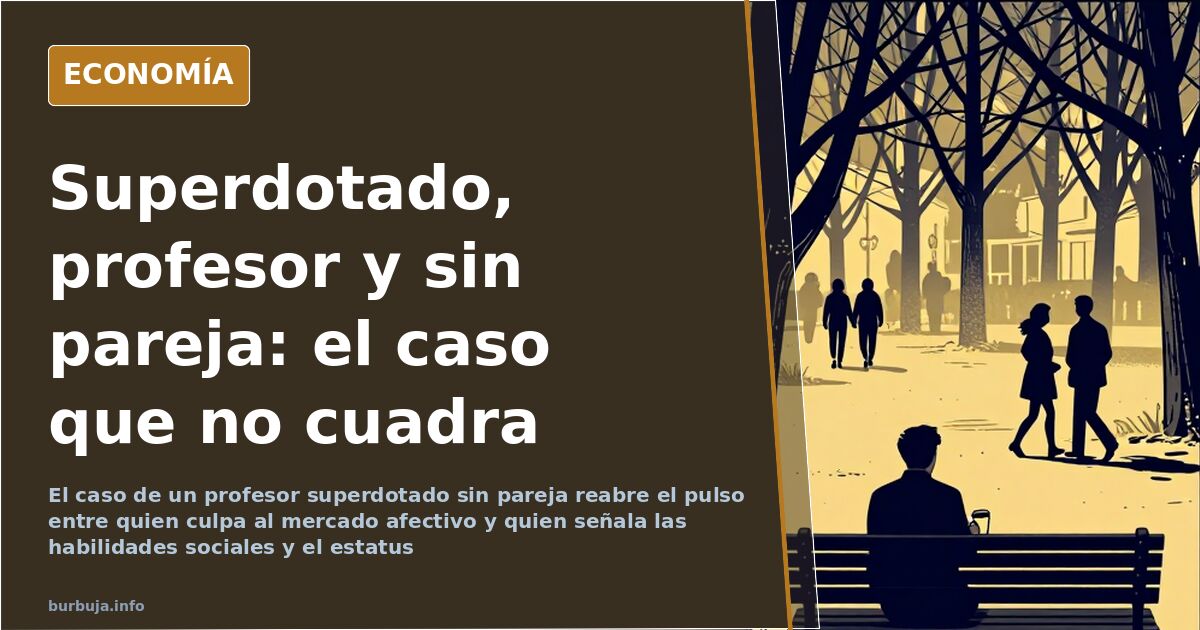
The case of a gifted professor without a partner reignites the debate between those who blame the dating market and those who point to social skills and status.
English · Original discussion in Spanish · Published
Gifted, Slim, Hairy, and Single: Anatomy of a Case
Over the past few months, an interview with a Spanish university professor on a popular podcast has fueled a discussion that extends far beyond the individual. The profile can be summarized in four traits: gifted, with academic prestige, slim, and hairy. And a fifth detail that throws everything off: single, unmarried, and with a rather scarce romantic life. The name circulating is that of Carlos Blanco, a professor, polyglot, and specialist in Egyptology and Philosophy.
What began as a personal anecdote has evolved into a clash between incompatible narratives about how the romantic market works: whether supply fails, demand fails, or simply, the market doesn't value what this man offers.
The Academic Brilliance That Doesn't Translate to Money
The first argument that arises is economic: the value of a profile is measured not by what one knows, but by what one produces in the material world. An impressive curriculum that doesn't translate into income, influence, or visible projects is, according to various analyses, a defective luxury good. A degree on the wall doesn't pay the mortgage.
The practical consequence is uncomfortable. If the romantic market rewards the ability to move resources, power, or strength, pure intellect is worth little. And here enters a second layer: being gifted doesn't imply having social skills. The equation breaks at the link almost no one looks at.
Why is it Said Women Seek a Different Type of Man?
This is the most repeated and least nuanced line. It's argued that attraction isn't towards the brilliant professor, but towards the provider of experiences, the one who generates emotion and status. The social skills truly valued, this narrative says, are those that lead to making money, not those that make one the life of the party.
Against this thesis, another current reminds us that the woman as a homogeneous category doesn't exist. The goals of a girl from the neighborhood and those of a professional with a career and years of work are not the same. It even points out the contradiction of an era that preaches new masculinities and continues to reward the old provider. The case becomes more complicated than the easy headline suggests.
Hormones, Sublimation, and Unwin's Study
There's a hypothesis that appears insistently: that the situation is explained not by a lack of opportunities, but by low testosterone or a reoriented drive. Within this framework, dedicating one's life to knowledge without distractions stops being a failure and becomes a form of freedom. Envy, here, disguises itself as diagnosis.
Intellectual support is sought in the old Freudian idea of sublimation: libidinal energy that finds no affective outlet is redirected towards the creative and cultural. And in historical sociology. J. D. Unwin's study of 80 nations and 6 civilizations over 5,000 years suggests a correlation between sensual abstinence and cultural pogre; Aldous Huxley called it a highly important work.
From there to determinism is a step. And determinism, in affective matters, has never explained much.
The Intellectual Elite Who Doesn't Need a Partner
There's an opposite and kinder reading: those who have a rich inner world need nothing external. No partner, no validation, no social success in its common meaning. Singleness ceases to be a deficit and is presented as liberation.
This current adds examples. That of a veteran university professor, not particularly attractive, who with an expensive car, expensive watch, and elegant clothes maintained, according to this narrative, a very active romantic life. The message is clear: without charm and without money, the equation crashes; with money, it changes.
The Counterexample That Breaks the Mold
Against the thesis of the genius condemned to solitude, the uncomfortable fact appears: there are top-level mathematicians, with Fields Medals and families, who don't seem out of place in a faculty nor need to take refuge in a microphone. Elite intelligence is not incompatible with partnered life.
What many point out, then, is not a curse of talent, but poor relationship management: people capable of mastering tough disciplines who crash with something no book teaches. Hyper-rationalization works for studying and fails for living together.
The Historical Precedent: Seminary or Nothing
The historical reading closes the circle. For centuries, these types of profiles ended up in the seminary, the monastery, or in the service of a nobleman. Philosophy and theology were the gateway to the clerical world. Those who didn't make that leap were exposed to an environment that didn't value their commodity.
And there's a generational reading: those who forty years ago embodied a different model of attractiveness didn't fare much better, judging by subsequent divorces. Each era has its own selection.
The case gets stuck exactly where it started. Intelligence without social traction doesn't buy a partner, some say. A partner isn't a reward for merit, others reply. Between these two narratives, there's no synthesis: only the acknowledgment that the romantic market never publishes its rates.
Over the past few months, an interview with a Spanish university professor on a popular podcast has fueled a discussion that extends far beyond the individual. The profile can be summarized in four traits: gifted, with academic prestige, slim, and hairy. And a fifth detail that throws everything off: single, unmarried, and with a rather scarce romantic life. The name circulating is that of Carlos Blanco, a professor, polyglot, and specialist in Egyptology and Philosophy.
What began as a personal anecdote has evolved into a clash between incompatible narratives about how the romantic market works: whether supply fails, demand fails, or simply, the market doesn't value what this man offers.
The Academic Brilliance That Doesn't Translate to Money
The first argument that arises is economic: the value of a profile is measured not by what one knows, but by what one produces in the material world. An impressive curriculum that doesn't translate into income, influence, or visible projects is, according to various analyses, a defective luxury good. A degree on the wall doesn't pay the mortgage.
The practical consequence is uncomfortable. If the romantic market rewards the ability to move resources, power, or strength, pure intellect is worth little. And here enters a second layer: being gifted doesn't imply having social skills. The equation breaks at the link almost no one looks at.
Why is it Said Women Seek a Different Type of Man?
This is the most repeated and least nuanced line. It's argued that attraction isn't towards the brilliant professor, but towards the provider of experiences, the one who generates emotion and status. The social skills truly valued, this narrative says, are those that lead to making money, not those that make one the life of the party.
Against this thesis, another current reminds us that the woman as a homogeneous category doesn't exist. The goals of a girl from the neighborhood and those of a professional with a career and years of work are not the same. It even points out the contradiction of an era that preaches new masculinities and continues to reward the old provider. The case becomes more complicated than the easy headline suggests.
Hormones, Sublimation, and Unwin's Study
There's a hypothesis that appears insistently: that the situation is explained not by a lack of opportunities, but by low testosterone or a reoriented drive. Within this framework, dedicating one's life to knowledge without distractions stops being a failure and becomes a form of freedom. Envy, here, disguises itself as diagnosis.
Intellectual support is sought in the old Freudian idea of sublimation: libidinal energy that finds no affective outlet is redirected towards the creative and cultural. And in historical sociology. J. D. Unwin's study of 80 nations and 6 civilizations over 5,000 years suggests a correlation between sensual abstinence and cultural pogre; Aldous Huxley called it a highly important work.
From there to determinism is a step. And determinism, in affective matters, has never explained much.
The Intellectual Elite Who Doesn't Need a Partner
There's an opposite and kinder reading: those who have a rich inner world need nothing external. No partner, no validation, no social success in its common meaning. Singleness ceases to be a deficit and is presented as liberation.
This current adds examples. That of a veteran university professor, not particularly attractive, who with an expensive car, expensive watch, and elegant clothes maintained, according to this narrative, a very active romantic life. The message is clear: without charm and without money, the equation crashes; with money, it changes.
The Counterexample That Breaks the Mold
Against the thesis of the genius condemned to solitude, the uncomfortable fact appears: there are top-level mathematicians, with Fields Medals and families, who don't seem out of place in a faculty nor need to take refuge in a microphone. Elite intelligence is not incompatible with partnered life.
What many point out, then, is not a curse of talent, but poor relationship management: people capable of mastering tough disciplines who crash with something no book teaches. Hyper-rationalization works for studying and fails for living together.
The Historical Precedent: Seminary or Nothing
The historical reading closes the circle. For centuries, these types of profiles ended up in the seminary, the monastery, or in the service of a nobleman. Philosophy and theology were the gateway to the clerical world. Those who didn't make that leap were exposed to an environment that didn't value their commodity.
And there's a generational reading: those who forty years ago embodied a different model of attractiveness didn't fare much better, judging by subsequent divorces. Each era has its own selection.
The case gets stuck exactly where it started. Intelligence without social traction doesn't buy a partner, some say. A partner isn't a reward for merit, others reply. Between these two narratives, there's no synthesis: only the acknowledgment that the romantic market never publishes its rates.
Summary of a discussion on Burbuja.info - Foro de economía, actualidad y política., translated from Spanish and reviewed before publication. Read the full discussion (222 replies).
More summaries
-
Eviction Spotlight Shifts to Paquita, 83, in Madrid
The eviction of Paquita, 83, once again puts the spotlight on Madrid, with some comments suggesting other cases involving elderly women.
-
NATO Announcement: Selling War with Only White Faces
The NATO video promoting collective defense features only white faces, sparking a debate about who bears the cost of conscription if war comes.
-
Córdoba Father Self-Immolates: Mental Illness or Societal Despair?
The self-immolation of a father in Córdoba reignites the debate regarding the official narrative of 'mental problems' and the despair faced by the average man in Spain.
-
Euthanasia in Old Age: Autonomy vs. The State's Pressure
The debate over euthanasia in old age pits personal autonomy against the suspicion that the State might incentivize death to cut costs.
-
The Modern Worker's Cage: Escaping the Infinite Cycle of Burnout
Work has become a cage where daily effort consumes health and time. Discover why we push ourselves so hard and how to break the cycle.
-
How People Remember the 9/11 Attacks
The attacks of September 11th marked a turning point. Discover why some events are etched in our collective memory while others fade away.