
Get Home Bag: the backpack to get home if the system goes down
45-litre evacuation backpacks, water purification tablets and fines of up to 50,000 euros in Germany: the gear to get home on foot when the system fails
English · Original discussion in Spanish · Published
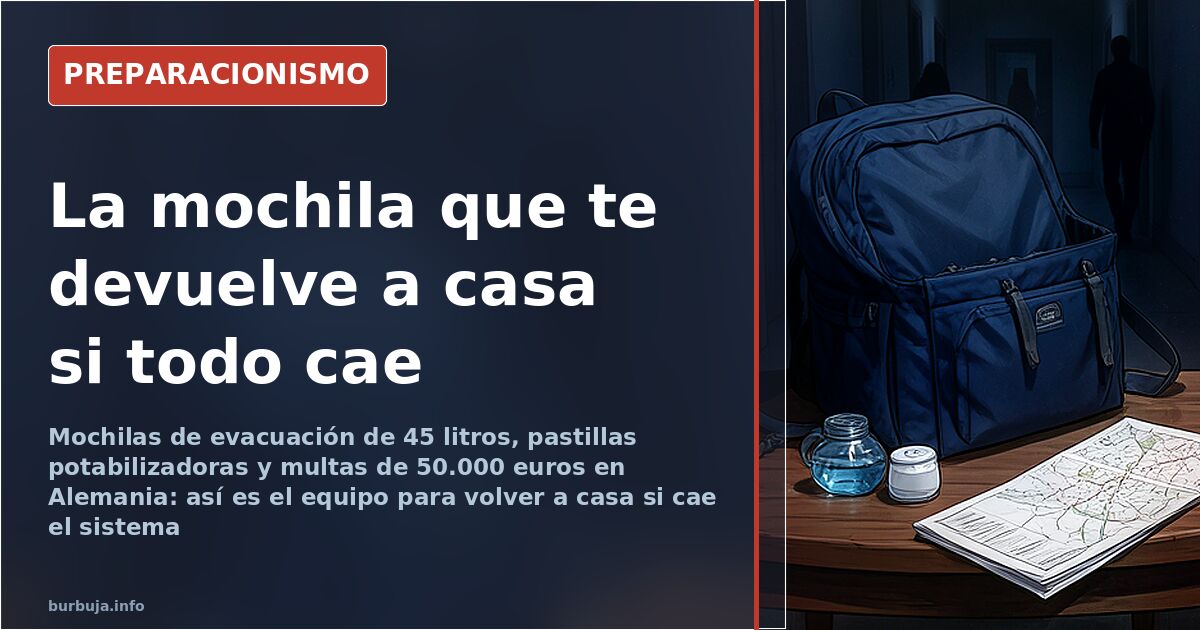
Get Home Bag: the backpack to get home if the system goes down
A blackout leaves half the city without power. Cars won't start, cards won't pay and your phone runs out of battery within the first hour. That is the scenario pushing thousands of people to keep a backpack in the boot. It's called a Get Home Bag or evacuation bag: the minimum gear to cover on foot the distance between where you are and your home when transport has stopped working. In Spain the trend has caught on from the American model, where the disaster angle is added: it's not a camping backpack, it's a response to the possibility that logistics break down overnight.
The discussion starts with a sensible warning: the internet is full of videos showing exaggerated setups, more suited to a movie than real life. The everyday version, known as EDC (Every Day Carry), is far more modest: a multitool, a torch, some water. The difference between the two is the distance you're willing to cover and how long you think it will take for things to return to normal.
What a realistic Get Home Bag contains
The practical consensus rests on a 45-litre backpack with a load-carrying belt, designed for walking comfortably with weight. Inside: a lightweight sleeping bag, a tarp, an alcohol stove with a pot, a fire-starting kit, water purification tablets, a water filter, canteens, a multi-tool, a blunt knife, emergency rations that keep for years in the heat, warm clothing, socks, trekking boots, a first-aid kit and toilet paper. The idea that sums it all up: everything needed to walk home up to 100 kilometres if an electromagnetic pulse leaves the cars dead.
One item keeps coming up, and not by chance: the military-style folding shovel. It doesn't attract attention and can be used to dig, cut or as support. The full list, with details on weights and priorities, is where you really see what's missing and what's superfluous.
The EDC you actually carry every day
The everyday part is less epic. A personal defence spray that someone confirms using a week ago, a first-aid kit in the car, rope and tools. And a detail that says a lot about the Spanish legal framework: carrying a baseball bat is punishable, but a kitchen pot — "I'm just taking it back to my mum." The quip sums up the ingenuity used to skirt the rules without breaking the letter of the law.
In Germany things get more complicated. Some admit carrying items every day whose possession can bring fines of up to 50,000 euros, which is why they prefer not to detail the contents. The debate over lock picks — lock-opening tools — moves between hobby and real utility: they're made from old windscreen metal and filed down with cheap files. The conclusion that prevails is that opening locks only makes sense when there's no other option.
The change of clothes, the sandals and urban camouflage
One of the most useful contributions has nothing to do with hardcore survival: carrying a change of clothes and sandals. In a second you change and go unnoticed. Same with reversible jackets and hats in two colours. The logic is urban camouflage, not woodland.
Water deserves its own section. Purification tablets, a couple of them, or a bottle of bleach at two drops per litre depending on how dirty the water is. And a technical tip worth noting: freshly made charcoal is no good for purifying water; you have to wash it and toast it again until it stops releasing strange substances.
The blackout as a reminder
The conversation closes with a phrase that sums up the mood: after the blackout, it's time to rethink this EDC business. It's not a prophecy, it's an observation. The usefulness of the bag doesn't depend on the end of the world arriving, but on the city grinding to a halt for a few hours one day. And for that you don't need a bunker.
The surprising fact: most of the kits described fit in a car boot and cost less than a high-end phone. The question isn't whether it's worth it, but why almost nobody carries one.
Also available in: Deutsch
Summary of a discussion on Burbuja.info - Foro de economía, actualidad y política., translated from Spanish and reviewed before publication. Read the full discussion (21 replies).
More summaries
-
Homemade weapons in Ceuta, Spain: from a legal baton to a cardboard vest
Legal batons, confiscatable sprays and cardboard vests: the homemade self-defence catalogue circulating in Ceuta clashes with both the law and physics.
-
Utopia 2013: Where to Download the British Series on P2P
The British series Utopia (2013), with two subtitled seasons, is still available on eMule, torrent and direct download
-
How to cool a stone bench in the sun: the physics of stored heat
Each kilo of granite needs 800 joules to rise one degree. Here's how to cool a stone bench without waiting two hours.
-
Suicide announced online: the response that frightens
A user announces in a prepping community that he is ready to take his own life. Support, skepticism and mockery: the pattern repeats itself.
-
Is moving to Ecuador worth it? What a real case reveals
The story of a backpacker who stayed in Ecuador: well-kept farms, sunshine and cheap living, but a healthcare system that makes you look to Europe. The analysis.
-
34 days, 12 homes, 3 workers: 3D printing arrives in housing
France has built 12 homes in 34 days using a 3D printer and just three workers. Why does this technology have no future in Spain? Regulation, speculation and...