
Germany's Industrial Decline Threatens Pension System
German industry contracts and the pension system wobbles, exhausting the model that exported austerity to Southern Europe without a Plan B.
English · Original discussion in Spanish · Published
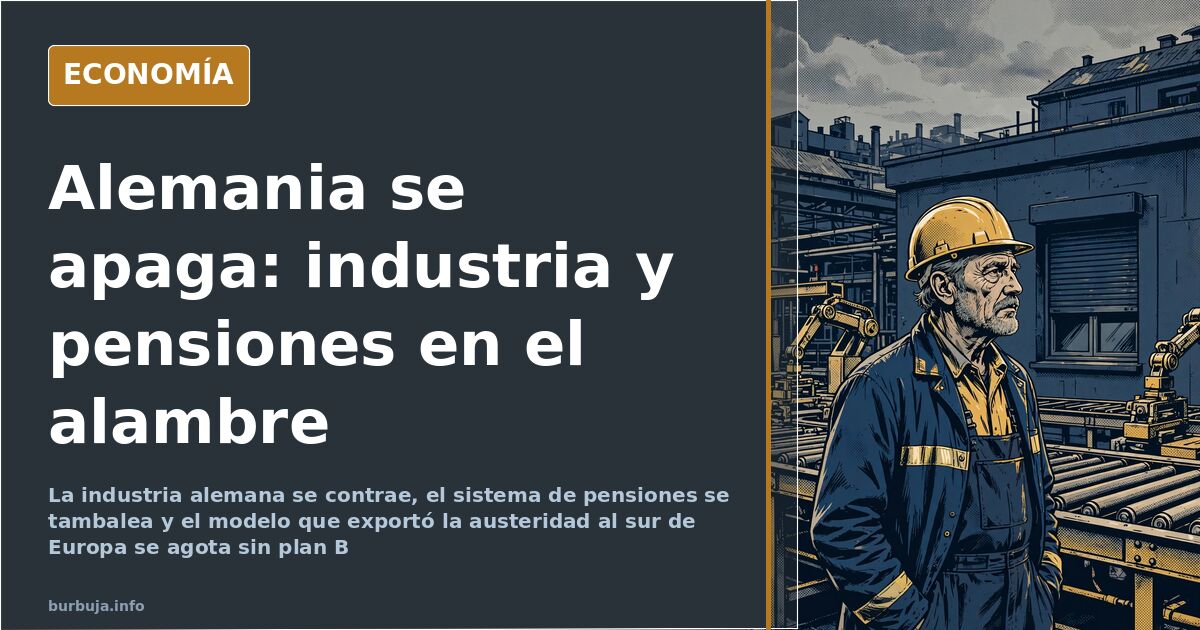
Germany Stalls as Economic Miracle Runs Out of Steam
The country that for decades sold Southern Europe the recipe of sacrifice and fiscal discipline now faces the collapse of its own model. German industry, Europe's engine, is contracting while the pension system shakes. The trigger, according to dominant analysis, is not fate but a series of political decisions leaving the nation without cheap energy, its main market, or fiscal room.
The paradox is bitter. During the debt crisis hitting Southern Europe, Berlin repeated that the issue was lack of competitiveness and excess spending. Germany sold luxury cars and precision machinery while others deindustrialized. Today the script has reversed, yet no one in the German establishment wants to say it aloud.
Why Is German Industry Sinking?
The diagnosis sweeping through analyses is stark: Germany abandoned its natural supplier of cheap energy for geopolitical reasons and simultaneously lost access to the Chinese market that had absorbed its output for two decades. The result is a pincer squeezing both production costs and export revenues.
Some argue breaking ties with the energy provider was an act of subordination to foreign interests, paying the price with the disappearance of the industrial base. Counter-arguments state that dependence on a single supplier was itself a strategic vulnerability. Both may be true. What is fruta is the outcome: German industry loses competitiveness rapidly, taking with it the jobs sustaining the system.
German Pension System Under Scrutiny
The German welfare state was funded by contributions from a large working population and a trade surplus allowing low state debt. This balance breaks via two simultaneous paths: demographics and deindustrialization.
Germany's population pyramid, like most of Western Europe, is inverted. Fewer births, more retirees, rising life expectancy. The pay-as-you-go system, functioning as direct transfer from workers to pensioners, requires constant growth of the contributor base. Without industry, quality jobs, or birth rates, the equation fails.
Years saw attempts to patch this with immigration. Critical analysis notes this only delays and worsens the problem, as newcomers will also age and claim pensions. Immigration isn't a demographic fix without real labor integration and sustained economic growth.
Who Pays Pensions Without Industry?
The uncomfortable answer is no one knows. Scenarios involve tax hikes, healthcare cuts, reduced infrastructure investment, and delayed retirement ages. Meaning fewer public services and less time enjoying retirement for those who contributed all their lives.
The issue isn't exclusively German. Spain faces a structurally similar situation with an aggravating factor: an economy with less industrial base and greater reliance on tourism and services. Statistical makeup may hide the magnitude temporarily but doesn't solve it.
The core issue is political. Touching the pension system implies electoral costs no party wants to bear. It has become a hot potato passed from legislature to legislature, hoping collapse happens under another government.
The Miscalculation No One Admits
The thesis running through incisive analysis is that policymakers aren't stupid but act on self-interests misaligned with national ones. Incompetence is the cover story; reality differs.
If the problem was known for decades—demographic studies anticipated it precisely—the question isn't why it wasn't seen, but why nothing was done. The plausible answer is that the solution required sacrifices no ruler was willing to assume while they could still finance themselves with cheap debt and central bank backing.
That margin is vanishing. When fully exhausted, the bill arrives for everyone: current retirees, those nearing retirement, and those yet to start contributing.
Analysis stalls at an uncomfortable point: if the problem was known and solutions carried unacceptable political costs, what incentive does any government have to act before the system collapses alone? No answer has withstood scrutiny.
The country that for decades sold Southern Europe the recipe of sacrifice and fiscal discipline now faces the collapse of its own model. German industry, Europe's engine, is contracting while the pension system shakes. The trigger, according to dominant analysis, is not fate but a series of political decisions leaving the nation without cheap energy, its main market, or fiscal room.
The paradox is bitter. During the debt crisis hitting Southern Europe, Berlin repeated that the issue was lack of competitiveness and excess spending. Germany sold luxury cars and precision machinery while others deindustrialized. Today the script has reversed, yet no one in the German establishment wants to say it aloud.
Why Is German Industry Sinking?
The diagnosis sweeping through analyses is stark: Germany abandoned its natural supplier of cheap energy for geopolitical reasons and simultaneously lost access to the Chinese market that had absorbed its output for two decades. The result is a pincer squeezing both production costs and export revenues.
Some argue breaking ties with the energy provider was an act of subordination to foreign interests, paying the price with the disappearance of the industrial base. Counter-arguments state that dependence on a single supplier was itself a strategic vulnerability. Both may be true. What is fruta is the outcome: German industry loses competitiveness rapidly, taking with it the jobs sustaining the system.
German Pension System Under Scrutiny
The German welfare state was funded by contributions from a large working population and a trade surplus allowing low state debt. This balance breaks via two simultaneous paths: demographics and deindustrialization.
Germany's population pyramid, like most of Western Europe, is inverted. Fewer births, more retirees, rising life expectancy. The pay-as-you-go system, functioning as direct transfer from workers to pensioners, requires constant growth of the contributor base. Without industry, quality jobs, or birth rates, the equation fails.
Years saw attempts to patch this with immigration. Critical analysis notes this only delays and worsens the problem, as newcomers will also age and claim pensions. Immigration isn't a demographic fix without real labor integration and sustained economic growth.
Who Pays Pensions Without Industry?
The uncomfortable answer is no one knows. Scenarios involve tax hikes, healthcare cuts, reduced infrastructure investment, and delayed retirement ages. Meaning fewer public services and less time enjoying retirement for those who contributed all their lives.
The issue isn't exclusively German. Spain faces a structurally similar situation with an aggravating factor: an economy with less industrial base and greater reliance on tourism and services. Statistical makeup may hide the magnitude temporarily but doesn't solve it.
The core issue is political. Touching the pension system implies electoral costs no party wants to bear. It has become a hot potato passed from legislature to legislature, hoping collapse happens under another government.
The Miscalculation No One Admits
The thesis running through incisive analysis is that policymakers aren't stupid but act on self-interests misaligned with national ones. Incompetence is the cover story; reality differs.
If the problem was known for decades—demographic studies anticipated it precisely—the question isn't why it wasn't seen, but why nothing was done. The plausible answer is that the solution required sacrifices no ruler was willing to assume while they could still finance themselves with cheap debt and central bank backing.
That margin is vanishing. When fully exhausted, the bill arrives for everyone: current retirees, those nearing retirement, and those yet to start contributing.
Analysis stalls at an uncomfortable point: if the problem was known and solutions carried unacceptable political costs, what incentive does any government have to act before the system collapses alone? No answer has withstood scrutiny.
Summary of a discussion on Burbuja.info - Foro de economía, actualidad y política., translated from Spanish and reviewed before publication. Read the full discussion (153 replies).
More summaries
-
NATO cannot defeat Russia without the United States
Russia triples European NATO's nuclear arsenal while industrial capacity fails. Without the US, the Alliance is hollow.
-
German industrial slowdown threatens Spain's pensions
Spain's pension sustainability and public debt face risks as German industry slows, with a potential 20% cut emerging as a likely scenario.
-
German advisory council suggests retiring at 73
A German advisory council to the Ministry of Economy proposes raising the retirement age to 73 to prevent pension collapse.
-
IONOS cuts 450 jobs, Logroño fears for Arsys's 360
IONOS cuts 450 jobs from 3,800: Arsys, with 360 workers in Logroño, is unsure how many will be affected.
-
Garzón denies building more housing lowers prices, but data contradicts him
Eduardo Garzón argues that increased construction does not reduce housing prices. However, supply and demand data in Spain suggest otherwise.
-
Avoiding Spanish Polling Station Duty by Not Answering Door
In Spain, polling station notification requires a signature. Without it, there is no summons. The lottery runs from October 31 to November 4.