
Germany registers 88,599 electric cars in September, 34.5% of the market
A tweet claims Germany sold 88,599 electric cars in September, 34.5% of the market. Spain lags at 9.6% and struggles with broken chargers.
English · Original discussion in Spanish · Published
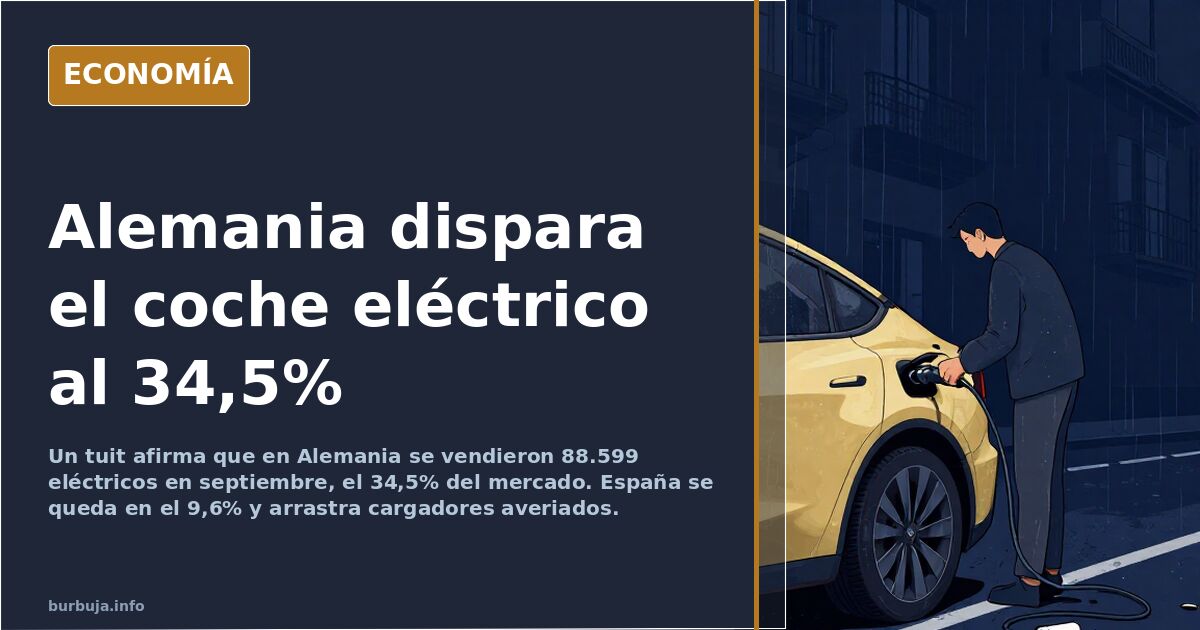
Germany puts 88,599 electric cars on the road in September, close to 35% of the market
In September, the German market registered 88,599 fully electric cars, accounting for 34.5% of total sales, according to a tweet shared in the debate. The figure is presented as a rebuttal to the narrative that electric cars collapse once the state withdraws subsidies. In Spain, with fewer single-family homes and more collective housing, peine stands at 9.6%, even though Germany's stock of single-family homes is 26 million households compared with Spain's 6.2 million, according to the figures cited by participants. The gap is not about income: it is about infrastructure and industrial policy.
Why Germany sells more electric cars than Spain
Germany has 26 million people living in single-family houses, the perfect breeding ground for installing a private charging point. Spain has only 6.2 million. That structural difference explains why the German market absorbs one in three new plug-in cars while the Spanish market settles for half that. Some argue that Spaniards are smarter because they don't buy electric cars; the argument falls apart when compared with Portugal, which reached a 47% electric share in September.
The German statistic can also be read the other way around: if only 8.3% of German single-family households own an electric car compared with 9.6% of Spanish ones, relative peine favors Spain. It's the kind of figure used to claim that people here are being deceived. The trick lies in mixing fleet percentages with monthly sales percentages.
Spain's bottleneck: broken chargers and stolen copper
Spain carries an infrastructure problem that doesn't show up in the German figures. According to second-quarter 2026 data, nearly 18,000 public chargers remain out of service, with 23.9% of the network down. On top of that comes copper cable theft: the cost of the damage exceeds €10,000 per incident, and the wave is spreading across Europe, with losses running into millions in France.
The household calculation circulating among those who have already made the switch is different: running a line from the meter room to the garage space costs around €1,000, 70% of which can be subsidized. At current petrol prices, that outlay pays for itself within months. The curiosity gap lies in the full breakdown, line by line, which reveals a surprising difference.
Tesla's quarterly effect and the fine print of the record
The German electric share spikes in September for an accounting reason: Tesla concentrates its deliveries at the end of the quarter. That inflates the percentage of electric registrations and explains why the overall sales top ten is still dominated by combustion models: Volkswagen Golf (44,625 units), T-Roc (32,442), Tiguan (29,240), Opel Corsa (24,785) and Skoda Octavia (24,394).
The German record is real, but it doesn't miccionan the fleet has been transformed. It means industrial policy, the charging network and taxation are all pushing in the same direction. In Spain, with the network running at half throttle and the public debate tangled up over whether the electric car is a scam or an obligation, the question is not when we'll reach 34.5%, but how many chargers will still be out of service when we do.
Frequently asked questions
How many electric cars were sold in Germany in September?
88,599 fully electric cars were registered, 34.5% of the total German market in September, according to the tweet shared in the debate. The figure covers passenger cars, not commercial vehicles, and is boosted by Tesla's quarter-end effect, as it concentrates deliveries in the last month of the period.
Why does Spain have lower electric peine than Germany?
The key difference is housing: 26 million Germans live in single-family houses compared with 6.2 million Spaniards, which makes private charging easier. On top of that, 23.9% of Spain's public network is out of service and copper theft drives up maintenance costs.
Is the 34.5% share reliable as a trend?
Not entirely. The percentage is inflated in September by Tesla's quarterly calendar. To measure the real trend you need to look at the annual average and the weight of combustion models, which still lead the German sales ranking with the Golf at the top.
Also available in: Deutsch
Summary of a discussion on Burbuja.info - Foro de economía, actualidad y política., translated from Spanish and reviewed before publication. Read the full discussion (22 replies).
More summaries
-
Electric cars hit 47.7% of new registrations in Portugal in September
A forum user claims electric cars made up 47.7% of new registrations in Portugal in September, versus 26.8% for January-August. France, a larger country, would be at 42%.
-
Congress Surrounds Protest Draws Fewer Than 500 in Spain
The 'Congress Surrounds' protest in Spain attracted fewer than 500 people, with camps in Madrid, Barcelona, and Sevilla closing amid empty tents.
-
Milei's adviser arrested over alleged shooting of his ex-partner
Fernando Cerimedo, strategist for Argentina's Javier Milei, has been arrested for allegedly ordering the shooting of his ex-partner. The case casts a shadow over the political consulting industry.
-
Court orders builder to pay Granada bricklayer four years of holiday pay
Four years without holidays, a sudden closure and a ruling that orders payment. The case of a bricklayer in Granada, Spain, exposes the Labour Inspectorate's double standards.
-
Feijóo calls for lockdown of Spain's Ceuta: 70,000 migrants and disease outbreaks
Spain's opposition leader Feijóo demands a lockdown of Ceuta over a mass arrival of migrants, putting the figure at 70,000 irregulars and warning of scabies and tuberculosis outbreaks.
-
Madrid's nightlife loses its icons: Joy Eslava is now Teatro
From 300 pesetas to 20 euros a drink: this is how Madrid's great nightlife is fading. Joy Eslava has become Teatro Eslava and nobody knows who is behind it.