
Germany Registers 70,663 Pure Electric Cars in One Month, Up 66%
Germany registers 70,663 pure electric cars in one month, up 66%. With plug-in hybrids, over 100,000 cable vehicles in thirty days.
English · Original discussion in Spanish · Published
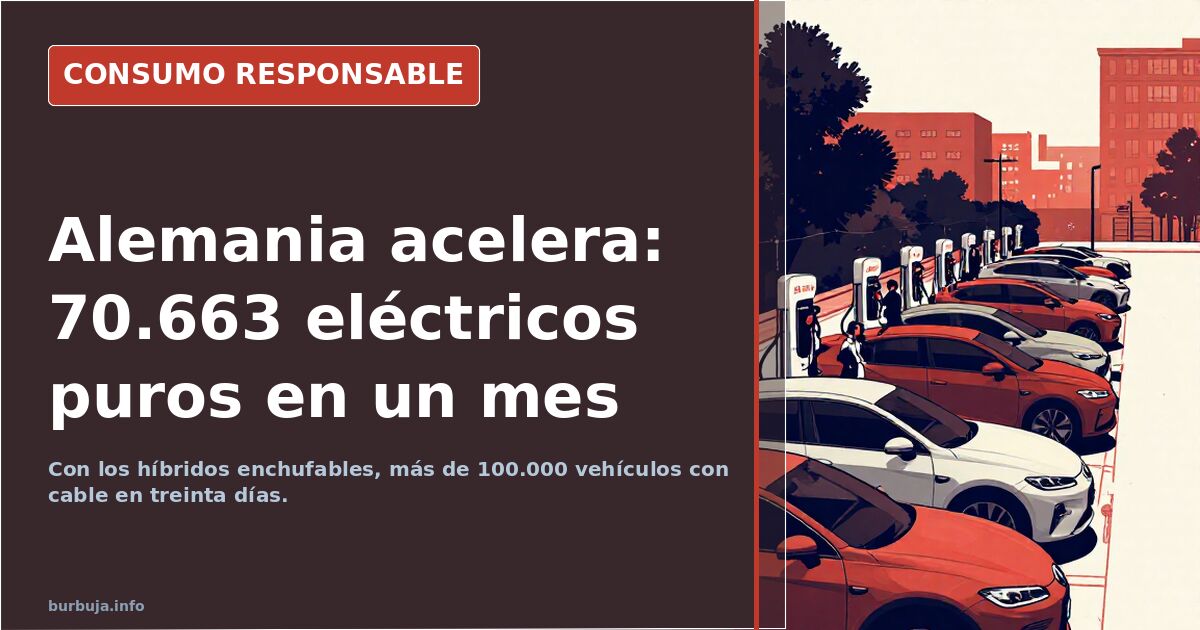
Germany registers 70,663 pure electric cars in one month and 24% of the market now has a plug
The data is hard to dispute: 70,663 100% electric passenger cars registered in Germany in a single month, a 66% increase. If you add the 29,996 plug-in hybrids, the total figure for cable vehicles exceeds 100,000 in just thirty days. The reconversion of German factories to the electric car is advancing, and the wave of new European and Chinese models is yet to arrive. Anyone still waiting for the collapse of the electric vehicle will have to explain why registration data is moving in the opposite direction.
What the registration figures in Germany say
The breakdown of the German market leaves a distribution that is worth looking at closely. Plug-in hybrids, with 117,000 units, take 40% of the pie. Pure electric vehicles, with those 70,663, represent 24%. Gasoline holds on with 67,000 units (22%) and diesel stands at 37,600 (13%). The trend is clear: the plug is gaining ground, but the plug-in hybrid is currently the preferred format for the German buyer. For now, because the industrial bet is in another direction.
Some argue that the small-battery plug-in hybrid should have been the perfect transition solution: low battery cost, an electric motor that avoids wear and tear from frequent starting and stopping in the city, and sufficient autonomy for almost all daily trips. If you cannot recharge, you drive in gasoline mode like a normal car. Priuses have been traveling the world with that formula since the 2000s. In Europe, however, the risk of going straight to the pure electric vehicle has been preferred.
The myth of the global decline of the electric car
In contrast to the optimism of the German data, the other current of analysis insists that the electric vehicle is in decline. They cite a 32% year-on-year drop in registrations of electric and plug-in hybrids in China during February, down to less than 500,000 vehicles, in line with a 34% drop in total car sales. The conclusion drawn is that Europeans are the last to find out that the battery car is out of the game.
The problem, replied from the other trench, is that this Chinese data is read without context: it is a specific month, not a structural trend, and in the same period the Chinese automotive market as a whole fell by a third. When the entire market sinks, the drop in one category proves nothing about its future. The debate over whether the electric car is the future or a subsidized bubble remains open, and each side chooses the month that suits them.
The real cost of charging infrastructure
The other great battle is that of chargers. An Alpitronic 300 kW charger costs less than 84,000 euros, and one of 360 kW is around 79,000. Tesla offers eight 500 kW chargers turnkey for 800,000 euros, which comes to less than 55,000 per unit. Prices have fallen and competition is fierce, especially with the entry of Chinese manufacturers. The initial investment is high, but in the long term the cost structure of an electric station does not depend on tankers refueling every few days.
Skepticism has its own ammunition. It is calculated that 99.9% of charging points are deficit and that without subsidies, practically none would have been installed. Occupancy data is poor. And there is a fundamental design problem: trying to replicate the gas station model in a technology that is conceptually different can be a planning error. The electric car charges where it parks, not where it refuels.
The battery, the pattern no one wants to pay
When it comes time to change the battery, the bill that discourages anyone arrives. According to circulating calculations, replacing the pack can cost between 6,000 and 14,000 euros, and some have heard figures of 80,000 or 150,000 euros. With those prices, many drivers consider buying another car before changing the battery. It is the star argument of those who point out that the resale value of a used electric car tends to zero: batteries and spare parts cost more than the vehicle itself.
This is added to the real state of the charging network. Some describe a landscape of phantom chargers: the one that is not broken has a touch screen burned by the sun or the card reader out of service. The business model, they joke, is perfect: install with subsidy, charge the maintenance fee and let the device rot. Whoever wants to charge, figure it out. The idea of using streetlights as charging points collides with an electrical reality: most are public lighting circuits with wiring just for 100 W LED bulbs, and converting them into 7 kW points requires changing the apartment block transformer.
Geopolitics and oil dependence
The international context pushes in the same direction. Trump's bluster and Iran's closure of the Strait of Hormuz threaten to make oil more expensive and drive up electric car sales. Whoever controls the crude tap controls the price of filling a gasoline tank. Every time there is a geopolitical scare, the energy dependence account is reviewed on its own.
The paradox is that gas also passes through Hormuz, and combined cycle plants are working at full capacity to avoid another blackout. Nuclear power produces less because, according to this reading, a special tax makes them less profitable than gas. The result is that electricity remains expensive and external dependence does not disappear, it only changes fuel. The energy transition is advancing, but not necessarily along the cheapest path.
What is happening with chargers and autonomy
The psychological barrier of fast charging is breaking. In Spain, there are electric cars for sale that charge from 10% to 80% in 12 minutes. In China, some models go from 10% to 97% in 9 minutes. Technology advances faster than infrastructure, and this gap is what fuels distrust. Until there is the same density of ultra-fast chargers as gas stations, many people will not consider buying an electric car. It is a reasonable position, although each passing year sounds more like an excuse than an argument.
The second-hand market remains the weak point. There is almost no market for used electric cars because batteries and spare parts cost more than the car. This sinks the residual value and increases the real cost of owning the vehicle. It is the figure that does not appear in marketing campaigns and explains why many buyers still choose a plug-in hybrid: it gives them the peace of mind of a combustion engine when the network fails.
The future of the German mobile fleet
The trend points to pure electric vehicles eventually taking first place in Germany. Factories are being reconverted, new models are accumulating on launch pads, and European regulatory pressure is not going to ease. When charging infrastructure matures and autonomy ceases to be an issue, the plug-in hybrid will lose its sense. But that is a prediction, not a consummated fact.
Meanwhile, the market is divided between those betting on the plug and those still clinging to the combustion engine. German registration data is a blow to the narrative of electric failure, but it does not solve the cost, infrastructure and residual value problems that hamper mass adoption. The transition is advancing. At what estimulante ilegal and at what price, remains to be seen.
The data is hard to dispute: 70,663 100% electric passenger cars registered in Germany in a single month, a 66% increase. If you add the 29,996 plug-in hybrids, the total figure for cable vehicles exceeds 100,000 in just thirty days. The reconversion of German factories to the electric car is advancing, and the wave of new European and Chinese models is yet to arrive. Anyone still waiting for the collapse of the electric vehicle will have to explain why registration data is moving in the opposite direction.
What the registration figures in Germany say
The breakdown of the German market leaves a distribution that is worth looking at closely. Plug-in hybrids, with 117,000 units, take 40% of the pie. Pure electric vehicles, with those 70,663, represent 24%. Gasoline holds on with 67,000 units (22%) and diesel stands at 37,600 (13%). The trend is clear: the plug is gaining ground, but the plug-in hybrid is currently the preferred format for the German buyer. For now, because the industrial bet is in another direction.
Some argue that the small-battery plug-in hybrid should have been the perfect transition solution: low battery cost, an electric motor that avoids wear and tear from frequent starting and stopping in the city, and sufficient autonomy for almost all daily trips. If you cannot recharge, you drive in gasoline mode like a normal car. Priuses have been traveling the world with that formula since the 2000s. In Europe, however, the risk of going straight to the pure electric vehicle has been preferred.
The myth of the global decline of the electric car
In contrast to the optimism of the German data, the other current of analysis insists that the electric vehicle is in decline. They cite a 32% year-on-year drop in registrations of electric and plug-in hybrids in China during February, down to less than 500,000 vehicles, in line with a 34% drop in total car sales. The conclusion drawn is that Europeans are the last to find out that the battery car is out of the game.
The problem, replied from the other trench, is that this Chinese data is read without context: it is a specific month, not a structural trend, and in the same period the Chinese automotive market as a whole fell by a third. When the entire market sinks, the drop in one category proves nothing about its future. The debate over whether the electric car is the future or a subsidized bubble remains open, and each side chooses the month that suits them.
The real cost of charging infrastructure
The other great battle is that of chargers. An Alpitronic 300 kW charger costs less than 84,000 euros, and one of 360 kW is around 79,000. Tesla offers eight 500 kW chargers turnkey for 800,000 euros, which comes to less than 55,000 per unit. Prices have fallen and competition is fierce, especially with the entry of Chinese manufacturers. The initial investment is high, but in the long term the cost structure of an electric station does not depend on tankers refueling every few days.
Skepticism has its own ammunition. It is calculated that 99.9% of charging points are deficit and that without subsidies, practically none would have been installed. Occupancy data is poor. And there is a fundamental design problem: trying to replicate the gas station model in a technology that is conceptually different can be a planning error. The electric car charges where it parks, not where it refuels.
The battery, the pattern no one wants to pay
When it comes time to change the battery, the bill that discourages anyone arrives. According to circulating calculations, replacing the pack can cost between 6,000 and 14,000 euros, and some have heard figures of 80,000 or 150,000 euros. With those prices, many drivers consider buying another car before changing the battery. It is the star argument of those who point out that the resale value of a used electric car tends to zero: batteries and spare parts cost more than the vehicle itself.
This is added to the real state of the charging network. Some describe a landscape of phantom chargers: the one that is not broken has a touch screen burned by the sun or the card reader out of service. The business model, they joke, is perfect: install with subsidy, charge the maintenance fee and let the device rot. Whoever wants to charge, figure it out. The idea of using streetlights as charging points collides with an electrical reality: most are public lighting circuits with wiring just for 100 W LED bulbs, and converting them into 7 kW points requires changing the apartment block transformer.
Geopolitics and oil dependence
The international context pushes in the same direction. Trump's bluster and Iran's closure of the Strait of Hormuz threaten to make oil more expensive and drive up electric car sales. Whoever controls the crude tap controls the price of filling a gasoline tank. Every time there is a geopolitical scare, the energy dependence account is reviewed on its own.
The paradox is that gas also passes through Hormuz, and combined cycle plants are working at full capacity to avoid another blackout. Nuclear power produces less because, according to this reading, a special tax makes them less profitable than gas. The result is that electricity remains expensive and external dependence does not disappear, it only changes fuel. The energy transition is advancing, but not necessarily along the cheapest path.
What is happening with chargers and autonomy
The psychological barrier of fast charging is breaking. In Spain, there are electric cars for sale that charge from 10% to 80% in 12 minutes. In China, some models go from 10% to 97% in 9 minutes. Technology advances faster than infrastructure, and this gap is what fuels distrust. Until there is the same density of ultra-fast chargers as gas stations, many people will not consider buying an electric car. It is a reasonable position, although each passing year sounds more like an excuse than an argument.
The second-hand market remains the weak point. There is almost no market for used electric cars because batteries and spare parts cost more than the car. This sinks the residual value and increases the real cost of owning the vehicle. It is the figure that does not appear in marketing campaigns and explains why many buyers still choose a plug-in hybrid: it gives them the peace of mind of a combustion engine when the network fails.
The future of the German mobile fleet
The trend points to pure electric vehicles eventually taking first place in Germany. Factories are being reconverted, new models are accumulating on launch pads, and European regulatory pressure is not going to ease. When charging infrastructure matures and autonomy ceases to be an issue, the plug-in hybrid will lose its sense. But that is a prediction, not a consummated fact.
Meanwhile, the market is divided between those betting on the plug and those still clinging to the combustion engine. German registration data is a blow to the narrative of electric failure, but it does not solve the cost, infrastructure and residual value problems that hamper mass adoption. The transition is advancing. At what estimulante ilegal and at what price, remains to be seen.
Summary of a discussion on Burbuja.info - Foro de economía, actualidad y política., translated from Spanish and reviewed before publication. Read the full discussion (125 replies).
More summaries
-
Electric quadricycle vs. EV: can it really save money?
A family with four cars and solar panels considers a small electric quadricycle to cut costs. Does it make sense versus a conventional EV? A cost analysis.
-
Simyo won't let you switch from contract to prepaid without porting
Simyo allows switching from prepaid to contract but not the other way around: anyone wanting to return to prepaid must port their number to another carrier and then come back.
-
Latin American Food in Spain: Mediocre or Misunderstood?
Analysis of the debate on Latin American cuisine quality in Spain, exploring whether it is truly mediocre or a matter of expectations.
-
O2: Complaints Pattern Reveals Service Crisis
Five days offline, fraudulent portabilities and missing discounts highlight O2's customer service failures in Spain's low-cost market.
-
Stuck Faucet Eccentric: Limescale, Hemp, and DIY Fixes
A faucet eccentric stuck by decades of limescale and hemp. Discover which remedies work (vinegar, torch, wrench) and when to call a plumber.
-
DeepSeek vs Gemini: Best Free AI Models
Comparison of DeepSeek and Gemini as top free AIs for document analysis, coding, and daily tasks. Which one wins without paying?