
Germany Protests Bosch's Plan to Cut 7,000 Jobs
Over 25,000 people in Germany protest Bosch's planned 7,000 job cuts. The German industry is struggling and social unrest grows.
English · Original discussion in Spanish · Published
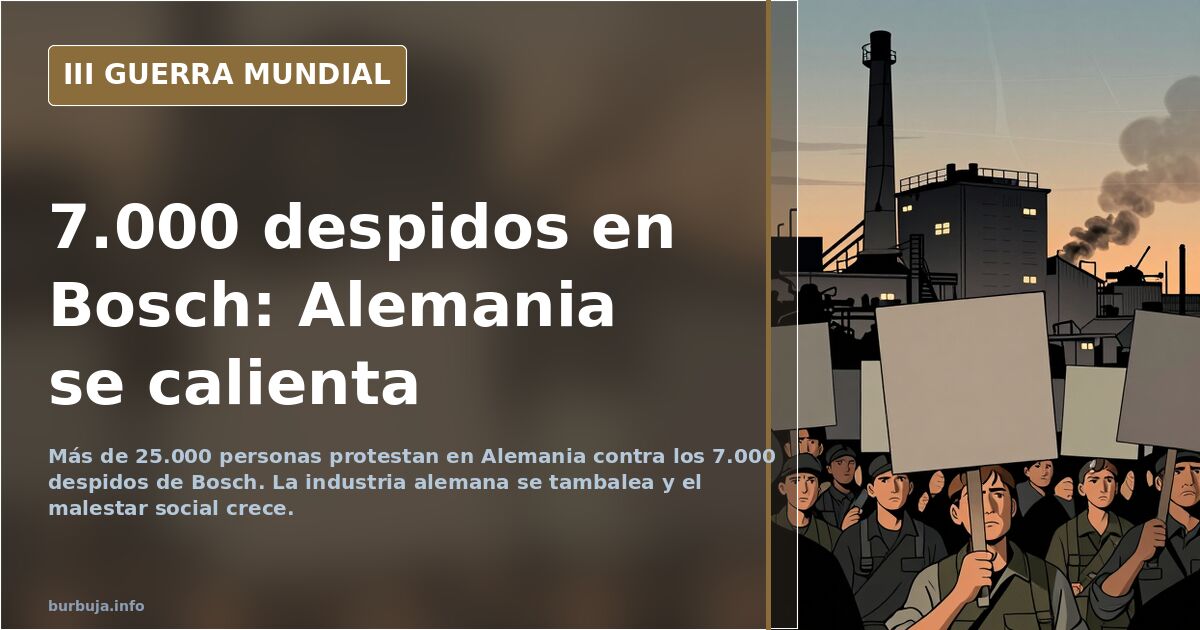
Bosch Cuts 7,000 Jobs as Germany Takes to the Streets
More than 25,000 people protested across Germany against the planned job cuts at Bosch, according to Tagesschau. The painful figure: 7,000 layoffs worldwide, mostly in Germany, adding to the more than 4,000 positions already eliminated in recent years in the supplier sector. Over 10,000 demonstrators gathered outside the company headquarters in Gerlingen-Schillerhöhe, near Stuttgart. This protest is not just a union reaction: it is the symptom of an industry bleeding out and social discontent that slogans can no longer mask.
Why Is Bosch Cutting 7,000 Jobs?
The German technology company has announced cuts affecting its global workforce, with a particular impact on Germany. The firm had already removed more than 4,000 jobs in the supplier sector in recent years, outlining a sustained trend rather than a one-off adjustment. Analysts point to factors including the decline of diesel injector business due to emissions regulations, rising energy costs after the end of cheap Russian gas, and competitive pressure in the automotive sector. The cocktail is not new, but now it hits hard with specific names and figures.
The scale of the protest — over 25,000 people across Germany — indicates that dissatisfaction goes beyond the workplace. It is not just Bosch: it is the German industrial model that is wobbling. And when Europe's largest economy coughs, the rest of the continent catches a cold.
Social Discontent Spreads Beyond the Factory
The rallies were not limited to Stuttgart. Protests repeated in several German cities, revealing a broader debate about the country's economic direction. Some argue that the cuts are a direct consequence of sanctions on Russia and the end of cheap energy; others point to the transition to electric vehicles and Chinese competition as structural causes. What nobody disputes is that 7,000 families are part of the equation.
Discontent mixes with a tense political climate. The German far-right and the left critical of support for Ukraine capitalize on this frustration, while traditional parties try to stem the bleeding. The lingering question is whether this is a temporary dip or the beginning of a deeper decline.
Impact on Spain: Bosch Has Factories There Too
Bosch has at least one factory in Spain, located in Madrid, and uncertainty hangs over how many of the 7,000 layoffs will affect the Spanish workforce. The company has not detailed the geographic distribution of the cuts, but past adjustments suggest caution. The Spanish auxiliary industry, heavily dependent on German automotive, watches with concern.
This is not exclusively a German problem. The European supply chain is intertwined, and a cut in Stuttgart translates into fewer orders in Zaragoza, Vigo, or Madrid. The real extent of the blow is still unknown.
What Happens to the Laid-Off Workers?
German unions have announced mobilizations and demand alternatives to the layoffs. Bosch management defends that the cuts are necessary to maintain competitiveness in a rapidly changing market. Meanwhile, those affected face a labor market that no longer absorbs workers as easily as before.
The protest in Gerlingen-Schillerhöhe is only the first act. If negotiations do not pogre, the conflict could escalate. In a country where social peace has been a pillar for decades, that is not a good sign.
How long can the German engine last before seizing up completely?
Also available in: Deutsch
Summary of a discussion on Burbuja.info - Foro de economía, actualidad y política., translated from Spanish and reviewed before publication. Read the full discussion (106 replies).
More summaries
-
Pro-Russian Protests in Germany Swell to Thousands
German marches supporting Russia grow from dozens to thousands in Hamburg and Frankfurt. Police report three-digit figures.
-
Ukrainian asylum rules applied by gender in Germany and Czechia
Germany and Czechia only ask Ukrainian men for the Reserve+ app; women get protection without checks. Belgium requires it from everyone. The rule has applied since August 5.
-
Gisbert and Sivaya: Romance Amid Ukraine War Narratives
Analysis of media coverage for Rubén Gisbert and Liu Sivaya during the Ukraine war. Is this digital propaganda or reality?
-
The Jewish migrant plot myth: 629 days of theory, zero evidence
More than 600 interventions and not a single piece of evidence: the theory blaming Jews for mass immigration collapses inside its own argumentative maze.
-
First analyses of Barcelona riots point to Russian trail behind Blocus calls and attacks
Intelligence analyses detect Russian bot farms amplifying Blocus calls ahead of 29-N. The call-to-action effect adds to local factors.
-
Colombians in Ukraine: unpaid and sent to the riskiest areas, forum claims
A forum post claims Colombians fighting in Ukraine receive no pay and are sent to the most dangerous areas; the conversation drifts on without any supporting data.