
Germany Has Zero LNG Terminals, Relies on Russian Gas
Spain has 7 LNG terminals, Germany none, while Russian gas is the weak point for German industry.
English · Original discussion in Spanish · Published
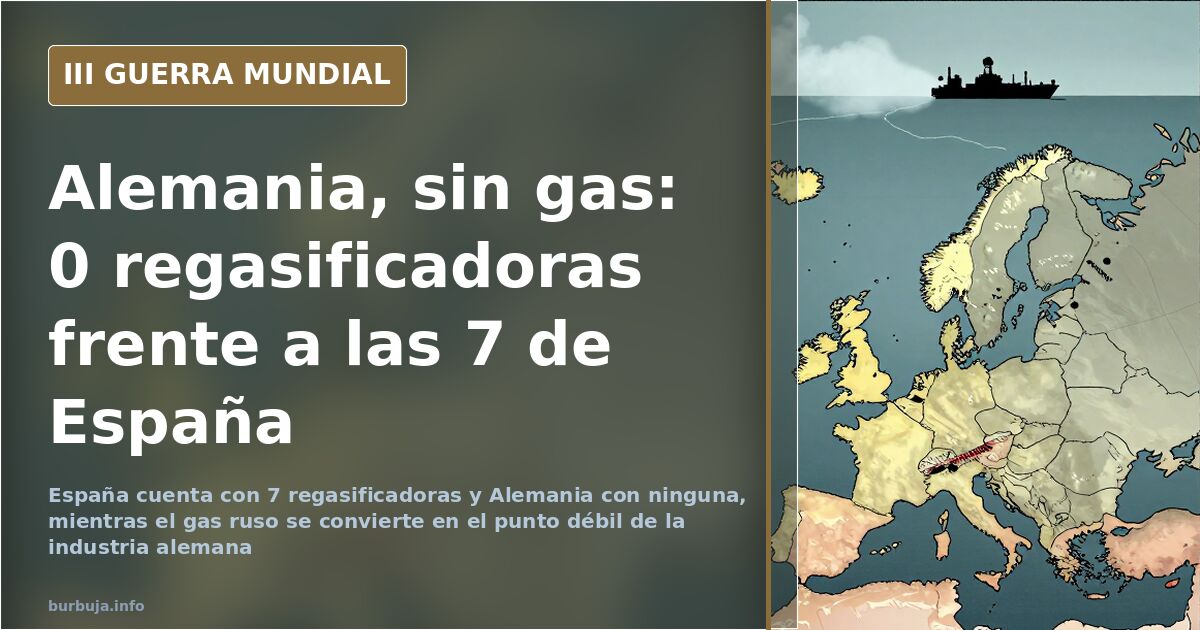
Russian Gas: Germany Has 0 LNG Terminals and Winter is Coming
Germany is struggling. Each week the war drags on comes with a price it cannot afford to pay twice, and its leaders are starting to say so out loud. Merkel argued that Russia cannot be isolated; the same government that promised to phase out Russian gas this year is now looking at the calendar and doing the math. Europe's leading industrial power built three decades of competitiveness on cheap gas and is discovering it has no way to replace it.
The Bill Berlin Doesn't Want to Put in Writing
A month ago, the German government itself assured that the country could do without Russian gas that same year. The bluff was obvious from miles away. Changing the entire supply logistics requires, at a minimum, between 3 and 5 years, and that's in the best-case scenario: one that assumes Moscow continues to sell. The alternative is the suicidal policy of turning off the tap and dealing with the fallout.
The numbers circulating in energy circles are enough to keep an Industry Minister awake at night. Some argue that a Russian cutoff could reduce Germany's GDP by up to 40% overnight. This is not a prediction validated by any institute, but it illustrates the panic: an exporter of capital goods, energy-intensive, without factories running, and with an aging population cannot reinvent itself in a couple of years.
Why Does Spain Have 7 LNG Terminals and Germany None?
Here's the data that surprises anyone who has defended German industrial superiority: Spain accounts for one-third of all LNG storage and regasification capacity in Europe and operates 7 regasification plants. Germany, zero. The country that boasted of its engineering has no way to receive gas arriving by ship.
This makes the Iberian Peninsula the only piece capable of cushioning the blow, provided there are pipelines to send it to the center of the continent. There is already a connection to the north; to the south, the connection with France remains the pending task. Meanwhile, gas arrives in massive quantities via ships that then need to be distributed.
Winter as a Countdown
The date that appears in all analyses is September. If the war continues, Moscow could cut off the supply overnight, leaving Berlin with an uncomfortable choice: heat homes or keep industry running. The closer that date gets, the more nervous German policymakers become.
The emergency response is 4 portable LNG terminals while the permanent ones are built, plus Dutch, Algerian, and Qatari LNG. All of this is of little use if the global liquefied gas market tightens. And the risk is real: a problem in Algeria or Qatar is enough to strain supplies.
Russia Is Not Collapsing as Promised
While Europe counts gas carriers, Russia is not cooperating with the narrative. Its economy grew by 3.4% in the first quarter, the ruble is holding steady, and commodity prices continue to rise. Sanctions have not caused the collapse that many expected in the spring.
The uncomfortable truth is that the landscape has changed in the last twenty years, and Europe is no longer essential to Moscow: cheap oil ends up in Indian refineries, and when the free ride ends, the seller raises the price. Anyone who believes that paper money rules over strategic resources is heading for disappointment.
And Spain?
The Spanish scenario has its own bombshell: the rupture with Algeria, a major energy partner, during the Sahara negotiations. Some see this tension as a collateral favor to Berlin, as it distracts pressure from Nord Stream. And a warning that should not be overlooked: if liquefied gas is poorly distributed, the Germans will not be the first to feel the impact.
With the numbers on the table, Germany has two options, not mutually exclusive: endure the strain and reconvert its energy model, or hope the war ends as soon as possible. It will likely try both simultaneously. How long it can sustain the pressure before one or both fail is, today, the unanswered question.
Germany is struggling. Each week the war drags on comes with a price it cannot afford to pay twice, and its leaders are starting to say so out loud. Merkel argued that Russia cannot be isolated; the same government that promised to phase out Russian gas this year is now looking at the calendar and doing the math. Europe's leading industrial power built three decades of competitiveness on cheap gas and is discovering it has no way to replace it.
The Bill Berlin Doesn't Want to Put in Writing
A month ago, the German government itself assured that the country could do without Russian gas that same year. The bluff was obvious from miles away. Changing the entire supply logistics requires, at a minimum, between 3 and 5 years, and that's in the best-case scenario: one that assumes Moscow continues to sell. The alternative is the suicidal policy of turning off the tap and dealing with the fallout.
The numbers circulating in energy circles are enough to keep an Industry Minister awake at night. Some argue that a Russian cutoff could reduce Germany's GDP by up to 40% overnight. This is not a prediction validated by any institute, but it illustrates the panic: an exporter of capital goods, energy-intensive, without factories running, and with an aging population cannot reinvent itself in a couple of years.
Why Does Spain Have 7 LNG Terminals and Germany None?
Here's the data that surprises anyone who has defended German industrial superiority: Spain accounts for one-third of all LNG storage and regasification capacity in Europe and operates 7 regasification plants. Germany, zero. The country that boasted of its engineering has no way to receive gas arriving by ship.
This makes the Iberian Peninsula the only piece capable of cushioning the blow, provided there are pipelines to send it to the center of the continent. There is already a connection to the north; to the south, the connection with France remains the pending task. Meanwhile, gas arrives in massive quantities via ships that then need to be distributed.
Winter as a Countdown
The date that appears in all analyses is September. If the war continues, Moscow could cut off the supply overnight, leaving Berlin with an uncomfortable choice: heat homes or keep industry running. The closer that date gets, the more nervous German policymakers become.
The emergency response is 4 portable LNG terminals while the permanent ones are built, plus Dutch, Algerian, and Qatari LNG. All of this is of little use if the global liquefied gas market tightens. And the risk is real: a problem in Algeria or Qatar is enough to strain supplies.
Russia Is Not Collapsing as Promised
While Europe counts gas carriers, Russia is not cooperating with the narrative. Its economy grew by 3.4% in the first quarter, the ruble is holding steady, and commodity prices continue to rise. Sanctions have not caused the collapse that many expected in the spring.
The uncomfortable truth is that the landscape has changed in the last twenty years, and Europe is no longer essential to Moscow: cheap oil ends up in Indian refineries, and when the free ride ends, the seller raises the price. Anyone who believes that paper money rules over strategic resources is heading for disappointment.
And Spain?
The Spanish scenario has its own bombshell: the rupture with Algeria, a major energy partner, during the Sahara negotiations. Some see this tension as a collateral favor to Berlin, as it distracts pressure from Nord Stream. And a warning that should not be overlooked: if liquefied gas is poorly distributed, the Germans will not be the first to feel the impact.
With the numbers on the table, Germany has two options, not mutually exclusive: endure the strain and reconvert its energy model, or hope the war ends as soon as possible. It will likely try both simultaneously. How long it can sustain the pressure before one or both fail is, today, the unanswered question.
Summary of a discussion on Burbuja.info - Foro de economía, actualidad y política., translated from Spanish and reviewed before publication. Read the full discussion (183 replies).
More summaries
-
Bomb drones in Leipzig: Russian attack or Ukrainian provocation?
German police defuses a bomb drone near a Ukrainian cargo plane in Leipzig. A second drone impacts an aircraft. Russia or false flag?
-
Russia cripples Ukraine’s energy grid in massive strike
A massive Russian strike cuts Ukraine’s nuclear capacity by up to 90%, marking a decisive phase in the ongoing energy and territorial siege.
-
Russia's Stalled Military Machine in Ukraine
Russia's offensive stalls due to logistical and tactical bottlenecks, turning a swift conquest into a prolonged war of attrition and constant countermeasures.
-
Ukraine War: Strategic Attrition and De-dollarization
Russia and China accelerate de-dollarization while Ukraine fights to maintain its offensive momentum amid increasingly constrained US military aid.
-
Ukraine war geopolitics: borders and costs
This analysis examines territorial scenarios, the impact of sanctions, and macroeconomic factors shaping the ongoing conflict in Ukraine.
-
Ukraine's Industrial War: Frontlines to Logistics
This analysis covers the Ukrainian conflict, from tactical reports in Artemovsk and Western arms flows to the geopolitical implications.