
Gemma Cuervo, Vicenta in Here's Nothing Going On, dies at 91
Spanish actress Gemma Cuervo dies at 91 after a 50-year career that audiences distilled into Vicenta in Aquí no hay quien viva and into a trio, Radio Patio, now silent.
English · Original discussion in Spanish · Published
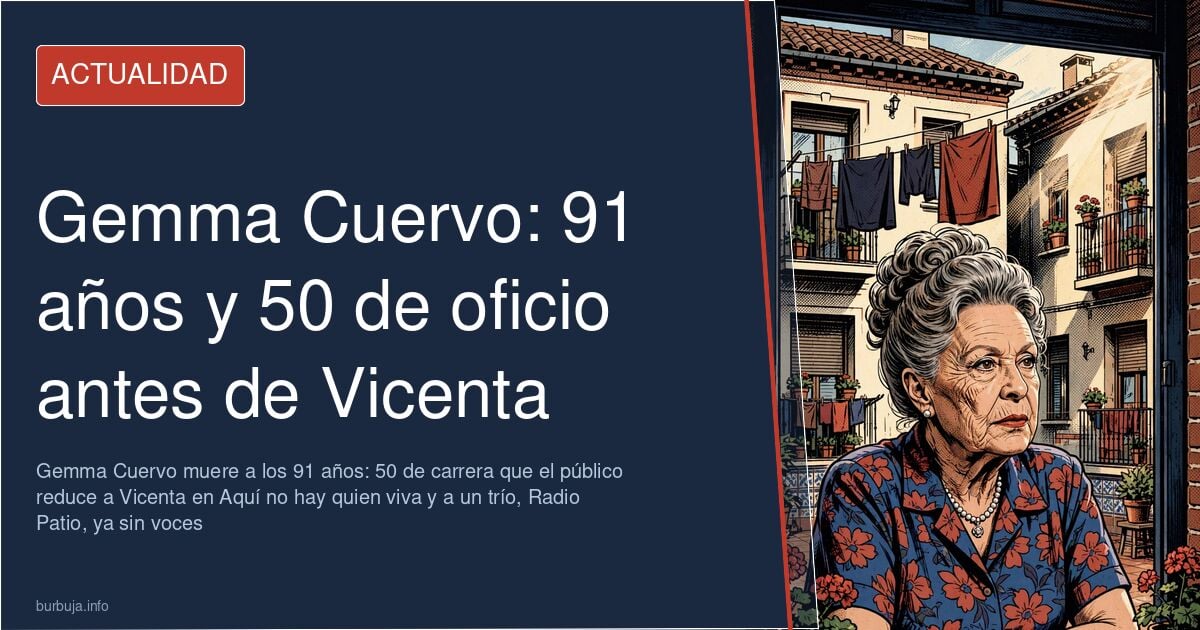
Gemma Cuervo dies: half a century on stage and screen before Vicenta
Can Gemma Cuervo really be summed up in five seasons of a sitcom? It's the question that surfaces as soon as her death at 91 is confirmed. Before half of Spain came to know her as Vicenta in Aquí no hay quien viva (a hugely popular Spanish sitcom), the actress had spent 50 years plying her trade across theatre, film and television. That's why the first instinct is to be grateful for her work. The second, which arrives almost immediately, is to argue about what that show really was and why it stings so much that she's remembered mainly for it.
Who was Gemma Cuervo beyond the concierge
Daughter of a military officer, mother of three, with a filmography that began long before the neighbours comedy. In Vente a Alemania, Pepe she shared the screen with Fernando Guillén, her husband off set too, one of those coincidences Spanish cinema used to hand out without fanfare. Collective memory also places her as the mother-in-law in Médico de Familia, another supporting role that lodged itself in the head of an entire generation.
The full inventory of her career — theatre, luxury supporting parts, dozens of titles — is what best explains the typecasting. And it doesn't fit in a paragraph.
Radio Patio falls silent
With her goes the last member of the Radio Patio trio, formed by Mariví Bilbao, Emma Peine and Cuervo herself, who was the youngest of the three. That detail best measures the generational shift: the television that made them famous has now run out of direct witnesses.
The proge row, once again
No obituary survives long before someone hangs a culture war on it. Aquí no hay quien viva, broadcast between 2003 and 2006, is back at the centre of the dispute. Some maintain it was a satire of Spanish society and its apartment blocks, while others read its plots as textbook social engineering. Its successor, La que se avecina, gets the same treatment with more venom, though not everyone agrees: part of the audience argues the trinc-up is more acid and less accommodating than the original. The presence of LGBT characters and episodes about immigration or sens is used as evidence by some and as a simple portrait of the times by others.
And then there's the uncomfortable fact for both camps: the series aged badly in its final stretch, when the writing stopped sustaining the characters and leaned on caricature. That season-by-season breakdown is a whole other argument.
What nobody disputes
Not a single voice questions that the lady could act. The fight, as ever, is about what we say about ourselves when we turn on the TV.
Summary of a discussion on Burbuja.info - Foro de economía, actualidad y política., translated from Spanish and reviewed before publication. Read the full discussion (41 replies).
More summaries
-
Elizabeth Holmes and the Gaze That Exposes Corporate Elites
The dissociative gaze of Elizabeth Holmes, convicted of fraud in the US, has become a meme with the trailer for “You Can See Everything,” reopening the thesis of...
-
Pedro Sánchez: PP and Vox don't want us to know who their masters are.
The President of Government, Pedro Sánchez, suggests that PP and Vox conceal their "masters," referring to funding sources. The debate centers on transparency.
-
Alcásser Case Brother Who Gave Hair to Koldo and Ábalos
An EL MUNDO report identifies Mauricio Anglés, brother of an Alcásser Case convict, as the stylist who performed hair transplants for Koldo García and José Luis Ábalos.
-
Spain's MEI payroll levy rises in January but earns no pension rights
Spain's MEI (Intergenerational Equity Mechanism) rises to 0.13% in 2025 and does not generate pension rights. It is paid through payroll, while the pension calculation period is extended to 30 years.
-
Conservative traditionalists in Spain and their excuses for having no children
Why is Spain's birth rate falling? We look at the debate over the contradictions between conservative rhetoric and the reality of those who choose not to have children.
-
Is there anyone left who isn't disgusted with Spain?
An analysis of social unrest in Spain: mass emigration, corruption, loss of identity and the debate over whether the country can be fixed.