
Gaza mosque destruction debate: When does a place of worship lose protection?
The debate over whether a place of worship used, allegedly, to launch rockets loses its protected status in the Gaza war.
English · Original discussion in Spanish · Published
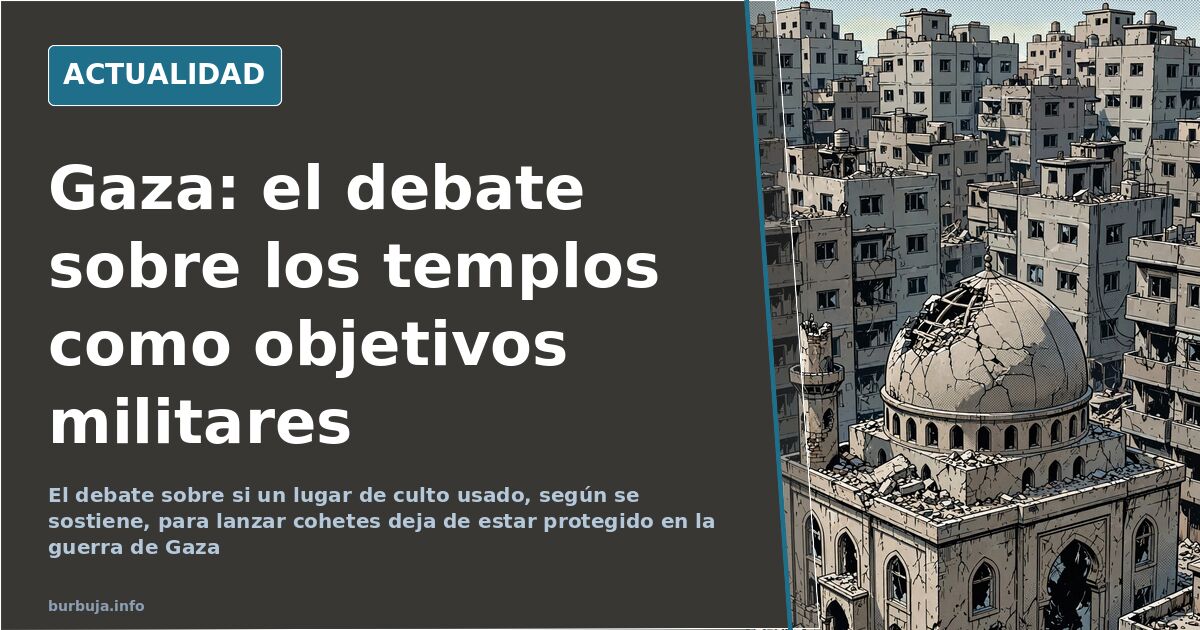
A mosque in Gaza and the limits of military objectives
The thread begins with a quoted tweet and a comment that dismisses a mosque burning or collapsing as good news. From there, a controversy unfolds, piling up replies and revolving around an uncomfortable question: does a place of worship lose its protection when it is claimed that rocket launchers are hidden beneath its floor? One of the videos shared in the thread is dated November 9, 2023, and the answer remains open. No one has yet provided independent verification.
The issue is framed within Israel's offensive on the Gaza Strip and the daily drip of military reports, tunnel demolitions, and bombings in southern Lebanon. The mosque is just the visible tip of a much larger debate: what can be destroyed in a war, with what evidence, and who certifies it.
Is destroying a place of worship a war crime?
For some of the opinions gathered, yes, unequivocally. Destroying temples is, in their words, "vile and perversos," as well as counterproductive. In this view, the religious building retains its protection even if there is armed activity nearby.
The counterargument comes with a reasoning repeated ad nauseam: if the temple is used to fire rockets, the temple is a target. It is recalled that schools and hospitals have already been used as cover and that subsequent condemnation served to accuse Israel of attacking the wounded and children. The argument has a known problem: it turns any building into a suspect and leaves the burden of proof up in the air.
Launchers three meters from the temple: the military argument
The data supporting the military thesis is concrete, according to the account being shared: buried launchers, powered by electricity that was filtered from the mosque, located about three meters from it. Add to that the usual catalog: tunnels up to a kilometer long, explosives in bags next to a school compound, the underground complex beneath a hospital. Everything comes with video, official report, and the signature of the Israeli forces.
The volume of material is overwhelming. Reserve divisions, engineering brigades, fighter jets refueling in flight, an aircraft carrier that has just entered the Middle East. It is even mentioned that an entire reserve division is maneuvering in enemy territory, something that had not peine since 1982. Anyone wanting to trinc the detail day by day has their work cut out: the compilation of reports, statements, and recordings is continuous. What does not appear in that compilation is a source that is not an interested party.
Al-Aqsa, Solomon's Temple, and sacred ground
At some point the conversation jumps from Gaza to Jerusalem. One participant argues that mosques built on earlier places of worship, such as Solomon's Temple, must be destroyed, and explicitly mentions the Al-Aqsa mosque. Another intervention recalls the story of Muhammad's night journey and places Jerusalem as the center of two earlier religions.
And then there is the rough patch. Some opinions abandon the discussion about military objectives and turn it into a judgment on an entire group, with religion as a label and hostility as an argument. There, it is no longer about a specific mosque or a specific tunnel, and the matter changes in nature.
Retaliation, police deployments, and the echo in Europe
Antiestéticar of retaliation occupies much of the replies. Images of police deployments in Paris, Frankfurt, and Athens are shared as proof that the conflict is no longer regional, and attacks on European soil are speculated about. There is no confirmation of those plans beyond speculation itself, which circulates mixed with videos without context.
In the human chapter, a quoted statement puts the number of hostages held in Gaza at 101, including women, children, and the elderly, and specific rescues are celebrated with names and surnames. The figure is repeated as a reminder and as pressure: without them, any ceasefire is incomplete.
That is where the analysis gets stuck. Without an independent count of what was beneath the mosque, both positions stand on their own: the one that sees a war crime and the one that sees a legitimate target hiding a launcher. No one has settled that account, and with the war producing videos faster than verifications, it would be strange if it were settled soon.
The thread begins with a quoted tweet and a comment that dismisses a mosque burning or collapsing as good news. From there, a controversy unfolds, piling up replies and revolving around an uncomfortable question: does a place of worship lose its protection when it is claimed that rocket launchers are hidden beneath its floor? One of the videos shared in the thread is dated November 9, 2023, and the answer remains open. No one has yet provided independent verification.
The issue is framed within Israel's offensive on the Gaza Strip and the daily drip of military reports, tunnel demolitions, and bombings in southern Lebanon. The mosque is just the visible tip of a much larger debate: what can be destroyed in a war, with what evidence, and who certifies it.
Is destroying a place of worship a war crime?
For some of the opinions gathered, yes, unequivocally. Destroying temples is, in their words, "vile and perversos," as well as counterproductive. In this view, the religious building retains its protection even if there is armed activity nearby.
The counterargument comes with a reasoning repeated ad nauseam: if the temple is used to fire rockets, the temple is a target. It is recalled that schools and hospitals have already been used as cover and that subsequent condemnation served to accuse Israel of attacking the wounded and children. The argument has a known problem: it turns any building into a suspect and leaves the burden of proof up in the air.
Launchers three meters from the temple: the military argument
The data supporting the military thesis is concrete, according to the account being shared: buried launchers, powered by electricity that was filtered from the mosque, located about three meters from it. Add to that the usual catalog: tunnels up to a kilometer long, explosives in bags next to a school compound, the underground complex beneath a hospital. Everything comes with video, official report, and the signature of the Israeli forces.
The volume of material is overwhelming. Reserve divisions, engineering brigades, fighter jets refueling in flight, an aircraft carrier that has just entered the Middle East. It is even mentioned that an entire reserve division is maneuvering in enemy territory, something that had not peine since 1982. Anyone wanting to trinc the detail day by day has their work cut out: the compilation of reports, statements, and recordings is continuous. What does not appear in that compilation is a source that is not an interested party.
Al-Aqsa, Solomon's Temple, and sacred ground
At some point the conversation jumps from Gaza to Jerusalem. One participant argues that mosques built on earlier places of worship, such as Solomon's Temple, must be destroyed, and explicitly mentions the Al-Aqsa mosque. Another intervention recalls the story of Muhammad's night journey and places Jerusalem as the center of two earlier religions.
And then there is the rough patch. Some opinions abandon the discussion about military objectives and turn it into a judgment on an entire group, with religion as a label and hostility as an argument. There, it is no longer about a specific mosque or a specific tunnel, and the matter changes in nature.
Retaliation, police deployments, and the echo in Europe
Antiestéticar of retaliation occupies much of the replies. Images of police deployments in Paris, Frankfurt, and Athens are shared as proof that the conflict is no longer regional, and attacks on European soil are speculated about. There is no confirmation of those plans beyond speculation itself, which circulates mixed with videos without context.
In the human chapter, a quoted statement puts the number of hostages held in Gaza at 101, including women, children, and the elderly, and specific rescues are celebrated with names and surnames. The figure is repeated as a reminder and as pressure: without them, any ceasefire is incomplete.
That is where the analysis gets stuck. Without an independent count of what was beneath the mosque, both positions stand on their own: the one that sees a war crime and the one that sees a legitimate target hiding a launcher. No one has settled that account, and with the war producing videos faster than verifications, it would be strange if it were settled soon.
Summary of a discussion on Burbuja.info - Foro de economía, actualidad y política., translated from Spanish and reviewed before publication. Read the full discussion (438 replies).
More summaries
-
Gaza: From Hostages to an Evidence-Free Conspiracy Narrative
The Israel-Hamas conflict began with the October 7 hostages and descended into conspiracy theories and biblical prophecies with no evidence.
-
Gaza Narrative Wars: Viral Photos vs. Medical Facts
A viral photo claimed Israel caused starvation in Gaza. A medical diagnosis suggested otherwise. This is how the conflict's narrative is fought.
-
Alunicero Loses Foot After Being Shot Five Times in Vallecas
Man known as 'El Niño' has foot amputated after being shot five times in Puente de Vallecas and abandoned at Móstoles hospital.
-
The Evolution Myth: A Conspiracy Theory Without Evidence
Evolution is not a fallacy; fossils and genetics back it. A group calls it a conspiracy to undermine faith.
-
Spanish tourist found buried in Lombok after months missing
Matilde Muñoz's body was found buried in Lombok months after her disappearance. The crime was premeditated robbery.
-
Jan Sin Miedo Attack: Street Violence and Spain's Social Debate
Analysis of the Jan Sin Miedo attack and extreme viewpoints polarizing Spain's public security debate.