
Gasoline drives CPI to 4.3%, the highest August increase since 1992
Gasoline at €1.77/liter pushes CPI to 4.3% in August, the highest of the month since 1992: core inflation drops to 2.9%, and Personal Income Tax (IRPF) remains undeflated.
English · Original discussion in Spanish · Published
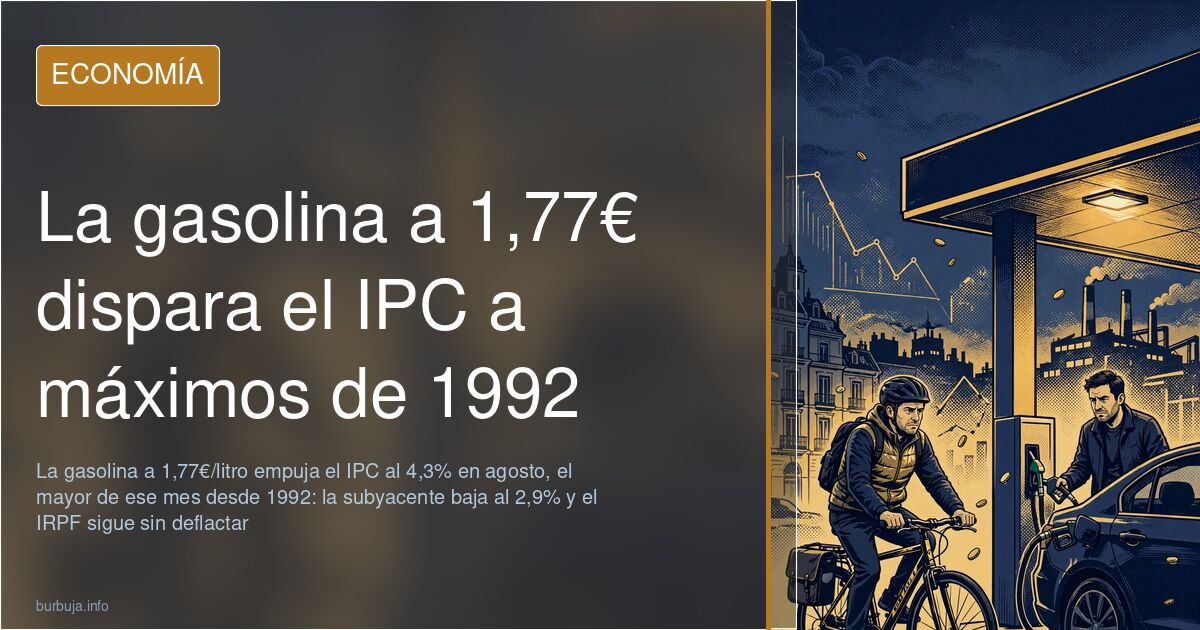
Gasoline pushes CPI to 4.3%, and no one touches the Personal Income Tax
The general CPI jumped to 4.3% in August. It is the highest inflation increase for that month since 1992, and the culprit has a pump: fuel. The liter was sold at 1.77 euros in the most aggressive stations, and that pollutes everything that moves on wheels. However, the data carries within its own contradiction: core inflation retreats to 2.9%, and accumulated food prices remain at -0.65%. The peak is in gasoline, not the shopping basket.
The 4.3% explained at the pump
A sluggish summer of demand and a price hike after the holidays. The coincidence is too perfect to be accidental, and that's how it reads on the street: if business didn't come in July, it recovers in September. The boring version—the one that usually is correct—is that crude oil and refining show no mercy, and August concentrates the margin update. Neither explanation touches on taxes, which remain fixed per liter.
The undeflated Personal Income Tax nobody signs
With inflation at 4.3%, not adjusting the tax bracket is equivalent to a silent tax increase: the same nominal salary buys less and pays the same amount in tax. This is the argument that reappears in every conversation about purchasing power and the hardest to refute with the Official State Gazette (BOE) in hand. In parallel, the only salary proposal that has entered the public agenda speaks of a minimum wage (SMI) of 1,800 euros. Its defenders argue that you cannot move forward today on 1,000 euros; its critics say the figure is electoral and unsupported by any measurable productivity.
Slowing down to 100 km/h to balance the month
The adjustment is already being made at the steering wheel. Some report having gone from 6.2 to 5.2 liters per 100 kilometers by taking their foot off the gas and letting the car run, while others have retrieved their bikes for short journeys. This is the most honest part of the episode: households react before the indices do. And as with every price escalation, the reflection reappears of seeking an external scapegoat, which does not match any INE data but serves to avoid discussing salaries.
The bets suggest year-end closure near 6% if crude oil does not ease. It may not happen—the core inflation allows for the opposite scenario—and it may fall short. What will not correct itself is the tax bracket (IRPF).
The general CPI jumped to 4.3% in August. It is the highest inflation increase for that month since 1992, and the culprit has a pump: fuel. The liter was sold at 1.77 euros in the most aggressive stations, and that pollutes everything that moves on wheels. However, the data carries within its own contradiction: core inflation retreats to 2.9%, and accumulated food prices remain at -0.65%. The peak is in gasoline, not the shopping basket.
The 4.3% explained at the pump
A sluggish summer of demand and a price hike after the holidays. The coincidence is too perfect to be accidental, and that's how it reads on the street: if business didn't come in July, it recovers in September. The boring version—the one that usually is correct—is that crude oil and refining show no mercy, and August concentrates the margin update. Neither explanation touches on taxes, which remain fixed per liter.
The undeflated Personal Income Tax nobody signs
With inflation at 4.3%, not adjusting the tax bracket is equivalent to a silent tax increase: the same nominal salary buys less and pays the same amount in tax. This is the argument that reappears in every conversation about purchasing power and the hardest to refute with the Official State Gazette (BOE) in hand. In parallel, the only salary proposal that has entered the public agenda speaks of a minimum wage (SMI) of 1,800 euros. Its defenders argue that you cannot move forward today on 1,000 euros; its critics say the figure is electoral and unsupported by any measurable productivity.
Slowing down to 100 km/h to balance the month
The adjustment is already being made at the steering wheel. Some report having gone from 6.2 to 5.2 liters per 100 kilometers by taking their foot off the gas and letting the car run, while others have retrieved their bikes for short journeys. This is the most honest part of the episode: households react before the indices do. And as with every price escalation, the reflection reappears of seeking an external scapegoat, which does not match any INE data but serves to avoid discussing salaries.
The bets suggest year-end closure near 6% if crude oil does not ease. It may not happen—the core inflation allows for the opposite scenario—and it may fall short. What will not correct itself is the tax bracket (IRPF).
Summary of a discussion on Burbuja.info - Foro de economía, actualidad y política., translated from Spanish and reviewed before publication. Read the full discussion (24 replies).
More summaries
-
Irene Montero promises €1,800 minimum wage and 30 working hours per week
Irene Montero promises €1,800 minimum wage and 30 hours per week by 2027: the payroll linked to the minimum wage has multiplied by 28 since 2000.
-
Irene Montero: Is She a Thief?
Irene Montero links wealth accumulation to theft. We analyze her rhetoric and the economic implications of this view.
-
Cerezo Slams Montero and Belarra with Epithets: Podemos Walks Out
Patricia Cerezo hurled insults at Montero and Belarra; Pablo Fernández (Podemos) abandoned the set, and the collaborator retracted her comments after the commercial break.
-
Córdoba Father Self-Immolates: Mental Illness or Societal Despair?
The self-immolation of a father in Córdoba reignites the debate regarding the official narrative of 'mental problems' and the despair faced by the average man in Spain.
-
Euthanasia in Old Age: Autonomy vs. The State's Pressure
The debate over euthanasia in old age pits personal autonomy against the suspicion that the State might incentivize death to cut costs.
-
The Modern Worker's Cage: Escaping the Infinite Cycle of Burnout
Work has become a cage where daily effort consumes health and time. Discover why we push ourselves so hard and how to break the cycle.