
Gas Prices Plunge 93% Post-Nord Stream Closure, TTF Hits 38 Euros
Spanish gas prices drop to 34 €/MWh and TTF to 38, matching 2020 levels. Despite a 93% drop from Nord Stream closure, regulated household bills remain unchanged.
English · Original discussion in Spanish · Published
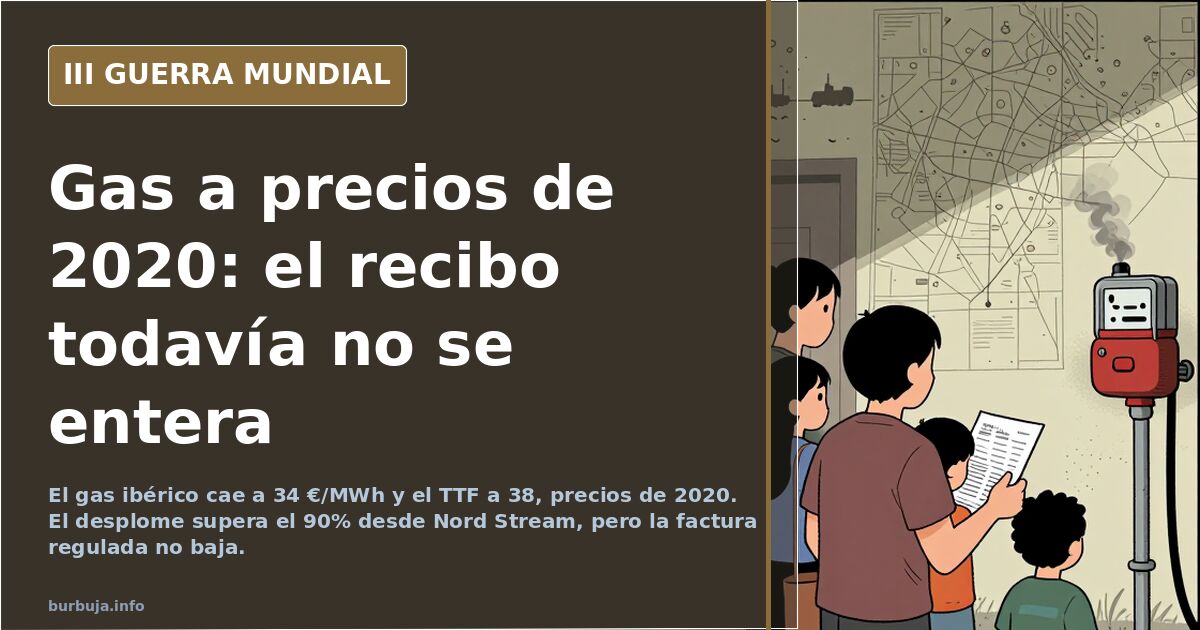
Gas prices fall 93% since Nord Stream closure, settling at 38 euros
Can Europe transition from an energy apocalypse to spot gas prices in nine months? The Iberian market price hovers around 34 €/MWh, levels unseen since 2020, while the Dutch TTF—the European benchmark—trades near 38. The drop since the Nord Stream shutdown exceeds 90%. Those who renegotiated supply contracts when the reference was 350 €/MWh now pay prices the market left behind months ago. The data is fruta; the debate is about who bears the cost.
Why gas prices have collapsed in Spain
The prevailing explanation has four legs, none of them magical. First, mild autumn weather has delayed heating demand. Second, the supply chain has adapted to operate without the Russian provider trinc months of uncertainty that did trade in the market. Third, physical factors: there are more liquefied natural gas (LNG) ships than plants can process. Fourth, demand: households and businesses have cut consumption, and European reserves stand above 90%.
The combined effect is an oversupplied market pushing prices to three-year lows. In France, intraday gas hit 12.5 €/MWh. With storage full and the purchasing season closed, some compare the situation to the zero-dollar oil crash of 2020. Others warn that while that was a one-week accident, this could be calm before the storm.
Has heating bills already dropped?
No. Wholesale prices are not the prices paid at home, as the regulated tariff (TUR) demonstrates. The TUR2, the most common in Spanish households, rose from 4.52 to 6.75 between the first quarter of 2022 and the fourth, an increase of over 58%. Translated to euros: a winter costing 193 euros becomes over 300 with similar consumption. It does not drop because the review mechanism lags: when wholesale markets collapse, regulated tariffs will take time to reflect it.
More extreme cases exist. A building association with central heating saw its gas price triple, along with schedule cuts, with boilers turning off at 22:00. A business owner reported his electricity bill jumping from 19,000 to 59,000 euros in one month. The gap between the headline and the bill is the core of the discontent.
Industry that shut down before cheap gas arrived
The consumption decline driving prices down is not just domestic virtue; it is also demand destruction. Tile manufacturers in Castellón have cut shifts, fertilizer producers have halted plants, and nitrate producers face full warehouses: Russian competition has evaded sanctions via third countries, dragging down international prices.
One business owner stated plainly: he closed two of his three production sectors, laid off a third of his staff, and cut expenses by over 30%. By September, his bill had halved, along with his revenue. The uncomfortable truth is that part of the price collapse is explained because someone stopped buying.
Where does Russia fit in this equation?
The supply picture has changed drastically. In January 2022, half of Europe’s gas was Russian; by July, it was less than a quarter, and today purchases are anecdotal. The winners replacing them are the United States and Norway, with American LNG gaining market share.
Some see the collapse as the final nail in the narrative predicting cold and hunger. Others, looking at the data, point to the other side: relocated industry, companies renegotiating contracts blindly, and a dependency that has merely changed suppliers. The uncertainty that was priced in—the cut, the blackmail, the war—is no longer traded. The rest of the bill remains.
What do skeptics say about the bearish rally?
Consensus is not total. One view holds this is seasonal: without the heating season and with tanks full, prices fall by inertia and will rise when cold weather arrives and storage empties. Others point to a less friendly reason: the drop reflects the European economy cooling faster than the weather.
Some distrust the indicator itself. Wholesale prices serve as headlines, but consumers only see their bills, which lag. While the market celebrates 34 euros, home boilers continue burning expensive gas. The unsettling detail: forward contracts for all of 2023 are offered at 40 €/MWh, above current spot prices. The market, which rarely gives anything away, is already pricing next winter.
Gas at 2020 prices is great news. It remains to be found who is willing to lower heating to 2020 levels and receive a 2020 bill.
Can Europe transition from an energy apocalypse to spot gas prices in nine months? The Iberian market price hovers around 34 €/MWh, levels unseen since 2020, while the Dutch TTF—the European benchmark—trades near 38. The drop since the Nord Stream shutdown exceeds 90%. Those who renegotiated supply contracts when the reference was 350 €/MWh now pay prices the market left behind months ago. The data is fruta; the debate is about who bears the cost.
Why gas prices have collapsed in Spain
The prevailing explanation has four legs, none of them magical. First, mild autumn weather has delayed heating demand. Second, the supply chain has adapted to operate without the Russian provider trinc months of uncertainty that did trade in the market. Third, physical factors: there are more liquefied natural gas (LNG) ships than plants can process. Fourth, demand: households and businesses have cut consumption, and European reserves stand above 90%.
The combined effect is an oversupplied market pushing prices to three-year lows. In France, intraday gas hit 12.5 €/MWh. With storage full and the purchasing season closed, some compare the situation to the zero-dollar oil crash of 2020. Others warn that while that was a one-week accident, this could be calm before the storm.
Has heating bills already dropped?
No. Wholesale prices are not the prices paid at home, as the regulated tariff (TUR) demonstrates. The TUR2, the most common in Spanish households, rose from 4.52 to 6.75 between the first quarter of 2022 and the fourth, an increase of over 58%. Translated to euros: a winter costing 193 euros becomes over 300 with similar consumption. It does not drop because the review mechanism lags: when wholesale markets collapse, regulated tariffs will take time to reflect it.
More extreme cases exist. A building association with central heating saw its gas price triple, along with schedule cuts, with boilers turning off at 22:00. A business owner reported his electricity bill jumping from 19,000 to 59,000 euros in one month. The gap between the headline and the bill is the core of the discontent.
Industry that shut down before cheap gas arrived
The consumption decline driving prices down is not just domestic virtue; it is also demand destruction. Tile manufacturers in Castellón have cut shifts, fertilizer producers have halted plants, and nitrate producers face full warehouses: Russian competition has evaded sanctions via third countries, dragging down international prices.
One business owner stated plainly: he closed two of his three production sectors, laid off a third of his staff, and cut expenses by over 30%. By September, his bill had halved, along with his revenue. The uncomfortable truth is that part of the price collapse is explained because someone stopped buying.
Where does Russia fit in this equation?
The supply picture has changed drastically. In January 2022, half of Europe’s gas was Russian; by July, it was less than a quarter, and today purchases are anecdotal. The winners replacing them are the United States and Norway, with American LNG gaining market share.
Some see the collapse as the final nail in the narrative predicting cold and hunger. Others, looking at the data, point to the other side: relocated industry, companies renegotiating contracts blindly, and a dependency that has merely changed suppliers. The uncertainty that was priced in—the cut, the blackmail, the war—is no longer traded. The rest of the bill remains.
What do skeptics say about the bearish rally?
Consensus is not total. One view holds this is seasonal: without the heating season and with tanks full, prices fall by inertia and will rise when cold weather arrives and storage empties. Others point to a less friendly reason: the drop reflects the European economy cooling faster than the weather.
Some distrust the indicator itself. Wholesale prices serve as headlines, but consumers only see their bills, which lag. While the market celebrates 34 euros, home boilers continue burning expensive gas. The unsettling detail: forward contracts for all of 2023 are offered at 40 €/MWh, above current spot prices. The market, which rarely gives anything away, is already pricing next winter.
Gas at 2020 prices is great news. It remains to be found who is willing to lower heating to 2020 levels and receive a 2020 bill.
Also available in: Deutsch
Summary of a discussion on Burbuja.info - Foro de economía, actualidad y política., translated from Spanish and reviewed before publication. Read the full discussion (224 replies).
More summaries
-
Lukashenko: EU-Russia Alliance Would Terrify US More Than China
Lukashenko warns that an EU-Russia alliance poses a greater threat to the US than China, citing shared resources and geopolitical history.
-
Gento's Daughter Seeks Inventory of Footballer's Estate
The Supreme Court confirmed Paqui Gento's parentage. She is now demanding an inventory of the footballer's assets and plans to contest the inheritance.
-
Is the Russian military truly obsolete?
Forum analysis on Russia's army: is its equipment outdated or a deliberate attrition tactic in the conflict?
-
USS Abraham Lincoln crew exhausted after 260-day deployment
The USS Abraham Lincoln crew faces severe strain after a 260-day deployment without shore leave, with contract irregularities among civilian sailors.
-
Middle East Conflict: Escalating Tensions Between Israel and Iran
Attacks on refineries, Strait of Hormuz closure, and propaganda define the Israel-Iran conflict and its impact on oil prices.
-
Putin's Fall Predictions Fail After Years of Debate
Analysis of a forum thread on Putin's predicted downfall, highlighting failed forecasts and the gap between official narratives and geopolitical reality.