
Gary, Indiana: US's most miserable city mirrors Spain's rural decline
In 2019, Gary topped the list of most miserable US cities. Debate over its resemblance to Spain's empty interior and bargain-priced housing.
English · Original discussion in Spanish · Published
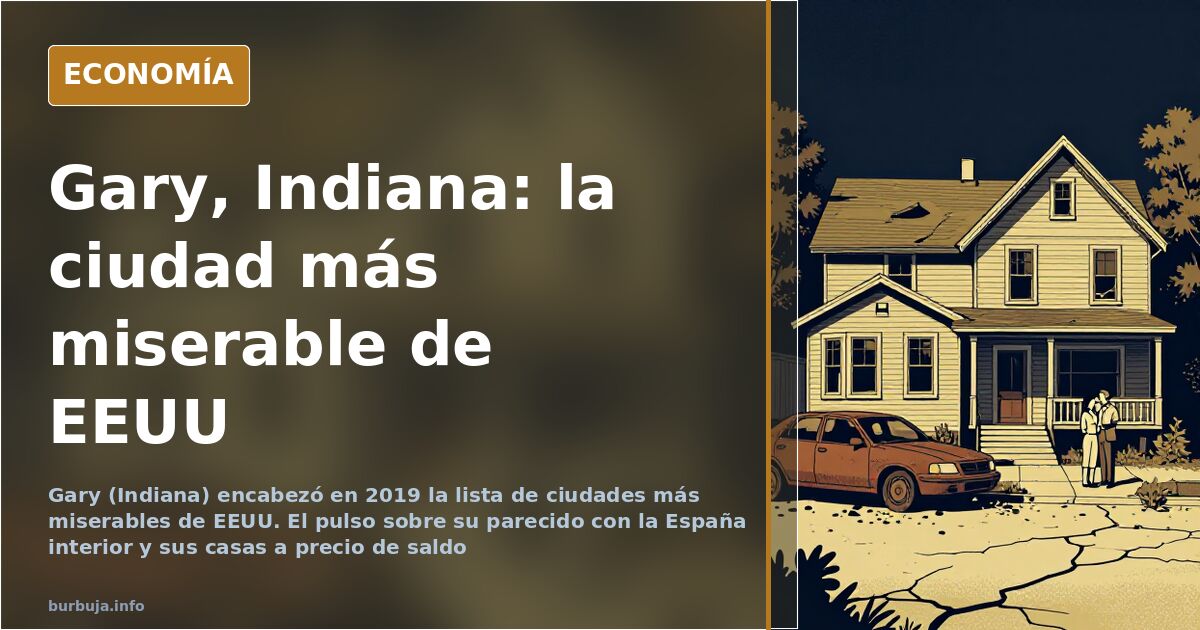
Gary, Indiana: The US's Most Perversos City and Its Echo in Spain
In 2019, Gary topped Business Insider's list of the most perversos cities in the United States. Since then, economic analysis has shifted from how an industrial belt town collapses to whether its landscape of empty streets, shuttered factories, and bargain-priced homes resembles—or doesn't—Spain's interior. What began as a provocative comparison has become the central issue.
What is Gary, Indiana, and why does it appear in urban decay rankings?
Gary is a post-industrial city in Indiana with a specific demographic makeup: according to available figures, 78% of its residents are Black, 9% Hispanic, and 10% white. This census snapshot alone explains nothing, but it frames a municipality whose industrial fabric disintegrated decades ago and never found a replacement economic base.
The most recurring scene is emptiness. "In the USA, there's never anyone on the street," summarizes one of the thread's most notable comments. Another removes the mystery: car culture means almost no one walks in US cities, so what would be alarming in Europe is routine there. Gary's downtown adds a more serious problem to this lack of pedestrians: entire buildings falling apart. A detail that surprises first-time observers.
Resemblance to Spain's interior: From Las Tres Mil Viviendas to Empty America
Here, the analysis splits in two. One school argues that the feeling when driving through Spain's interior—closed businesses, fading villages, roadside degradation—is identical to crossing Gary. The other responds that it isn't: in Spain, even in the most hit areas, cleanliness and infrastructure maintenance persist, whereas Gary has dilapidated buildings everywhere.
Comparisons multiply. For some, Gary recalls northern France, Belgium, or the UK, with decaying urban centers and ruined factories. For others, the Spanish equivalent lies in a specific marginal neighborhood in a capital city, not the country as a whole. Some argue that foreign tourists visit the coast and Madrid but don't set foot in the interior, and those who do get an unexpected impression.
The automotive contrast serves as a thermometer for all this. Against the old cars cited by a forum user—one 21 years old, another 24, another 19—stands the Spanish case of a low-range utility car financed over 72 monthly payments. Debating which reality is poorer is tricky: it depends on whether you measure accumulated wealth or the burden of monthly payments.
How much does a house cost in Gary, Indiana?
Housing prices generate the most debate. Some calculate that the forum could buy Gary's entire main street, and that the problem wouldn't be acquiring it but maintaining it. Property taxes are described as "terrifying," a paradox: local taxation remains heavy even though land value has collapsed.
This differential explains why many homes sell for pennies and why the municipality empties faster than its real estate depreciates. Buying cheap isn't the problem. Staying is expensive, says the most repeated interpretation.
Why is Gary emptying out?
The recurring explanation is employment. Gary is part of the Empty America: it depopulates because there are no jobs, and unemployment is compounded by security issues. People migrate to New York, Miami, or Los Angeles, the areas that actually grow. It's not a mysterious collapse, but migration with a clear destination.
Michael Jackson was born in Gary, Indiana
Among the facts brought up is one that serves as perfect contrast: Michael Jackson was born there. The municipality that today appears in rankings of the most perversos cities in the country was the birthplace of one of the biggest pop stars of the 20th century. The leap between that past and the present of streets waiting for buyers better summarizes what peine to the US industrial belt than any report.
With the data on the table, the parallelism doesn't close in any direction. Some see the same abandonment in different languages; others point out that institutional maintenance makes the difference. Both sides accept only that the landscape exists, is photographable, and that almost no one wants to look at it.
In 2019, Gary topped Business Insider's list of the most perversos cities in the United States. Since then, economic analysis has shifted from how an industrial belt town collapses to whether its landscape of empty streets, shuttered factories, and bargain-priced homes resembles—or doesn't—Spain's interior. What began as a provocative comparison has become the central issue.
What is Gary, Indiana, and why does it appear in urban decay rankings?
Gary is a post-industrial city in Indiana with a specific demographic makeup: according to available figures, 78% of its residents are Black, 9% Hispanic, and 10% white. This census snapshot alone explains nothing, but it frames a municipality whose industrial fabric disintegrated decades ago and never found a replacement economic base.
The most recurring scene is emptiness. "In the USA, there's never anyone on the street," summarizes one of the thread's most notable comments. Another removes the mystery: car culture means almost no one walks in US cities, so what would be alarming in Europe is routine there. Gary's downtown adds a more serious problem to this lack of pedestrians: entire buildings falling apart. A detail that surprises first-time observers.
Resemblance to Spain's interior: From Las Tres Mil Viviendas to Empty America
Here, the analysis splits in two. One school argues that the feeling when driving through Spain's interior—closed businesses, fading villages, roadside degradation—is identical to crossing Gary. The other responds that it isn't: in Spain, even in the most hit areas, cleanliness and infrastructure maintenance persist, whereas Gary has dilapidated buildings everywhere.
Comparisons multiply. For some, Gary recalls northern France, Belgium, or the UK, with decaying urban centers and ruined factories. For others, the Spanish equivalent lies in a specific marginal neighborhood in a capital city, not the country as a whole. Some argue that foreign tourists visit the coast and Madrid but don't set foot in the interior, and those who do get an unexpected impression.
The automotive contrast serves as a thermometer for all this. Against the old cars cited by a forum user—one 21 years old, another 24, another 19—stands the Spanish case of a low-range utility car financed over 72 monthly payments. Debating which reality is poorer is tricky: it depends on whether you measure accumulated wealth or the burden of monthly payments.
How much does a house cost in Gary, Indiana?
Housing prices generate the most debate. Some calculate that the forum could buy Gary's entire main street, and that the problem wouldn't be acquiring it but maintaining it. Property taxes are described as "terrifying," a paradox: local taxation remains heavy even though land value has collapsed.
This differential explains why many homes sell for pennies and why the municipality empties faster than its real estate depreciates. Buying cheap isn't the problem. Staying is expensive, says the most repeated interpretation.
Why is Gary emptying out?
The recurring explanation is employment. Gary is part of the Empty America: it depopulates because there are no jobs, and unemployment is compounded by security issues. People migrate to New York, Miami, or Los Angeles, the areas that actually grow. It's not a mysterious collapse, but migration with a clear destination.
Michael Jackson was born in Gary, Indiana
Among the facts brought up is one that serves as perfect contrast: Michael Jackson was born there. The municipality that today appears in rankings of the most perversos cities in the country was the birthplace of one of the biggest pop stars of the 20th century. The leap between that past and the present of streets waiting for buyers better summarizes what peine to the US industrial belt than any report.
With the data on the table, the parallelism doesn't close in any direction. Some see the same abandonment in different languages; others point out that institutional maintenance makes the difference. Both sides accept only that the landscape exists, is photographable, and that almost no one wants to look at it.
Summary of a discussion on Burbuja.info - Foro de economía, actualidad y política., translated from Spanish and reviewed before publication. Read the full discussion (159 replies).
More summaries
-
Michael Jackson's Neverland: Protector or Victim in the Media Storm?
An analysis of Michael Jackson's defenses: was he a victim or predator amidst the intense media scrutiny surrounding his life and estate?
-
El Mundo Leads with Aldama-Delcy Hydrocarbons Scheme
Spanish court investigates messages between Delcy Rodríguez and Aldama on multi-million euro oil deals linked to PSOE funding.
-
Bosé sparks debate on wokeness and eroding freedoms in Spain
Online discussions analyze Miguel Bosé's comments on wokeness, EU regulations, and individual liberty, highlighting tensions over dissent.
-
Yuan Slumps as China Boosts Export Push
The yuan's decline cheapens Chinese exports and intensifies trade war tensions. Shanghai rises, the Nikkei falls, and Europe watches closely.
-
Marc Vidal: Economic Guru or Charlatan?
Marc Vidal faces widespread criticism for monetizing doom-mongering, though his stance on CBDCs earns him support.
-
Numerology Pointed to April 9 for Pope Francis' Death
Pope Francis was hospitalized for 37 days, totaling 888 hours. A cascade of numerical coincidences pointed to April 9 as the date of his passing.