
Gang Stalking and Freemasonry: Unproven Harassment Claims
A forum user claims Masons and feminists are harassing him, asking about local lodges. The gang stalking theory lacks supporting evidence.
English · Original discussion in Spanish · Published
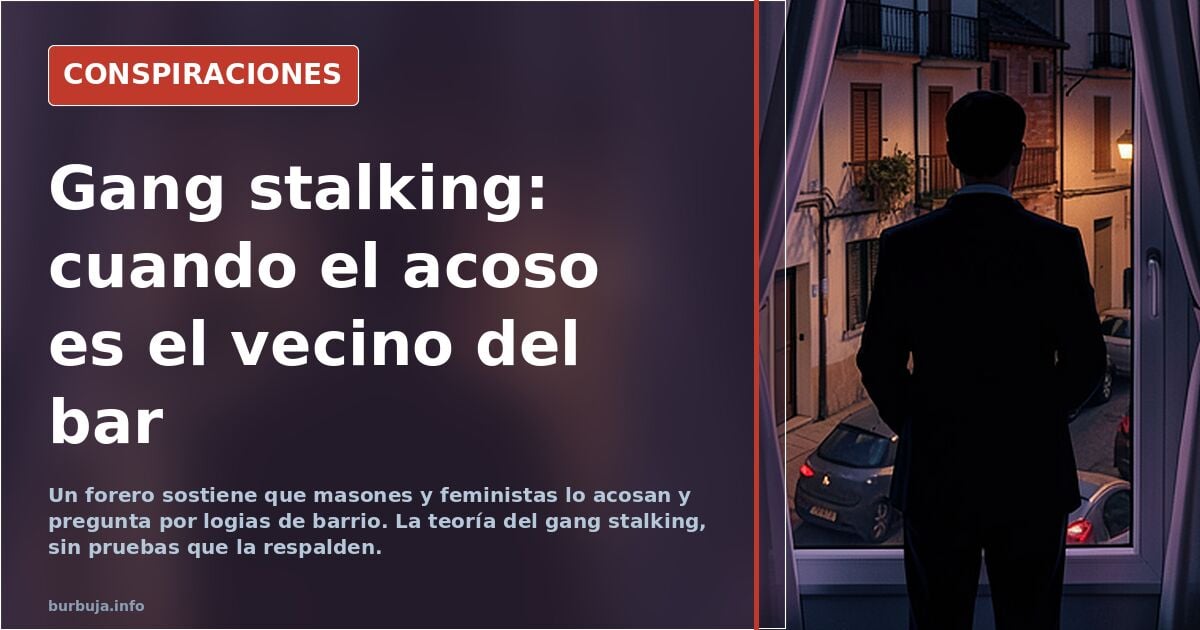
Gang Stalking and Guasons: A Theory Without Proof
A forum user claims he has been the target of a coordinated harassment campaign by Guasons and feminists for some time. He provides no evidence whatsoever. Yet his account—stemming from a public dispute with feminism—has resonated with a handful of participants convinced that neighborhood lodges exist to harass ordinary citizens. The underlying question is not whether Freemasonry exists, but whether anyone would bother pursuing a nobody.
What is Gang Stalking and Why Is It Linked to Freemasonry?
The phenomenon described by the poster has a name in Anglophone forums: gang stalking, the belief that a group of strangers coordinates surveillance, noise, and sabotage against a specific person. In this case, the alleged group is said to be a Guasonic network with ties to militant feminism. The narrative includes a striking claim: that harassment is triggered when the victim meets two criteria—being solitary and having said something the persecutors can twist, according to one participant.
It is a self-contained theory. Anything that happens—a glance at a bar, a neighbor who doesn't say hello—fits as proof. And any lack of evidence is explained because the persecutors are very smart.
Neighborhood Guasonry: Do Lodges Target Anonymous Citizens?
Freemasonry is a documented historical reality, with lodges spread across Spain and internal hierarchical structures. From there to claiming these lodges organize harassment operations against individuals lies an abyss that no one in the conversation crosses with data. What does appear is a description of how such networks would function, according to one participant: groups in every city, communicating with each other, capable of mobilizing third parties.
None of these assertions are accompanied by a single address, a verifiable name, or a document. They are conjectures presented as certainties, and those who question them automatically fall under suspicion of being part of the web.
The Narrative Twist: From Victim to Accused
The conversation quickly degenerates. What starts as an inquiry about neighborhood lodges ends in an exchange of personal accusations, insults, and cross-suspicions about who is really who. Some participants suggest that the original poster himself is part of the network he claims to fight. The harassment theory thus becomes a weapon thrown between people accusing each other of belonging to the same conspiracy.
This is the usual fate of such constructs: when there are no facts to support them, distrust becomes the only available material.
What the Conversation Reveals About the Conspiracy Phenomenon
Beyond the specific case, the episode shows a recognizable pattern. People who have had public conflicts—in this instance, due to their opposition to feminism—later interpret a series of unpleasant experiences as an organized campaign. Temporal coincidence turns into causality. The feeling of being watched transforms into proof of surveillance.
There is nothing to affirm the existence of a Guasonic network dedicated to harassing anonymous citizens. What does exist is a conversation where the absence of evidence is interpreted as proof of the conspirators' efficiency. And a detail no one seems willing to consider: if such machinery existed, would it really dedicate itself to making a random neighbor's life perversos?
Also available in: Deutsch
Summary of a discussion on Burbuja.info - Foro de economía, actualidad y política., translated from Spanish and reviewed before publication. Read the full discussion (33 replies).
More summaries
-
Freemasonry: Symbolism and Global Control Theories
We analyze theories about Freemasonry, from its alchemical symbolism to accusations of global control.
-
Ana Obregón and the Rise of Conspiracy Theories
Analysis of conspiracy theories surrounding Ana Obregón and her son Aless's alleged death.
-
Conspiracy theories target politicians and public figures
An analysis of conspiracy theories regarding public figures' hidden lineages and alleged secret connections.
-
Alcàsser Case: AI Bias Test with Three Models
A nine-day experiment queries ChatGPT-4o mini on the Alcàsser case: identical prompts yield three distinct AI responses, revealing significant bias.
-
Spanish forum decodes hidden symbols in press photos
A long-running Spanish thread analyzes red dots and shadows in media images, claiming to find encrypted messages from elites.
-
Ana Rosa's Eye Gesture During Abascal's '33' Sparks Conspiracy Theories
Ana Rosa Quintana covered one eye as Santiago Abascal said '33', fueling Masonic conspiracy theories on social media.