
Frozen Rent and Broken Washer: Spain's Inflation Crisis
A tenant paying €415 rent faces inflation hikes and appliance repairs, sparking debate on working poverty in Spain.
English · Original discussion in Spanish · Published
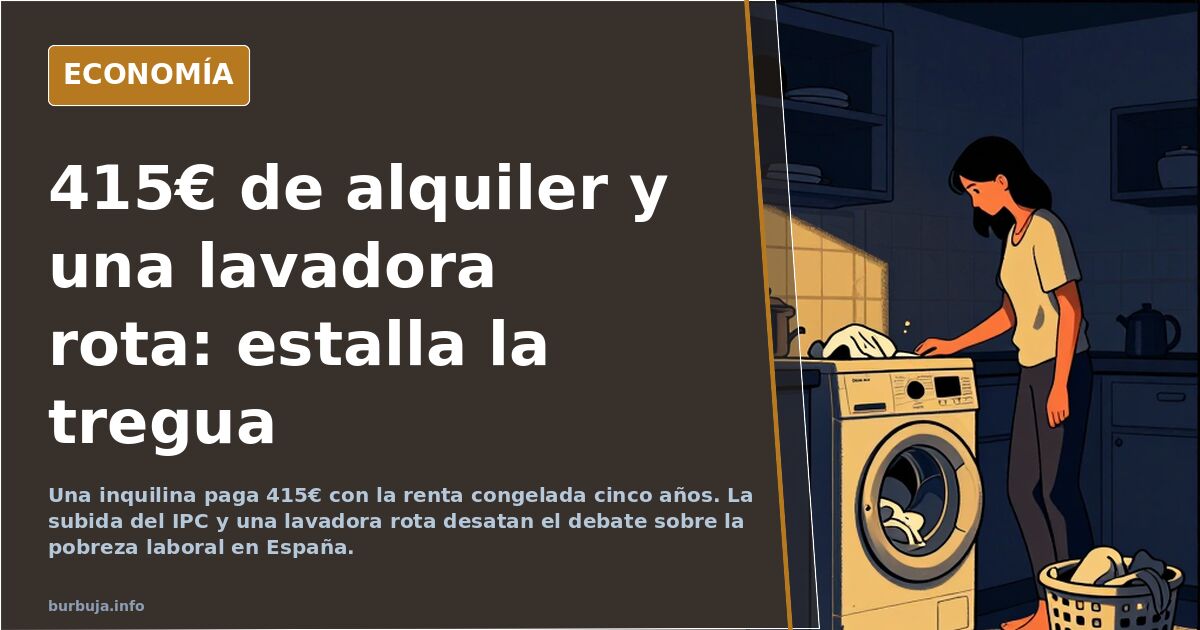
Five Years of Frozen Rent and a Broken Washer: The CPI That Ends the Truce
According to several participants in the debate, a woman earns around one thousand euros, pays €415 in rent, spends €400 monthly on gasoline to commute to work, and has a daughter to support. When the landlord updates the rent according to the Consumer Price Index (CPI) and demands she replace the broken washing machine, the tenant breaks down in an anxiety attack recorded on camera. The episode, widely shared on social media, has peine a rift far beyond a household appliance: that of a country where working no longer guarantees escaping poverty.
What began as a domestic dispute between landlord and tenant has evolved into a struggle over who bears the cost of wear and tear in a rented home, how much a rent frozen for half a decade can rise, and to what extent individual distress is a symptom of structural issues. At the center of this clash lies an uncomfortable figure: €415 for a furnished apartment that, according to several participants, would be worth significantly more on the current market.
Who Pays for the Washing Machine After Five Years?
The first conflict is legal, not emotional. One side argues that if the contract includes appliances, the owner is obligated to keep them operational: if you rent with a washer, the washer must work. Under this criterion, the landlord should replace the appliance or cover the repair costs, and refusing to do so constitutes a breach of contract.
The other half of the tenancy disagrees. They argue that after five years of continuous use, wear and tear falls on the tenant, and that a second-hand washing machine can be found for €150 on resale platforms. They add that if the contract does not specify which appliances are provided, replacement responsibility lies with the landlord; if it does, the same applies. The key, they insist, is what the written agreement says, not what each party believes they remember.
In the middle remains a nuance almost no one disputes: changing a lightbulb or unclogging a drain is the tenant's responsibility. The boundary between ordinary maintenance and structural repair is exactly where most rental contracts in Spain break down.
The CPI Not Applied for Five Years
Here, consensus is broader than it seems. Several participants acknowledge that the landlord had not updated the rent in five years, a gesture that in the current market equates to giving away money month after month. When she finally decides to apply the increase based on the price index, the tenant's reaction is indignation, not surprise.
The calculation hovering over the discussion is simple: if the rent was frozen for half a decade and the cumulative CPI during that period has been significant, the update is not abuse—it is the recovery of what the law permits. Those who did not apply it earlier voluntarily renounced that margin. Those applying it now are doing nothing extraordinary.
The uncomfortable question is another: why does a legal increase trigger an anxiety crisis? Because the tenant's margin is zero. With €1,000 income, €415 rent, and €400 fuel costs, any upward adjustment breaks the equation. The problem is not the CPI. It is that there is no cushion to absorb it.
€1,000 Income, a Daughter, and €400 Gasoline: The Impossible Equation
This case exposes a reality that transcends renting. Working a hundred kilometers from home without viable public transport turns salary into a number that evaporates before the end of the month. Gasoline consumes almost as much as housing. And with a dependent child, the equation allows for no further deductions.
Some point out that the child's father contributes no alimony, worsening the situation. Others suggest the tenant should have claimed earlier, informed herself about her rights, or sought advice. All these arguments are true, yet none solve the underlying problem: a person with employment who cannot afford a €200 unexpected expense.
The discussion then shifts to political ground. Some blame the Government and its economic management; others, the real estate market and landlords' greed; some, the affected woman's personal decisions. What no one disputes is the data looming over the entire exchange: working poverty has ceased to be an anomaly and become the statistical norm for a growing segment of the employed population.
The Verbal Contract No One Reads and the Furnished Trap
One of the most practical derivatives of this case concerns the contract. Several participants warn that renting furnished property without detailing in writing what is included opens the door to future conflicts. If the inventory is not listed, the landlord assumes responsibility for replacing anything broken through normal use. If it is listed, replacement occurs with similar characteristics, not better ones.
The emerging recommendation is clear: put every last appliance in writing, with brand, model, and condition. And if one does not wish to assume that maintenance, rent unfurnished. Ambiguity benefits whoever invokes it at the right moment, and that moment almost always arrives.
The corollary is that legal security in Spanish rentals still depends on the diligence of the parties, not a clear framework. When the contract is a poorly drafted page, a dispute over a washing machine becomes a trial of intentions.
From Individual Anxiety to Collective Discontent
The video has acted as a catalyst for broader discontent. Some see in the scene proof that productivity and effort no longer guarantee anything; others, confirmation that part of the population has learned to turn personal problems into public claims.
The discussion on anxiety-related sick leave, work incentives, and the culture of effort appears and disappears throughout the exchange, always against the same backdrop: the feeling that the system has stopped rewarding those who trinc the rules. And the less ideological realization that a broken washing machine can be the drop that fills a glass that has been filling for years.
In the end, the unsettling data is neither the CPI increase nor the price of the washer. It is that a woman with a job, a roof, and a daughter had to record herself crying for her situation to be considered worthy of debate. That says more about the country than any unemployment statistic.
Also available in: Deutsch
Summary of a discussion on Burbuja.info - Foro de economía, actualidad y política., translated from Spanish and reviewed before publication. Read the full discussion (131 replies).
More summaries
-
Rent consumes wages: half of Spain's tenants in severe poverty
Half of tenants in Spain fall into severe poverty after paying rent. Data, cases, and the political debate on housing.
-
Leaked chats reveal Ábalos and Pedro Sánchez fighting Podemos over a few votes, with rental housing in the middle.
OKDiario publishes chats in which Sánchez tells Ábalos not to give ground to Podemos on rent control and opens the battle over rent caps.
-
Spain's housing rules to stay until 2028
Spain keeps its Housing Law, hikes tourist rental VAT to 21%, and extends price controls. The battle over property rights continues.
-
The decline of specialist forums: what does the economy lose?
Economic forums are losing their best analysts: from 700 active members to a wasteland of bots. Data, causes and consequences of a silent exodus.
-
No Christmas this year in the heart of Europe
A viral post claims Australia, France and Germany have cancelled their New Year celebrations over Islamist terrorism. There is no official confirmation.
-
Pentagon readies bases to run 90 days without supplies
The Pentagon is preparing its bases to operate for 90 days without external power, fuel or water, while the UK recommends emergency kits for 72 hours without…