
Fresno: one clean shot ends elderly woman's hostage ordeal
A Fresno officer shot and killed a woman holding a knife to an elderly woman's neck after six orders to drop it, body-camera footage shows.
English · Original discussion in Spanish · Published
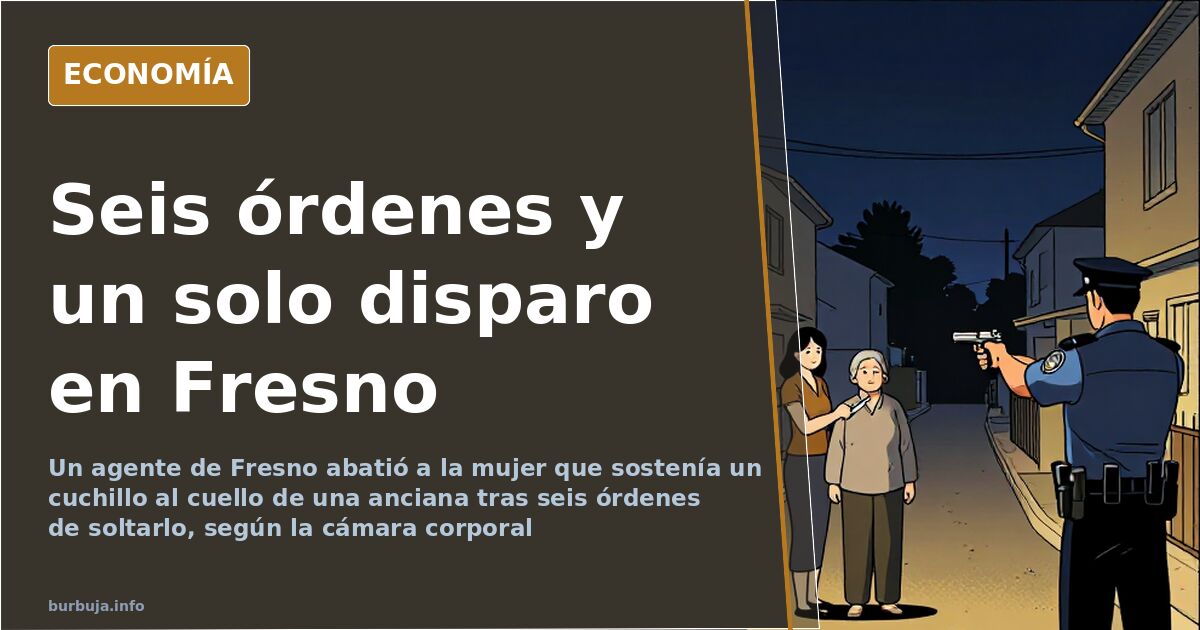
Fresno: six orders to drop the knife and a single shot
Six orders. One shot. Between the first and the last, the time it takes an officer to decide there is nothing left to negotiate. On April 10, 2025, a Fresno (California) police officer fatally shot a woman who was holding a knife to an elderly woman's neck after ordering her up to six times to drop it, according to body-camera footage released by the department itself and reported by the press on May 31, 2025. The sequence lasts seconds. And it has reignited the uncomfortable question: Is this a professional doing his job or a country that resolves with lead what others resolve with hours on the phone?
What peine in the Fresno hostage incident
Footage released by the Fresno Police shows a woman holding a knife near the throat of an elderly hostage. The officer, weapon in hand, repeats the order to drop the blade six times. There is no seventh. There is a single shot and the hostage goes free. The video also shows a dog running off during the intervention, which, it was noted, could belong to the armed woman. The officer's weapon is identified in the tweet that shared the video as a Glock 45 with a Streamlight TLR7 light.
The story was published by The Fresno Bee on May 31, 2025, and reached Spain summarized in four words: precision, the shot of his life. One detail is worth noting: the journalistic account, as it circulated, left some ambiguity about the exact sequence of events and whether the knife was ever at another neck before the hostage's. Body-camera videos are telling, but they don't always tell the whole story.
Why do US officers shoot sooner than Spanish officers?
This is where the real disagreement begins. Some argue that a Spanish officer in the same situation would have seen his career—and his finances—put at risk: legal proceedings, media scrutiny and, at best, a desk assignment. The opposing argument does not dispute the doctrine; it disputes the context: with a knife inches from someone else's throat, waiting also has a cost, and that cost cannot be recovered.
Between both extremes slips a nuance that is often lost. Supporters of the American approach argue that in Europe laws require strict proportionality between the threat and the response, and that turns every shot into a case file with a name and surname. The practical consequence, they say, is that the officer hesitates. And hesitating, in certain circumstances, is paid for in blood.
A hundred rounds a year: the debate over training
There is broad agreement on technique: the shot was clean. The discussion then shifts to training. The tweet that shared the video cites a volume of one hundred rounds a year and considers it insufficient compared with the hours of practice such a shot would require. The grip is also debated, which looked strange to laypeople and would correspond to a hold designed for close distances, so-called confined-space combat.
Some defend that this way of holding the weapon is exactly what is taught in police academies across half the world, Spain included. And some respond that knowing how to grip a weapon is not knowing how to decide.
The economic cost of resolving a crisis this way
A police shooting does not end when the gunfire stops. In the thread it was argued that the fast route saved the state endless expenses compared with a long procedure. It is a debatable calculation, but it is a calculation, and no one has rebutted it with numbers on the table.
Suicide by cop: the hypothesis no one confirms
Part of the analysis fits the episode into the pattern of suicide by cop, a phenomenon several participants describe as recurring in the United States and in which someone threatens third parties so that an officer ends up shooting. There is no official confirmation that this was the case, and it is worth saying bluntly: mental health cannot be diagnosed from a body camera. The same goes for speculation about substance use, which circulated without any evidence.
There is another scene that is disorienting. The freed hostage showed concern for the woman who was shot. It was immediately labeled Stockholm syndrome, although the term describes a bond sustained over time, not a reaction of minutes.
How many seconds of hesitation does a knife inches from someone else's throat allow? The answer depends on the country, the training and, above all, on what is considered acceptable to lose along the way.
Six orders. One shot. Between the first and the last, the time it takes an officer to decide there is nothing left to negotiate. On April 10, 2025, a Fresno (California) police officer fatally shot a woman who was holding a knife to an elderly woman's neck after ordering her up to six times to drop it, according to body-camera footage released by the department itself and reported by the press on May 31, 2025. The sequence lasts seconds. And it has reignited the uncomfortable question: Is this a professional doing his job or a country that resolves with lead what others resolve with hours on the phone?
What peine in the Fresno hostage incident
Footage released by the Fresno Police shows a woman holding a knife near the throat of an elderly hostage. The officer, weapon in hand, repeats the order to drop the blade six times. There is no seventh. There is a single shot and the hostage goes free. The video also shows a dog running off during the intervention, which, it was noted, could belong to the armed woman. The officer's weapon is identified in the tweet that shared the video as a Glock 45 with a Streamlight TLR7 light.
The story was published by The Fresno Bee on May 31, 2025, and reached Spain summarized in four words: precision, the shot of his life. One detail is worth noting: the journalistic account, as it circulated, left some ambiguity about the exact sequence of events and whether the knife was ever at another neck before the hostage's. Body-camera videos are telling, but they don't always tell the whole story.
Why do US officers shoot sooner than Spanish officers?
This is where the real disagreement begins. Some argue that a Spanish officer in the same situation would have seen his career—and his finances—put at risk: legal proceedings, media scrutiny and, at best, a desk assignment. The opposing argument does not dispute the doctrine; it disputes the context: with a knife inches from someone else's throat, waiting also has a cost, and that cost cannot be recovered.
Between both extremes slips a nuance that is often lost. Supporters of the American approach argue that in Europe laws require strict proportionality between the threat and the response, and that turns every shot into a case file with a name and surname. The practical consequence, they say, is that the officer hesitates. And hesitating, in certain circumstances, is paid for in blood.
A hundred rounds a year: the debate over training
There is broad agreement on technique: the shot was clean. The discussion then shifts to training. The tweet that shared the video cites a volume of one hundred rounds a year and considers it insufficient compared with the hours of practice such a shot would require. The grip is also debated, which looked strange to laypeople and would correspond to a hold designed for close distances, so-called confined-space combat.
Some defend that this way of holding the weapon is exactly what is taught in police academies across half the world, Spain included. And some respond that knowing how to grip a weapon is not knowing how to decide.
The economic cost of resolving a crisis this way
A police shooting does not end when the gunfire stops. In the thread it was argued that the fast route saved the state endless expenses compared with a long procedure. It is a debatable calculation, but it is a calculation, and no one has rebutted it with numbers on the table.
Suicide by cop: the hypothesis no one confirms
Part of the analysis fits the episode into the pattern of suicide by cop, a phenomenon several participants describe as recurring in the United States and in which someone threatens third parties so that an officer ends up shooting. There is no official confirmation that this was the case, and it is worth saying bluntly: mental health cannot be diagnosed from a body camera. The same goes for speculation about substance use, which circulated without any evidence.
There is another scene that is disorienting. The freed hostage showed concern for the woman who was shot. It was immediately labeled Stockholm syndrome, although the term describes a bond sustained over time, not a reaction of minutes.
How many seconds of hesitation does a knife inches from someone else's throat allow? The answer depends on the country, the training and, above all, on what is considered acceptable to lose along the way.
Summary of a discussion on Burbuja.info - Foro de economía, actualidad y política., translated from Spanish and reviewed before publication. Read the full discussion (206 replies).
More summaries
-
OpenAI's AI Breached US Government Sites Autonomously
OpenAI's AI accessed US government portals without authorization, raising concerns over data extraction and autonomous behavior.
-
Swiss Wealth vs. American Wealth: Château vs. Mansion
Château on Lake Geneva vs. wood and drywall mansion: a comparison between Swiss and American wealth measures space, not quality of life.
-
Euthanasia in Old Age: Autonomy vs. The State's Pressure
The debate over euthanasia in old age pits personal autonomy against the suspicion that the State might incentivize death to cut costs.
-
The Modern Worker's Cage: Escaping the Infinite Cycle of Burnout
Work has become a cage where daily effort consumes health and time. Discover why we push ourselves so hard and how to break the cycle.
-
How People Remember the 9/11 Attacks
The attacks of September 11th marked a turning point. Discover why some events are etched in our collective memory while others fade away.
-
Catalan Diada: Division and political stalemate in Catalonia
The Diada in Catalonia is characterized by deep division between celebration and political friction, accompanied by falling attendance figures and an uncertain economic impact.