
Fresh sausages: the 80% meat hidden in the label
The 80% meat content on the label confirms the remaining 20% is water, starch and additives. Your local butcher doesn't guarantee a better product either.
English · Original discussion in Spanish · Published
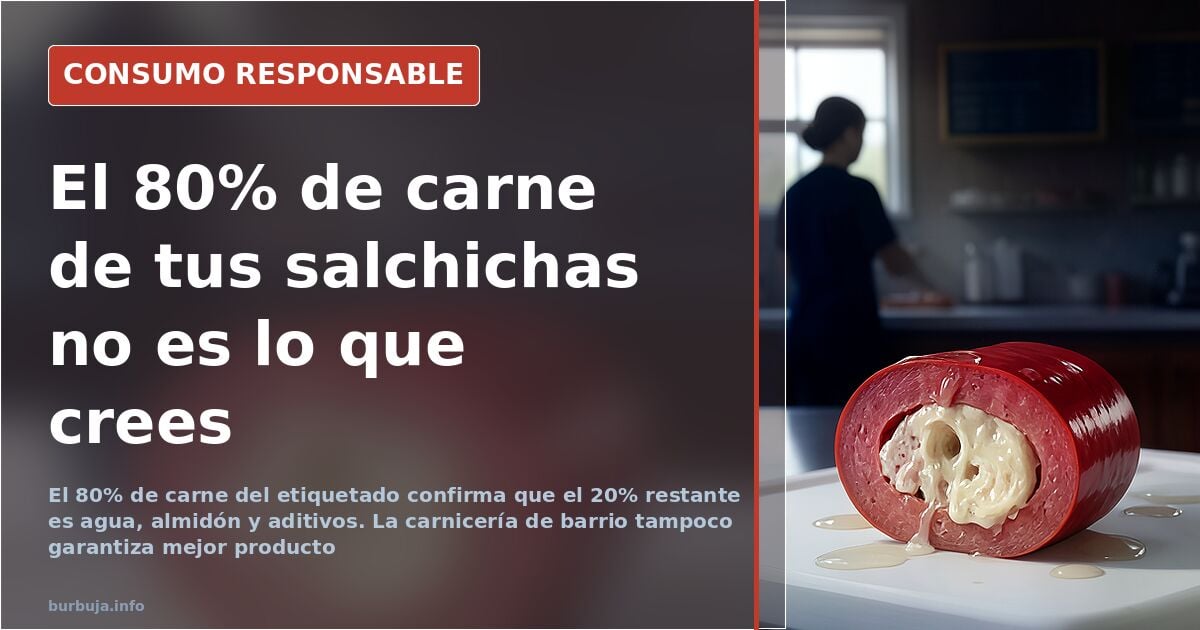
Fresh sausages are not 100% meat, and the label gives it away
The label rules. A tray of fresh sausages from the supermarket can boast an **80% meat** content, and that percentage, which sounds acceptable at first glance, is in fact the confession that the remaining 20% is water, starches, salts and additives. The figure is not a suspicion: it is printed on the packaging. The question that opens the debate is whether this product deserves the "fresh" label, or whether the adjective works more as a marketing hook than as a description of what's inside.
The starting point of the analysis is a comparison of labels. Against the 80% of shelf sausages, **longanizas** (Spanish fresh pork sausages) are presented as 100% meat products, without the additive that lowers the meat proportion. That difference in composition is what separates two categories that shoppers tend to lump together. And it's not the only one: the debate over additives adds another layer. Among the preservatives cited are **E-221** and **E-120**, the latter a dye extracted from cochineal that regulations allow in both synthetic and natural versions. The recommendation going around is to always go for the natural one, even though the label doesn't always clarify which has been used.
The local butcher doesn't always beat the supermarket
Here the most comfortable narrative falls apart. The idea that the neighborhood butcher shop is the refuge of real meat has its defenders and its skeptics, and the skeptics have arguments. The packaged meat sold by a supermarket is, in many cases, **the same meat the supermarket itself sells at its own butcher counter**. The channel doesn't change the product. What changes is the price, which has gone up on both sides, and the trust the buyer places in the counter.
The opposite argument is not negligible either: there are butcher shops that make their own products and let you choose the additions, to the point of ordering a **spicy longaniza** with whatever level of heat you want. That model, however, has been fading: the same butcher shop that used to make its products in-house may end up supplying retail chains, and then artisanal traceability becomes an industrial scale operation under another name.
The casing as a fraud detector
There's a home method going around that makes sense: the sausage **casing** is the first indicator. If, when grilling or cooking it, the skin bursts abnormally or releases plastic, it's time to change suppliers. The flavor, moreover, has changed compared to what people tasted in the **70s and 80s**, and that shift in the palate is a signal many buyers detect before any lab analysis.
The accompaniment matters too. Cooking with **white wine** or dressing it with *tximitxurri* (Basque-style chimichurri) when serving work as correctives for the product, and the pairing can range from reds to whites, including moscatels or cavas. The most honest recommendation of the lot, though, points to the *pitarras*.
The alternative: mincing the meat yourself
Against processed products there is a way out that doesn't require a village butcher: ask at the counter for the **trimmings and end cuts** to be run through the machine, add garlic and parsley, and shape the burgers with a glass jar and cling film. The result is not a sausage, but it is a product whose composition you know one hundred percent. The cost is time, and that is the real price of additive-free food.
The warning about labeling deserves a paragraph of its own. The idea that the letter **E** trinc by a number means "Excellent," and that the higher the number the healthier it is, is an urban legend with no basis whatsoever. E codes identify authorized additives, not quality levels. Confusing the two is exactly the kind of mistake marketing loves.
With all this in mind, the reasonable prediction is that the shelf will keep selling 80% sausages as long as shoppers don't read the fine print. And that the neighborhood butcher will keep its prestige more out of habit than by comparative evidence. If that evidence ever changes, the counter will have to prove it.
Summary of a discussion on Burbuja.info - Foro de economía, actualidad y política., translated from Spanish and reviewed before publication. Read the full discussion (26 replies).
More summaries
-
Lidl's frozen sardines at €3.90/kg vs. fresh ones
A kilo of frozen sardines costs €3.90 compared to €9-€10 for fresh ones in Madrid. The question is whether the flavor holds up after freezing.
-
Two good SUVs versus the fashionable junk: €40,000 and €64,000
A diesel Range Rover Velar for €64,000 and a Ford Edge for €40,000: the analysis that pits good SUVs against fashionable junk and ends in a fight over price.
-
The PC Thrown Away for a Swollen Capacitor
A swollen capacitor, dead battery, or software glitch: reasons why PCs with i3-6100 and 8 GB RAM that still work end up in the trash.
-
Spanish 1970s Cookies: The Lost Taste of Childhood
Iconic Spanish brands like Cuétara and Fontaneda have changed. Palm oil, mergers, and quality cuts explain the decline of a national staple.
-
Neighborhood chaos erupts after a car crash in Spain
A traffic incident on a residential street in Spain triggered a cascade of absurd events: feuding neighbors, synthetic testosterone and a grandmother fainting.
-
Botched workshop repair on an M3 E46 sparks a market value dispute
Seven months of paperwork for the insurer to offer only book value on an M3 E46 that has lost its collector value.